Biological life is fundamentally compartmentalized. Cell membranes—amphiphilic lipid bilayers just $4text{ nm}$ thick—act as impermeable electrical capacitors and chemical barriers. Embedded voltage-gated ion channels exploit atomic-scale electrostatics to generate and propagate the rapid bioelectric pulses—Action Potentials—that underpin all neural computation.
1. Lipid Bilayer Thermodynamics & Capacitance
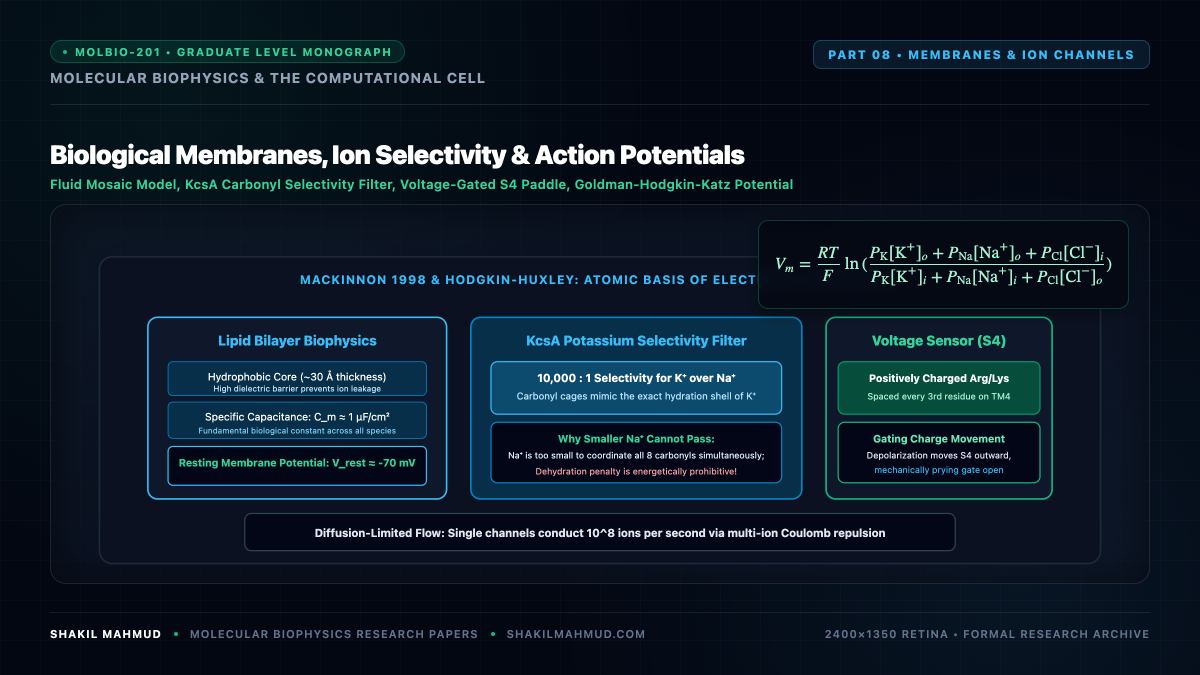
Phospholipids self-assemble spontaneously into lamellar bilayers driven by the hydrophobic effect ($Delta G_{text{assembly}} < 0$). The hydrophobic acyl hydrocarbon core creates an immense dielectric energy barrier against polar and ionic permeation:
[
Delta G_{text{Born}} = frac{z^2 e^2}{8 pi epsilon_0 r_{text{ion}}} left( frac{1}{epsilon_{text{membrane}}} – frac{1}{epsilon_{text{water}}} right)
]
Since $epsilon_{text{membrane}} approx 2$ while $epsilon_{text{water}} approx 80$, the Born solvation penalty for a sodium or potassium ion crossing the naked bilayer exceeds $150text{–}200 text{ kJ/mol}$, rendering the pure lipid membrane essentially an ideal electrical insulator with a specific capacitance of:
[
C_m approx 1.0 ; mutext{F/cm}^2
]
2. The Goldman-Hodgkin-Katz (GHK) Voltage Equation
Under steady-state physiological conditions, active ion transporters (primarily the $text{Na}^+/text{K}^+$-ATPase pump) maintain steep trans-membrane chemical gradients: internal $text{K}^+ sim 140 text{ mM}$ vs external $text{K}^+ sim 5 text{ mM}$; internal $text{Na}^+ sim 10 text{ mM}$ vs external $text{Na}^+ sim 145 text{ mM}$.
For an individual ionic species $i$, the thermodynamic equilibrium resting potential where diffusive flux balances electrical drift is given by the Nernst Equation:
[
E_i = frac{R T}{z_i F} ln left( frac{[i]_{text{out}}}{[i]_{text{in}}} right)
]
When multiple ions permeate simultaneously through distinct channel populations, the zero-net-current resting membrane potential $V_m$ is governed by the Goldman-Hodgkin-Katz (GHK) Voltage Equation:
[
V_m = frac{R T}{F} ln left( frac{P_{text{K}} [text{K}^+]_{text{out}} + P_{text{Na}} [text{Na}^+]_{text{out}} + P_{text{Cl}} [text{Cl}^-]_{text{in}}}{P_{text{K}} [text{K}^+]_{text{in}} + P_{text{Na}} [text{Na}^+]_{text{in}} + P_{text{Cl}} [text{Cl}^-]_{text{out}}} right)
]
At rest, the membrane is predominantly permeable to potassium ($P_{text{K}} gg P_{text{Na}}$), establishing a resting potential close to $E_{text{K}} approx -70 text{ to } -85 text{ mV}$.
3. Atomic Mechanism of Ion Selectivity: The KcsA Channel
How can an ion channel conduct potassium ions at the near-diffusion limit ($sim 10^8 text{ ions/sec}$) while discriminating against sodium ions—which are smaller—by a selectivity factor exceeding $10,000 : 1$?
Roderick MacKinnon resolved this paradox in 1998 by solving the atomic crystal structure of the bacterial KcsA channel:
- The Selectivity Filter: A narrow $1.2 text{ nm}$ long pore lined by the conserved amino acid sequence Thr-Val-Gly-Tyr-Gly (TVGYG). The backbone carbonyl oxygens project into the pore lumen, creating four equidistant coordination cages ($S_1text{–}S_4$).
- Dehydration vs Coordination Compensation: To pass through the filter, a potassium ion must shed its eight primary hydration shell water molecules ($Delta H_{text{dehydration}} approx +330 text{ kJ/mol}$). The carbonyl cages replicate the exact geometry and electrostatic dipole field of the hydration shell, compensating precisely for the dehydration penalty.
- Why Sodium is Excluded: Sodium ($text{Na}^+$) has a smaller Pauli ionic radius ($r = 0.95 text{ AA}$ vs $1.33 text{ AA}$ for $text{K}^+$). The rigid carbonyl cage cannot collapse sufficiently to coordinate the smaller sodium ion without incurring prohibitive protein strain energy. Consequently, sodium cannot compensate for its dehydration penalty and is rejected.
- Electrostatic Knock-On Conduction: Multiple potassium ions occupy adjacent filter sites separated by single water molecules ($S_1 – S_3$ or $S_2 – S_4$). Mutual Coulombic repulsion lowers the exit barrier, shooting ions through the pore in a frictionless knock-on cascade.
4. The Hodgkin-Huxley Non-Linear Conductance Dynamics
The initiation of the neural action potential is driven by voltage-gated sodium and potassium channels whose conductances depend non-linearly on membrane voltage $V_m$:
[
C_m frac{d V_m}{dt} = I_{text{stim}} – bar{g}_{text{Na}} m^3 h (V_m – E_{text{Na}}) – bar{g}_{text{K}} n^4 (V_m – E_{text{K}}) – g_L (V_m – E_L)
]
Where $m$ and $h$ are sodium activation and inactivation gating variables, and $n$ is potassium activation, governed by first-order voltage-dependent differential equations:
[
frac{dx}{dt} = alpha_x(V_m)(1 – x) – beta_x(V_m)x quad (x in {m, n, h})
]
Depolarization triggers rapid activation of $m$, unleashing a massive inward $text{Na}^+$ current that flips membrane potential to $+40 text{ mV}$, followed by slower $h$ inactivation and delayed $n$ activation that repolarizes the membrane—the computational pulse of nervous systems.