At the nanoscale, physical reality is radically different from the macroscopic world: inertia is entirely negligible (Reynolds number $text{Re} sim 10^{-5}$), and viscous drag and violent thermal fluctuations dominate every interaction. Biological molecular motors do not operate as deterministic steam engines; instead, they function as non-equilibrium statistical engines—Brownian ratchets—converting chemical free energy ($Delta G_{text{ATP}}$ or electrochemical ion gradients) into mechanical torque and directed processive transport with thermodynamic efficiencies approaching $100%$.
1. The Proton Motive Force & Chemiosmotic Coupling
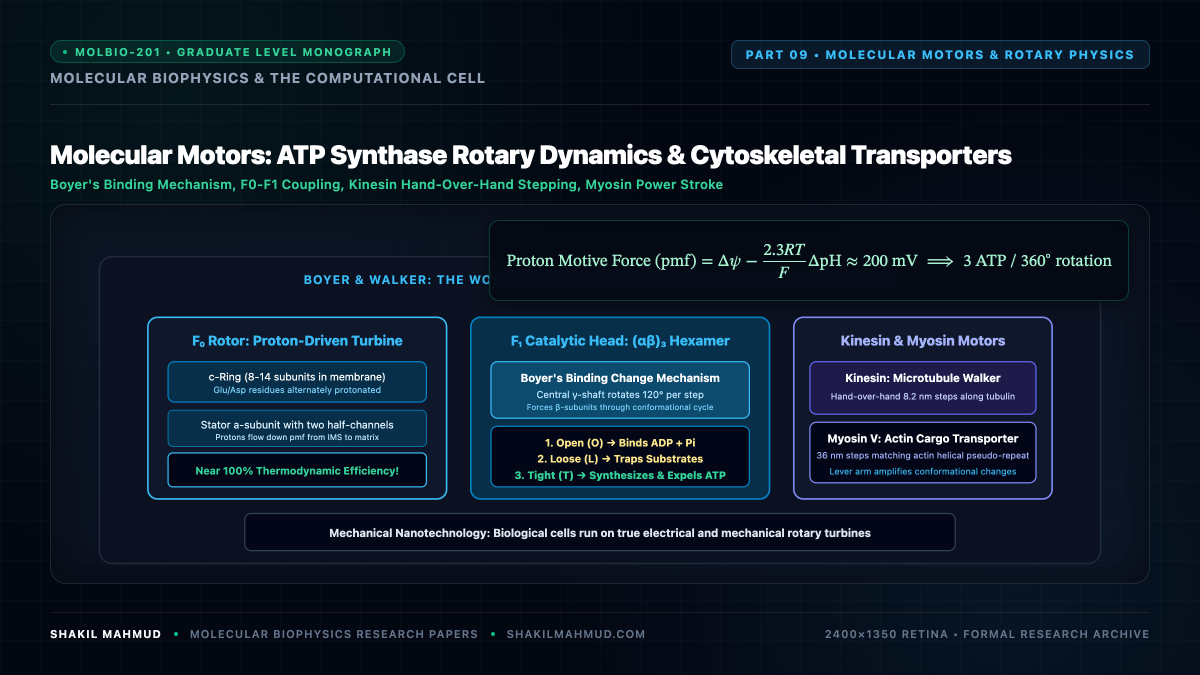
In 1961, Peter Mitchell formulated the Chemiosmotic Hypothesis: mitochondrial and chloroplast electron transport chains do not generate ATP via elusive high-energy chemical intermediates, but by actively translocating protons ($text{H}^+$) across the inner membrane to establish an electrochemical potential difference known as the Proton Motive Force ($Delta p$):
[
Delta p = Delta Psi – frac{2.303 , R T}{F} Delta text{pH}
]
Where:
- $Delta Psi = psi_{text{in}} – psi_{text{out}}$ is the transmembrane electrical potential difference ($approx -160 text{ to } -180 text{ mV}$).
- $Delta text{pH} = text{pH}_{text{in}} – text{pH}_{text{out}}$ is the chemical pH gradient ($approx 0.5text{–}1.0 text{ pH units}$).
- Under standard physiological conditions, $Delta p approx -200text{–}220 text{ mV}$, providing approximately $sim 20 text{ kJ/mol}$ of thermodynamic driving force per mole of protons translocated into the mitochondrial matrix.
2. ATP Synthase: The Coupled $F_0 F_1$ Rotary Machine
The synthesis of the universal biological energy currency, adenosine triphosphate (ATP), is catalyzed by $F_0 F_1$-ATP Synthase, an extraordinary dual rotary motor working in series:
- The $F_0$ Motor (Membrane-embedded electric turbine): Composed of a stationary $a$-subunit stator and a rotating oligomeric ring of $c$-subunits ($c_8text{–}c_{15}$). Protons from the intermembrane space enter the $a$-subunit half-channel, protonate a conserved carboxylate side-chain (Asp61 / Glu58) on a $c$-subunit, neutralizing its charge and allowing the hydrophobic $c$-ring to rotate through the membrane lipid phase. After a nearly full rotation, the proton exits through the second cytoplasmic half-channel.
- The Central Stalk ($gammaepsilon$ crankshaft): The rotating $c$-ring is rigidly coupled to the asymmetric central $gamma$-stalk, which extends directly into the catalytic $F_1$ head.
- The $F_1$ Motor (Catalytic generator): A stationary $(alphabeta)_3$ hexameric sphere anchored to the membrane by a peripheral stator stalk ($b_2delta$). As the asymmetric $gamma$-subunit rotates within the hexamer in discrete $120^circ$ steps, it forces the three catalytic $beta$-subunits through Paul Boyer’s Binding Change Mechanism:
[
beta_{text{Open}} (text{empty}) xrightarrow{+ text{ADP} + text{P}_i} beta_{text{Loose}} (text{bound}) xrightarrow{gamma text{ rotation}} beta_{text{Tight}} (text{catalysis: ATP formed}) xrightarrow{gamma text{ rotation}} beta_{text{Open}} (text{ATP released})
]
Remarkably, the chemical synthesis of ATP at the tight active site requires almost zero free energy ($Delta G approx 0$); the entire mechanical energy of rotation is consumed in overcoming the immense affinity barrier to eject the synthesized ATP molecule from the active site!
3. Cytoskeletal Motors: Kinesin & Myosin Hand-Over-Hand Walkers
Inside the eukaryotic cell, directed transport along polarized cytoskeletal filaments is driven by linear molecular motors:
- Conventional Kinesin-1: A dimeric motor that transports cargo toward the plus-end of microtubules in precise $8.2 text{ nm}$ steps (matching the $alpha/beta$-tubulin dimer repeat distance). Optical trapping experiments demonstrate that kinesin walks via an asymmetric hand-over-hand mechanism, generating stall forces of $F_{text{stall}} approx 6text{–}7 text{ pN}$ per motor head.
- Myosin II & V: Actin-dependent motors driving muscle contraction and vesicle motility through cyclic lever-arm swinging triggered by ATP hydrolysis, phosphate release (power stroke), and ADP dissociation.
4. Brownian Ratchet Formalism & Langevin Dynamics
Because thermal noise $k_B T approx 4.1 text{ pN}cdottext{nm}$ at $298 text{ K}$ constantly buffets the motor, molecular motility is modeled by the 1D over-damped Langevin Equation:
[
gamma frac{dx}{dt} = -frac{partial V(x, t)}{partial x} + sqrt{2 gamma k_B T} , xi(t)
]
Where $gamma = 6 pi eta r$ is the viscous Stokes friction drag coefficient, $V(x, t)$ is an asymmetric, time-dependent sawtooth potential landscape switched by chemical reaction states, and $xi(t)$ is Gaussian white noise ($langle xi(t) rangle = 0$, $langle xi(t)xi(t’) rangle = delta(t – t’)$). In the flashing ratchet model, periodic switching of the asymmetric barrier rectifies isotropic thermal motion into unidirectional transport, demonstrating how biology harnesses chaos to generate order.