Enzymes are the catalytic dynamos that drive the chemical machinery of life. Accelerating biochemical reaction rates by factors of $10^6$ to $10^{17}$ over uncatalyzed baselines, enzymes do not alter thermodynamic equilibrium ($Delta G^circ_{text{rxn}}$); rather, they function by stabilizing high-energy chemical transition states and transmitting long-range conformational information via allosteric networks.
1. The Michaelis-Menten & Briggs-Haldane Formalisms
The simplest model of single-substrate enzyme kinetics involves the reversible formation of a non-covalent enzyme-substrate complex ($ES$), followed by an irreversible catalytic breakdown yielding product $P$ and regenerating free enzyme $E$:
[
E + S underset{k_{-1}}{overset{k_1}{rightleftharpoons}} ES xrightarrow{k_{text{cat}}} E + P
]
Under the Briggs-Haldane Quasi-Steady-State Approximation (QSSA), the concentration of the intermediate complex $[ES]$ rapidly reaches a stationary dynamic plateau ($frac{d[ES]}{dt} approx 0$):
[
frac{d[ES]}{dt} = k_1 [E][S] – (k_{-1} + k_{text{cat}})[ES] = 0
]
Applying the conservation of total enzyme $[E]_0 = [E] + [ES]$, we solve for the steady-state velocity $v = frac{d[P]}{dt} = k_{text{cat}} [ES]$:
[
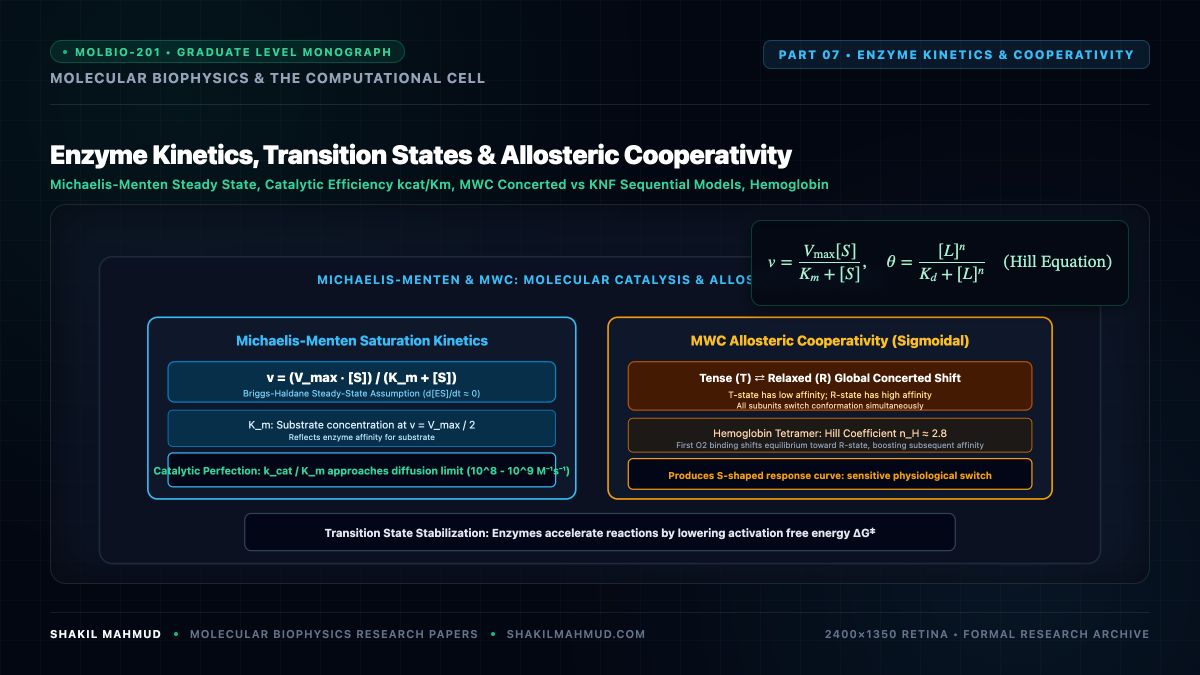
v = frac{V_{max} [S]}{K_M + [S]}
]
Where:
- $V_{max} = k_{text{cat}} [E]_0$ is the maximal asymptotic catalytic velocity at substrate saturation.
- $k_{text{cat}}$ (turnover number, $text{s}^{-1}$) is the number of substrate molecules converted to product per catalytic active site per second.
- $K_M = frac{k_{-1} + k_{text{cat}}}{k_1}$ is the Michaelis Constant, representing the specific substrate concentration at which the reaction velocity is half-maximal ($v = V_{max}/2$).
- The ratio $k_{text{cat}} / K_M$ measures the catalytic efficiency. The theoretical upper ceiling is set by the Smoluchowski diffusion limit ($10^8text{–}10^9 text{ M}^{-1}text{s}^{-1}$), characterizing “kinetically perfect” enzymes such as triosephosphate isomerase and catalase.
2. Transition State Theory & The Eyring Formulation
According to Linus Pauling’s 1946 postulate, an enzyme catalyzes a reaction not by binding the ground-state substrate tightly, but by binding the Transition State ($X^ddagger$) with complementary stereochemical affinity orders of magnitude higher than the ground state ($S$):
[
frac{k_{text{cat}}}{k_{text{uncat}}} = frac{K_S}{K_{TX}} = expleft( frac{Delta Delta G^ddagger}{R T} right)
]
In Eyring Transition State Theory, the catalytic rate constant $k_{text{cat}}$ is expressed as:
[
k_{text{cat}} = kappa frac{k_B T}{h} expleft( -frac{Delta G^ddagger}{R T} right) = kappa frac{k_B T}{h} expleft( frac{Delta S^ddagger}{R} right) expleft( -frac{Delta H^ddagger}{R T} right)
]
A reduction in the activation free-energy barrier $Delta G^ddagger$ by a mere $5.7 text{ kJ/mol}$ ($1.36 text{ kcal/mol}$, the energy of a single weak hydrogen bond) accelerates the reaction rate tenfold at $298 text{ K}$.
3. Allostery: MWC Concerted vs KNF Sequential Models
Many multi-subunit enzymes exhibit sigmoidal (non-hyperbolic) rate curves, indicating cooperative allosteric binding where ligand binding at one subunit influences catalytic activity at distant active sites.
- Monod-Wyman-Changeux (MWC) Concerted Model: The allosteric oligomer exists in an intrinsic thermodynamic equilibrium between two symmetrical quaternary states: the low-affinity T (Tense) state and high-affinity R (Relaxed) state:
[
L_0 = frac{[T_0]}{[R_0]}
]
Substrate binding shifts the global equilibrium toward the R state in an all-or-none concerted conformational transition across all subunits simultaneously. - Koshland-Némethy-Filmer (KNF) Sequential Model: Rejects simultaneous symmetry. Ligand binding induces a localized conformational change in an individual subunit (induced fit), which sequentially modulates the interaction energy and binding affinity of neighboring adjacent subunits.
The Hill Equation phenomenologically quantifies cooperativity:
[
theta = frac{[S]^h}{K_{0.5}^h + [S]^h}
]
Where $h > 1$ signifies positive cooperativity, enabling ultra-sensitive molecular switches in metabolic regulation.