Without sensory feedback, attempting to manipulate objects with a robotic prosthesis is like performing delicate surgery under heavy local anesthesia: users crush fragile items or drop heavy tools because visual inspection alone is too slow to gauge friction and contact force. True motor agency requires closing the loop bidirectionally by writing sensory information back into the nervous system. Intracortical Microstimulation (ICMS) of the primary somatosensory cortex (( ext{S1})) injects artificial tactile sensations directly into the brain, restoring the sensation of physical touch.
1. The Somatotopic Map and Area 3b/1 Functional Organization
The primary somatosensory cortex (( ext{S1})) is organized somatotopically along the postcentral gyrus, formalized in Wilder Penfield’s classical Sensory Homunculus. Micro-stimulation studies in non-human primates and human tetraplegic participants reveal:
- Brodmann Area 3b and Area 1 contain fine-grained, contiguous representations of individual fingertip pads.
- Delivering microampere electrical pulses through an electrode located in the index finger representation evokes an artificial tactile sensation (a conscious percept) localized specifically to the patient’s physical index fingertip, completely bypassing damaged spinal cord pathways.
2. Biphasic Waveforms and the Shannon Safety Criterion
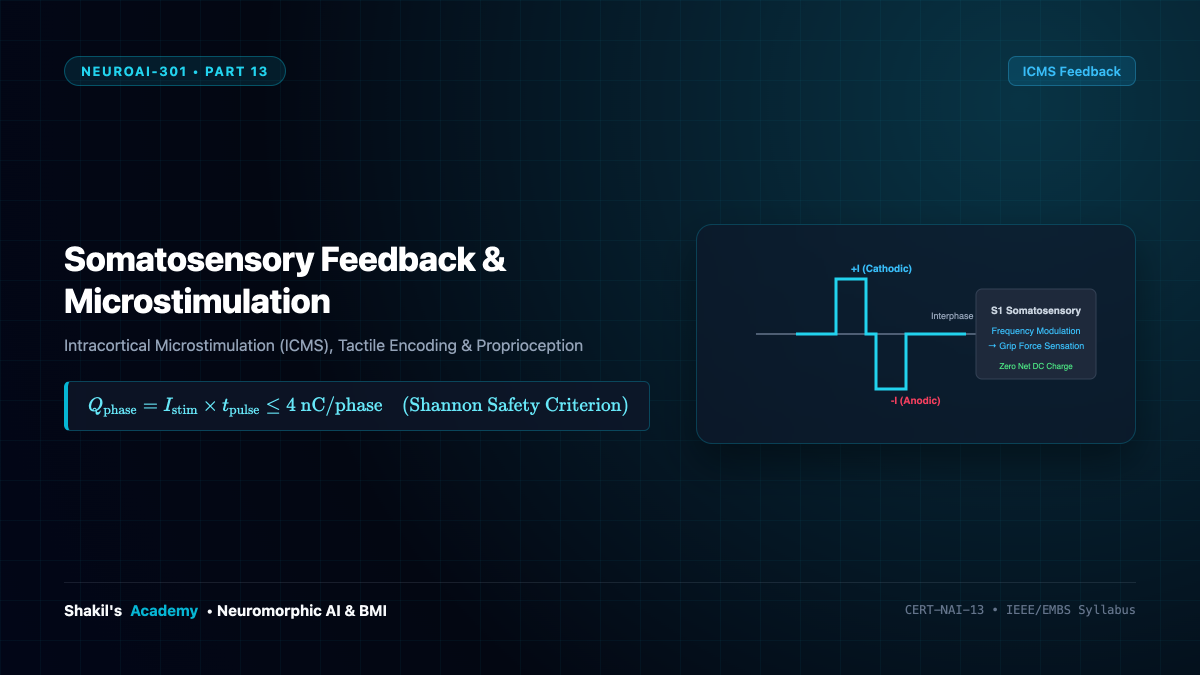
Injecting direct electrical currents into brain tissue carries substantial risks: electrolysis of water produces toxic hydrogen peroxide and pH shifts, while metal dissolution destroys electrode tips. Neurostimulation strictly mandates Charge-Balanced, Biphasic Current Pulses:
[
Q_{ ext{cathodic}} + Q_{ ext{anodic}} = int_0^{t_{ ext{stim}}} I(t) dt = 0
]
- A cathodic (negative) phase of duration (t_{ ext{pulse}} approx 200 mu ext{s}) depolarizes local pyramidal cell axons, triggering an action potential.
- A short interphase delay ((sim 50 mu ext{s})) allows membrane depolarization to propagate.
- An equal and opposite anodic (positive) phase reverses electrochemical surface reactions, removing all deposited charge from the electrode-electrolyte interface.
To prevent tissue damage, Shannon (1992) established the universal safety equation relating charge density per phase (D = Q/A) and charge per phase (Q):
[
log(D) = k – log(Q) implies logleft(rac{Q}{A}
ight) + log(Q) le k
]
where (k approx 1.75 ext{ to } 1.85) represents the threshold for irreversible neural tissue injury. Clinical protocols restrict microstimulation below (4 ext{ nC/phase}) and (30 mu ext{C/cm}^2).
3. Biomimetic Sensory Encoding Algorithms
Biological mechanoreceptors in human skin consist of four distinct classes:
- Slowly Adapting Type I (SA-I, Merkel Discs): Encode static pressure and sustained contact force.
- Fast Adapting Type I (FA-I, Meissner Corpuscles): Encode low-frequency slip and dynamic flutter ((10 ext{–}50 ext{ Hz})).
- Fast Adapting Type II (FA-II, Pacinian Corpuscles): Encode high-frequency transient vibrations ((100 ext{–}300 ext{ Hz})) signaling sudden impact or texture roughness.
Neuromorphic biomimetic feedback encodes robotic fingertip pressure sensor data by modulating both the amplitude (recruiting more nearby neurons) and the pulse frequency (modulating instantaneous firing rate):
[
f_{ ext{stim}}(t) = f_{ ext{base}} + alpha cdot F(t) + beta cdot rac{dF(t)}{dt}
]
Linear frequency modulation ((20 ext{ Hz to } 100 ext{ Hz})) allows patients to discriminate varying degrees of robotic grip firmness, enabling blindfolded users to pick up and manipulate delicate objects (e.g., eggs and soft fruit) without crushing them (Flesher et al., Science Translational Medicine, 2016).