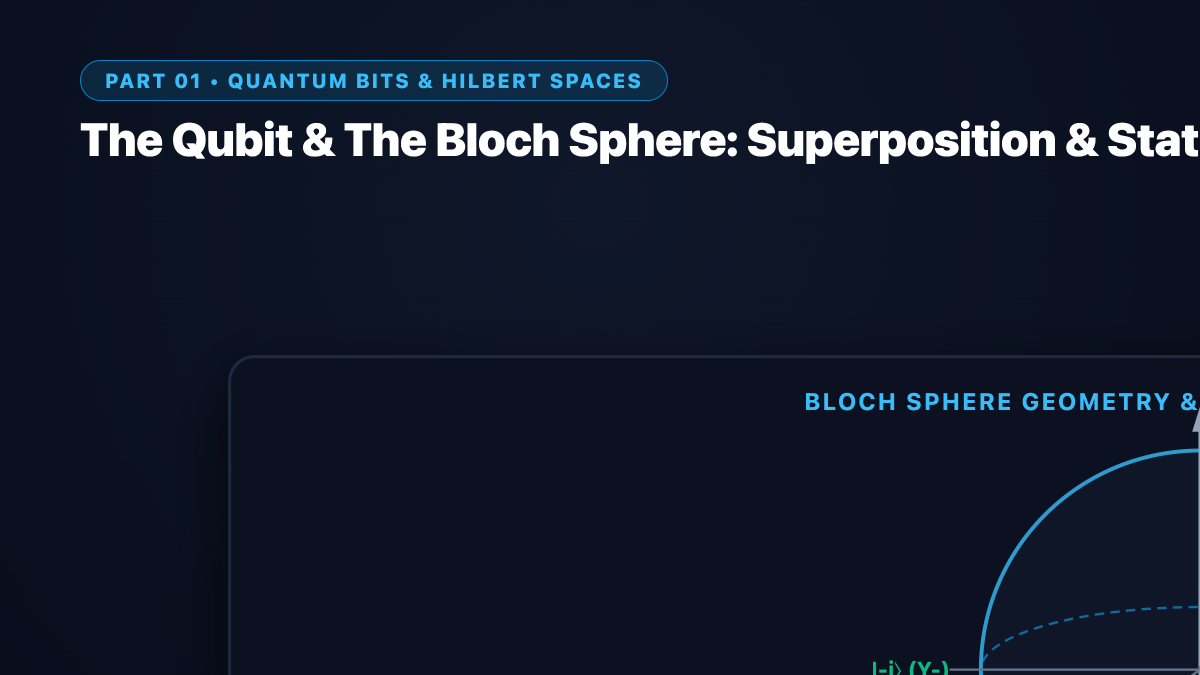
At the foundation of classical information theory (Claude Shannon, 1948) lies the binary digit—the bit—a discrete mathematical entity restricted strictly to the binary set ${0, 1}$. Classical computation is governed by the deterministic manipulation of these macroscopic voltage states. Yet the physical universe, at its deepest subatomic foundations, is not classical. In 1982, Richard Feynman famously observed that classical Turing machines cannot simulate quantum physical systems without incurring an exponential computational penalty. The foundational atom of quantum computation is the Qubit (Quantum Bit). By exploiting the geometric richness of complex Hilbert spaces and quantum superposition, a single qubit spans an uncountably infinite continuum of quantum states visualized on the surface of the Bloch Sphere.
1. The Mathematical Definition of a Qubit
Formally, a qubit is a state vector residing in a two-dimensional complex Hilbert space $mathcal{H}_2 cong mathbb{C}^2$ equipped with an inner product $langle cdot | cdot rangle$. The standard computational basis is spanned by two orthonormal basis kets, denoted using Paul Dirac’s bra-ket notation:
$$|0rangle = begin{pmatrix} 1 \ 0 end{pmatrix}, quad |1rangle = begin{pmatrix} 0 \ 1 end{pmatrix} quad text{where} quad langle 0|0 rangle = langle 1|1 rangle = 1, quad langle 0|1 rangle = 0$$
By the Principle of Quantum Superposition, an arbitrary pure quantum state $|psirangle$ is a linear combination of basis kets parameterized by two complex probability amplitudes $alpha, beta in mathbb{C}$:
$$|psirangle = alpha |0rangle + beta |1rangle = begin{pmatrix} alpha \ beta end{pmatrix}$$
The total probability of finding the quantum system in any state upon measurement must equal unity, dictating the Normalization Condition:
$$langle psi | psi rangle = |alpha|^2 + |beta|^2 = 1$$
2. Global Phase Invariance & Complex Projective Geometry ($mathbb{C}P^1$)
A pair of complex numbers $alpha = a_1 + i a_2$ and $beta = b_1 + i b_2$ has four real degrees of freedom. The normalization condition $|alpha|^2 + |beta|^2 = a_1^2 + a_2^2 + b_1^2 + b_2^2 = 1$ confines the state space to a three-dimensional unit hypersphere $mathbb{S}^3 subset mathbb{R}^4$.
However, quantum physical observables are governed exclusively by expectation values of Hermitian operators $hat{A}$. Multiplying the state vector by an arbitrary global phase factor $e^{igamma}$ ($gamma in mathbb{R}$) leaves all physical measurement outcomes identical:
$$langle psi | e^{-igamma} hat{A} e^{igamma} | psi rangle = langle psi | hat{A} | psi rangle$$
Because physical states are rays in projective Hilbert space, quotienting the hypersphere $mathbb{S}^3$ by the global $U(1)$ phase gauge symmetry ($mathbb{S}^3 / U(1) cong mathbb{C}P^1 cong mathbb{S}^2$) reveals that the pure state space of a single qubit is topologically and geometrically identical to a two-dimensional Riemannian sphere: the Bloch Sphere.
3. Parameterization of the Bloch Sphere
By factoring out the unobservable global phase, we write any pure state $|psirangle$ uniquely in terms of two real angular parameters: the polar colatitude $theta in [0, pi]$ and the azimuthal longitude $phi in [0, 2pi)$:
$$|psirangle = cosleft(frac{theta}{2}right)|0rangle + e^{iphi}sinleft(frac{theta}{2}right)|1rangle$$
This state maps to a unit vector $vec{r} = (r_x, r_y, r_z) in mathbb{R}^3$ on the surface of the sphere via the expectation values of the Pauli spin matrices $vec{sigma} = (sigma_x, sigma_y, sigma_z)$:
$$r_x = langle psi | sigma_x | psi rangle = sinthetacosphi$$
$$r_y = langle psi | sigma_y | psi rangle = sinthetasinphi$$
$$r_z = langle psi | sigma_z | psi rangle = costheta$$
Cardinal Points on the Bloch Sphere
- North Pole ($theta = 0$): $|psirangle = |0rangle$, Bloch vector $vec{r} = (0, 0, 1)$.
- South Pole ($theta = pi$): $|psirangle = |1rangle$, Bloch vector $vec{r} = (0, 0, -1)$.
- Positive X-Axis ($theta = pi/2, phi = 0$): $|+rangle = frac{1}{sqrt{2}}(|0rangle + |1rangle)$, vector $vec{r} = (1, 0, 0)$.
- Negative X-Axis ($theta = pi/2, phi = pi$): $|-rangle = frac{1}{sqrt{2}}(|0rangle – |1rangle)$, vector $vec{r} = (-1, 0, 0)$.
- Positive Y-Axis ($theta = pi/2, phi = pi/2$): $|+irangle = frac{1}{sqrt{2}}(|0rangle + i|1rangle)$, vector $vec{r} = (0, 1, 0)$.
- Negative Y-Axis ($theta = pi/2, phi = 3pi/2$): $|-irangle = frac{1}{sqrt{2}}(|0rangle – i|1rangle)$, vector $vec{r} = (0, -1, 0)$.
4. The Geometry of Orthogonality: The $theta/2$ Factor
A crucial mathematical subtlety of quantum geometry is the factor of $theta/2$ in the state amplitudes. In Euclidean Hilbert space, two vectors are orthogonal if their inner product vanishes:
$$langle psi | psi_perp rangle = 0$$
On the Bloch sphere, orthogonal states do not meet at a $90^circ$ right angle; they are situated antipodal to one another ($180^circ$ apart)! For example, the orthogonal counterpart to the North pole $|0rangle$ ($theta = 0$) is the South pole $|1rangle$ ($theta = pi$). In general, the antipodal state to $(theta, phi)$ is $(pi – theta, phi + pi)$, yielding:
$$vec{r}_{|psirangle} cdot vec{r}_{|psi_perprangle} = -1$$
5. The Quantum Measurement Postulate & State Collapse
While a qubit before measurement resides in a continuous coherent superposition across the entire spherical surface, extracting classical information requires a Projective Measurement.
According to the Born Rule (Max Born, 1926), measuring a state $|psirangle = alpha|0rangle + beta|1rangle$ in the computational basis ${|0rangle, |1rangle}$ yields non-deterministic classical bit outcomes with probabilities:
$$P(0) = |langle 0 | psi rangle|^2 = |alpha|^2 = cos^2left(frac{theta}{2}right)$$
$$P(1) = |langle 1 | psi rangle|^2 = |beta|^2 = sin^2left(frac{theta}{2}right)$$
Immediately upon measurement, the continuous superposition is permanently destroyed (von Neumann state reduction): the state vector collapses discontinuously to the measured eigenstate $|0rangle$ or $|1rangle$. Any subsequent measurement in the same basis returns the identical outcome with $100%$ probability.
The profound computational power of quantum mechanics arises not from reading continuous amplitudes directly, but from choreographing quantum logic gates to create constructive interference on the desired answer while inducing destructive interference across all incorrect answers prior to final projective collapse.