“It is unworthy of excellent men,” wrote Gottfried Wilhelm Leibniz in 1685, “to lose hours like slaves in the labor of calculation which could safely be relegated to anyone else if machines were used.” In the intellectual ferment of the Enlightenment, mathematics transcended ink and parchment. Philosophers sought to externalize the human intellect by constructing clockwork brains from brass, steel, and binary logic.
1. The Mechanical Dawn: Schickard’s Calculating Clock
The dawn of mechanical calculating machines emerged alongside the scientific revolution. In 1623, German polymath Wilhelm Schickard designed the Rechenuhr (Calculating Clock) for astronomer Johannes Kepler to assist in calculating planetary orbits. Schickard’s machine combined Napier’s bones (logarithmic rods mounted on cylinders) for multiplication with an internal gear train for addition and subtraction.
The Achilles’ heel of early gear calculation was the carry propagation problem. When an accumulator wheel turns from 9 to 0, it must advance the wheel to its immediate left by 1. In a multi-digit operation like $99,999 + 1$, the carry must propagate across all five registers simultaneously:
$$99999_{10} + 1 \implies \text{Carry across } 5 \text{ successive decades}$$In Schickard’s simple interlocking tooth mechanism, propagating five simultaneous carries demanded immense mechanical torque. If the operator turned the dial forcefully, the delicate gear teeth stripped; if turned gently, the machine jammed. Schickard’s prototypes were destroyed in a fire during the Thirty Years’ War, leaving the field open for a nineteen-year-old French prodigy.
2. Blaise Pascal and the Pascaline: The Gravity Carry Engine
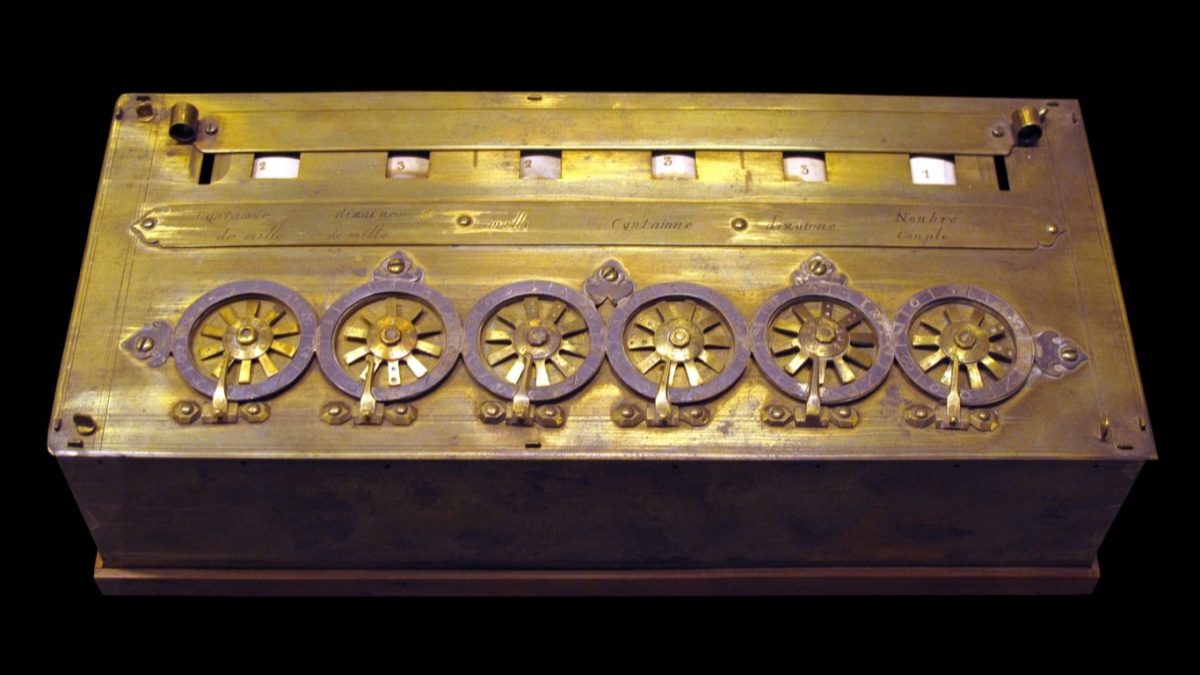
In 1642, Blaise Pascal designed the Pascaline to relieve his father, a royal tax commissioner in Rouen, from exhausting manual ledger computations. Pascal spent three years constructing more than fifty prototypes before arriving at a brilliant physical solution to the carry bottleneck: the sautoir (gravity-assisted hopper).
| Mechanism Component | Physical Principle | Engineering Advantage |
|---|---|---|
| Input Dials | Rotating slotted wheels | Direct user entry of base-10 and non-decimal livres/sous/deniers |
| The Sautoir (Carry Hopper) | Potential energy storage under gravity | Decouples carry force from user dial torque; zero cascading resistance |
| Internal Drums | Complementary digit display rings | Executes subtraction through addition of nines’ complements |
The Physics of the Sautoir
Rather than relying on the operator’s finger torque to push adjacent gears, the Pascaline utilized potential energy. As each wheel rotated from 4 through 9, a small weighted claw—the sautoir—was gradually hoisted upward against gravity. At the exact instant the wheel transitioned from 9 to 0, the sautoir tripped over a tooth, falling under its own weight and striking the pinion of the next decade wheel.
Because each sautoir stored its own gravitational potential energy independently, a cascading ripple carry like $99,999 + 1$ did not require multiplying user torque. Each decade fell sequentially under gravity like a row of dominos. The Pascaline was the first practical, commercially fabricated calculating engine in history.
Subtractive Logic: The Nines’ Complement
Because the ratchet-and-pawl design of the sautoir permitted rotation in only one direction, the Pascaline could not mechanically turn backward for subtraction. Pascal solved this with profound algorithmic ingenuity: he implemented nines’ complement arithmetic, the direct mechanical precursor to modern computer twos’ complement:
$$a – b = a + (10^k – 1 – b) – 10^k + 1$$By displaying a dual set of numerals on the accumulator drum (a lower row for direct addition and an upper row displaying $9 – d_i$ for complements), Pascal converted subtraction into pure forward addition.
3. Gottfried Wilhelm Leibniz: The Stepped Drum and Universal Calculus
While Pascal mechanized addition and subtraction, multiplication required repeated manual addition. In 1673, German polymath Gottfried Wilhelm Leibniz unveiled his Stepped Reckoner (Staffelwalze) before the Royal Society of London and the Académie des Sciences in Paris.
Leibniz’s breakthrough was the stepped drum: a brass cylinder bearing nine fluted gear teeth of increasing lengths along its longitudinal axis. As the cylinder rotated, an axially movable spur gear engaged anywhere from 0 to 9 teeth depending on its sliding position along a splined shaft. By cranking the stepped drum once, a single digit was multiplied mechanically in $O(1)$ operations:
$$\Delta R = d \cdot \text{Rotations}$$Leibniz mounted an array of eight stepped drums on a sliding two-tier carriage, creating the first machine capable of multiplying an eight-digit number by a four-digit number directly through carriage shifts and crank revolutions.
4. The Binary Code and the Calculus of Reason
Leibniz’s greatest computational legacy was theoretical. In his 1679 treatise Explication de l’Arithmétique Binaire (Explanation of Binary Arithmetic), Leibniz recognized that all numbers and logical operations could be reduced to just two characters: $0$ and $1$:
$$N = \sum_{i=0}^{n} b_i \cdot 2^i, \quad b_i \in \{0, 1\}$$Leibniz perceived profound theological and physical symmetry in binary: $1$ represented God and creation *ex nihilo*, while $0$ represented the void. More practically, he recognized that mechanical calculators built on binary arithmetic would require far fewer moving parts than base-10 machines—an insight that lay dormant until electronic digital switches arrived in the 20th century.
Characteristica Universalis and Calculus Ratiocinator
Leibniz envisioned far more than a number cruncher. He dreamed of mechanizing human thought itself. He proposed the Characteristica Universalis—a universal formal language in which all human concepts, ethics, and scientific truths could be expressed as mathematical symbols. Alongside it, he conceived the Calculus Ratiocinator: a formal calculus that would resolve philosophical disputes algorithmically:
“When controversies arise, there will be no more need of disputation between two philosophers than between two accountants. For it would suffice for them to take their pens in their hands, to sit down at their tables, and to say to each other: Calculemus! (Let us calculate!)”
This audacious declaration was the philosophical birth of Artificial Intelligence. Leibniz was the first to proclaim that rational thought is an algorithmic computation.
Primary Academic References
- Pascal, B. (1645). Lettre dédicatoire à Monseigneur le Chancelier sur le sujet de la machine nouvellement inventée par le sieur B. P. pour faire toutes sortes d’opérations d’arithmétique. Paris.
- Leibniz, G. W. (1703). Explication de l’arithmétique binaire, qui se sert des seuls caractères 0 et 1. Histoire de l’Académie Royale des Sciences, 85–89.
- Goldstine, H. H. (1972). The Computer from Pascal to von Neumann. Princeton University Press.
- Davis, M. (2000). The Universal Computer: The Road from Leibniz to Turing. W. W. Norton & Company.