In 1970, computing was an authoritarian priesthood. Multimillion-dollar corporate mainframes were locked away in air-conditioned glass sanctums, operated exclusively by technicians in white coats feeding batches of punched cards. A small cabal of renegade visionaries in northern California believed computers should not belong to corporations or the military, but to artists, children, and individual humans. By inventing the personal computer, the graphical user interface, and the mouse, they unleashed the greatest democratization of creative power in history.
1. Engelbart and the “Mother of All Demos” (1968)
The philosophical catalyst for interactive computing occurred on December 9, 1968, at the Fall Joint Computer Conference in San Francisco. Dr. Douglas Engelbart of the Augmentation Research Center at SRI took the stage before 1,000 engineers to present a live 90-minute demonstration of his NLS (oN-Line System).
In what is universally revered as the “Mother of All Demos,” Engelbart sat before a custom console wearing an audio headset. On a 22-foot projection screen, he demonstrated technologies that seemed like science fiction:
- The Computer Mouse: A carved wooden box housing two perpendicular wheels tracking $X$ and $Y$ displacement across a desk surface.
- Interactive Hypertext & Windowing: Dynamically linking documents with clickable hyperlinks and splitting the screen into side-by-side text panes.
- Real-Time Collaborative Editing: Engelbart collaborated live on a shared document with a colleague 30 miles away in Menlo Park, displaying two independent mouse cursors and streaming two-way video on screen simultaneously!
Engelbart did not view computers as calculators; he saw them as cognitive prosthetics designed to “augment human intellect” to solve humanity’s increasingly complex problems.
2. Xerox PARC: The Golden Crucible of Palo Alto
In 1970, Xerox Corporation was the undisputed king of paper photocopying. Fearing that paperless electronic offices would destroy their monopoly, Xerox CEO Peter McColough funded the Palo Alto Research Center (PARC) in California, granting research director Bob Taylor an unlimited budget and total intellectual freedom.
Taylor assembled the greatest concentration of computer science geniuses in history: Alan Kay, Butler Lampson, Charles Simonyi, Adele Goldberg, Dan Ingalls, Bob Metcalfe, and Gary Starkweather.
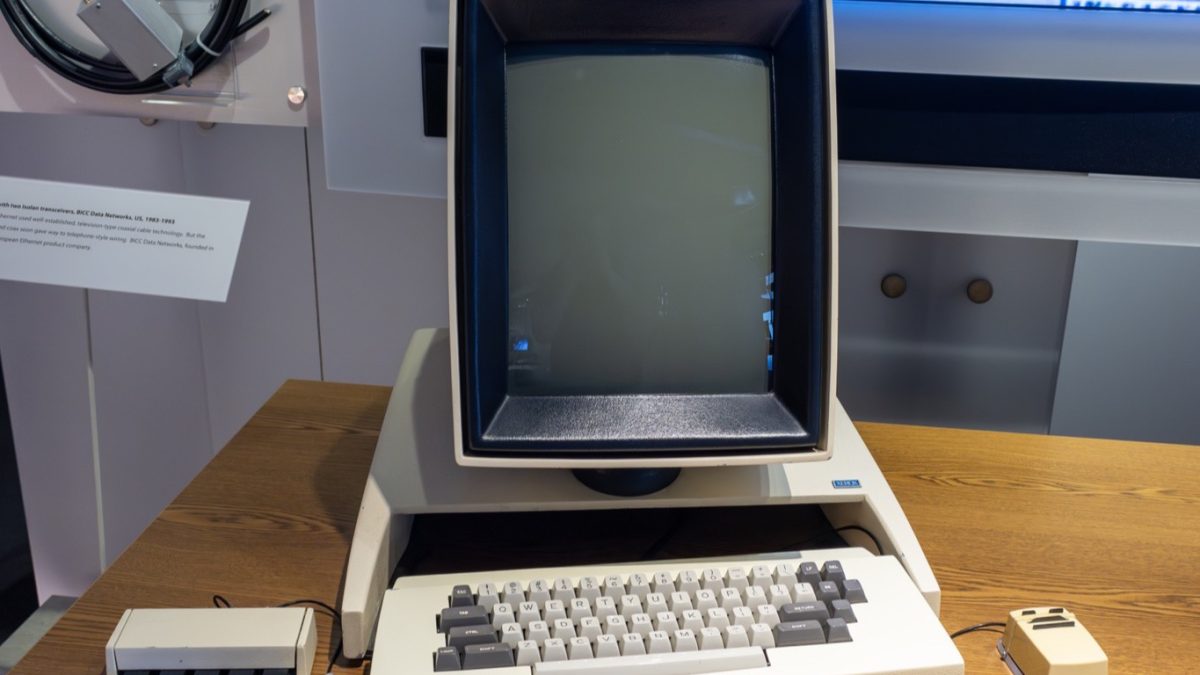
The Xerox Alto (1973): The First Modern Personal Computer
In 1973, Butler Lampson and Chuck Thacker built the Xerox Alto. It was not a shared time-sharing terminal; it was an authentic, dedicated personal computer designed for one human being:
- Bitmapped Portrait Display: Rather than character-generator matrices locked into 80-column ASCII text, every individual phosphor pixel on the 606×808 screen was mapped to a specific bit in RAM. This allowed arbitrary typography, graphics, and full proportional fonts (*WYSIWYG* – What You See Is What You Get).
- Graphical User Interface (GUI): Overlapping windows, icons, pull-down menus, radio buttons, and scroll bars created by Alan Kay and Dan Ingalls.
- Smalltalk: Alan Kay’s pure object-oriented programming language where every entity was an object that communicated via message passing.
- Ethernet (1973): Invented by Bob Metcalfe, connecting Altos at 2.94 Mbps over coaxial cable using CSMA/CD (Carrier Sense Multiple Access with Collision Detection).
- Laser Printing: Invented by Gary Starkweather, printing bitmap raster images at 300 DPI directly from an Alto.
Xerox corporate executives in New York failed completely to understand what PARC had created, dismissing the Alto as an expensive toy that could not generate immediate photocopier revenues.
3. The Homebrew Computer Club and the Apple II
While Xerox sat on its treasures, an anarchist revolution was brewing in the garage workshops of Silicon Valley. In March 1975, electronics hobbyists gathered in Gordon French’s Menlo Park garage for the inaugural meeting of the Homebrew Computer Club.
Among the attendees was a reclusive engineering genius working at Hewlett-Packard named Steve Wozniak. Inspired by the $25 MOS Technology 6502 8-bit microprocessor, Wozniak spent his evenings hand-wiring a computer that plugged directly into a home television and keyboard. His ambitious friend Steve Jobs insisted they sell the bare circuit boards: the Apple I was born in 1976.
In 1977, Wozniak and Jobs unveiled the Apple II at the West Coast Computer Faire. Encased in a sleek beige molded plastic shell with built-in color graphics, sound, an external floppy drive controller, and Dan Bricklin’s VisiCalc spreadsheet (the world’s first “killer app”), the Apple II proved that ordinary households, accountants, and schools would buy computers by the millions.
4. 1984: The Macintosh and the GUI for the Masses
In December 1979, Steve Jobs visited Xerox PARC in exchange for allowing Xerox to purchase \$1 million of pre-IPO Apple stock. When PARC engineers demonstrated the Alto running Smalltalk’s bitmapped GUI with a mouse, Jobs was spellbound:
“I was totally blinded to the computer science brilliance of what they had done. All I could see was that within ten years, every computer on Earth would work this way. It was so obvious!”
Jobs returned to Apple and spearheaded the development of the Macintosh. Driven by brilliant programmers and hardware engineers—Bill Atkinson, Andy Hertzfeld, Burrell Smith, and designer Susan Kare—Apple refined PARC’s research concepts into a commercial product: introducing the trash can icon, proportional dragging, menu bars, and intuitive window controls.
On January 24, 1984, accompanied by Ridley Scott’s famous Orwellian Super Bowl commercial, Steve Jobs pulled the Macintosh from a canvas bag. The machine spoke its own introduction via synthesized voice and drew a graphic of itself on its crisp 9-inch bitmapped display. Command-line terminals were relegated to server rooms; computing had become visual, intuitive, and personal.
Primary Academic References
- Engelbart, D. C., & English, W. K. (1968). A research center for augmenting human intellect. AFIPS Fall Joint Computer Conference, 33, 395–410.
- Kay, A., & Goldberg, A. (1977). Personal Dynamic Media. Computer, 10(3), 31–41.
- Thacker, C. P., et al. (1982). Alto: A personal computer. In Computer Structures: Principles and Examples, McGraw-Hill, 549–572.
- Hiltzik, M. A. (1999). Dealers of Lightning: Xerox PARC and the Dawn of the Computer Age. HarperBusiness.