In the summer of 1958, the United States Office of Naval Research called a press conference in Washington to announce an invention that sounded like pure science fiction: an electronic machine that could learn from experience, recognize shapes, and would soon be capable of walking, talking, seeing, and reproducing itself. It was Frank Rosenblatt’s Perceptron. Eleven years later, a devastating mathematical critique by Marvin Minsky and Seymour Papert crushed the field under a ten-year intellectual and financial ice age: the First AI Winter.
1. The Biological Metaphor: McCulloch, Pitts, and Hebb
While the founders of symbolic AI at Dartmouth modeled intelligence after mathematical logic and chess-playing, a rival school of thought—Connectionism—sought to build intelligence from the bottom up, mirroring the biological architecture of the human brain.
In 1943, neurophysiologist Warren McCulloch and self-taught prodigy Walter Pitts published their landmark paper A Logical Calculus of the Ideas Immanent in Nervous Activity. They modeled a biological neuron as a simplified mathematical threshold switch:
$$y = \Theta \left( \sum_{i=1}^{n} w_i x_i – \theta \right)$$where $x_i \in \{0, 1\}$ are binary inputs, $w_i$ are synaptic weights (excitatory or inhibitory), $\theta$ is a threshold, and $\Theta$ is the Heaviside step function. McCulloch and Pitts proved that networks of these simple threshold neurons could compute any Boolean logical function.
In 1949, Canadian psychologist Donald Hebb proposed the neurophysiological mechanism for learning in his book The Organization of Behavior. Known as Hebbian Learning, the rule states that when two neurons fire simultaneously, the synaptic connection between them strengthens:
$$\Delta w_{ij} = \eta \cdot x_i \cdot x_j$$“Neurons that fire together, wire together.”
2. Frank Rosenblatt and the Mark I Perceptron
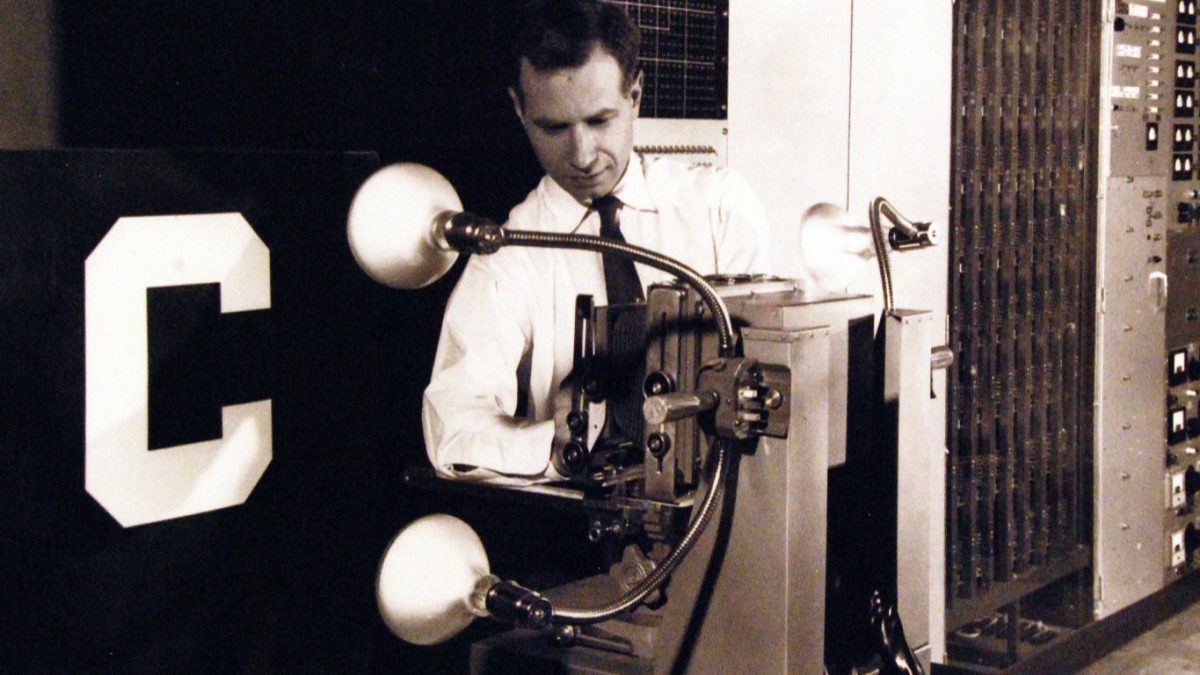
In 1957 at the Cornell Aeronautical Laboratory in Buffalo, New York, psychologist Frank Rosenblatt operationalized McCulloch, Pitts, and Hebb’s theories into physical hardware: the Mark I Perceptron.
The Mark I was not a software simulation; it was a bespoke, room-sized analog machine designed for optical pattern recognition:
- Retina: A $20 \times 20$ grid of 400 cadmium-sulfide (CdS) photocells mounted inside a camera box, providing a 400-pixel visual input.
- Association Units: The 400 sensory inputs connected through fixed, randomized electrical wiring to 512 associative units.
- Motor-Driven Synaptic Weights: Synaptic weights were physical potentiometers driven by electric servomotors. When the machine made an error during training, servomotors physically rotated the potentiometers clockwise or counter-clockwise to adjust electrical resistance!
The Perceptron Learning Algorithm
Rosenblatt formulated the mathematically rigorous Perceptron Learning Rule. For a binary classification task with inputs $\mathbf{x} = [x_1, x_2, \dots, x_n]^T$, weight vector $\mathbf{w}$, bias $b$, and target label $y \in \{-1, +1\}$:
$$\hat{y} = \text{sign}(\mathbf{w}^T \mathbf{x} + b)$$ $$\mathbf{w}_{t+1} = \mathbf{w}_t + \eta (y – \hat{y}) \mathbf{x}$$In 1962, Rosenblatt proved the famous Perceptron Convergence Theorem: if the training data is linearly separable (meaning a single hyperplane can divide class $+1$ from class $-1$ in $n$-dimensional space), the perceptron learning algorithm is mathematically guaranteed to find a separating hyperplane in a finite number of update steps, regardless of initial weights!
3. The Minsky-Papert Critique: The XOR Death Blow
The sensational press coverage surrounding the Perceptron—fueled by Rosenblatt’s grandiose claims—alarmed the symbolic AI establishment at MIT. In 1969, MIT AI Lab co-founders Marvin Minsky and Seymour Papert published an exhaustively rigorous mathematical treatise titled simply: Perceptrons: An Introduction to Computational Geometry.
Minsky and Papert did not attack the perceptron with rhetoric; they destroyed it with geometric proofs. Their most famous proof demonstrated that a single-layer perceptron cannot compute the basic Exclusive-OR (XOR) function:
| $x_1$ | $x_2$ | XOR Output $y$ | Linear Constraint Required |
|---|---|---|---|
| 0 | 0 | 0 | $w_1(0) + w_2(0) + b < 0 \implies b < 0$ |
| 1 | 0 | 1 | $w_1(1) + w_2(0) + b \ge 0 \implies w_1 + b \ge 0$ |
| 0 | 1 | 1 | $w_1(0) + w_2(1) + b \ge 0 \implies w_2 + b \ge 0$ |
| 1 | 1 | 0 | $w_1(1) + w_2(1) + b < 0 \implies w_1 + w_2 + b < 0$ |
Summing the two inequalities for $y = 1$ yields: $(w_1 + b) + (w_2 + b) \ge 0 \implies w_1 + w_2 + 2b \ge 0$.
However, from the two inequalities for $y = 0$, we have $b < 0$ and $w_1 + w_2 + b < 0$. Adding them yields $w_1 + w_2 + 2b < 0$.
This is a direct mathematical contradiction ($0 \le w_1 + w_2 + 2b < 0$). No single linear decision boundary $\mathbf{w}^T \mathbf{x} + b = 0$ can separate the diagonally opposed points of the XOR truth table in two-dimensional space!
While Minsky and Papert acknowledged that multilayer perceptrons (MLPs) could theoretically solve XOR by warping the coordinate space, they expressed extreme pessimism that an efficient mathematical algorithm could ever be found to train intermediate hidden layers: “Our intuitive judgment that the extension is sterile,” they wrote.
4. The Lighthill Report and the First AI Winter
The impact of Minsky and Papert’s book was catastrophic. Research funding for artificial neural networks evaporated overnight. Scientists working on connectionism were denied grants, tenures, and conference platforms.
The freeze soon spread to symbolic AI as well. In 1973, the British Science Research Council commissioned distinguished fluid dynamicist Sir James Lighthill to evaluate government-funded AI research. Lighthill’s devastating report concluded that AI had failed utterly to achieve its grandiose promises:
- AI algorithms that worked on simple toy domains (like blocks world) failed catastrophically when scaled to the real world due to combinatorial explosion: the search space grew exponentially ($O(b^d)$).
- Common-sense knowledge and automated language translation remained hopeless quagmires.
Simultaneously in the United States, the passage of the Mansfield Amendment (1973) legally barred DARPA from funding open-ended, blue-sky research lacking direct military applications. Millions of dollars in research contracts were abruptly canceled. From 1974 until the early 1980s, the field entered the First AI Winter—a desolate era of skepticism, abandoned laboratories, and crushed academic careers.
Primary Academic References
- McCulloch, W. S., & Pitts, W. (1943). A logical calculus of the ideas immanent in nervous activity. Bulletin of Mathematical Biophysics, 5(4), 115–133.
- Rosenblatt, F. (1958). The perceptron: a probabilistic model for information storage and organization in the brain. Psychological Review, 65(6), 386–408.
- Minsky, M., & Papert, S. (1969). Perceptrons: An Introduction to Computational Geometry. MIT Press.
- Lighthill, J. (1973). Artificial Intelligence: A General Survey. Science Research Council, London.