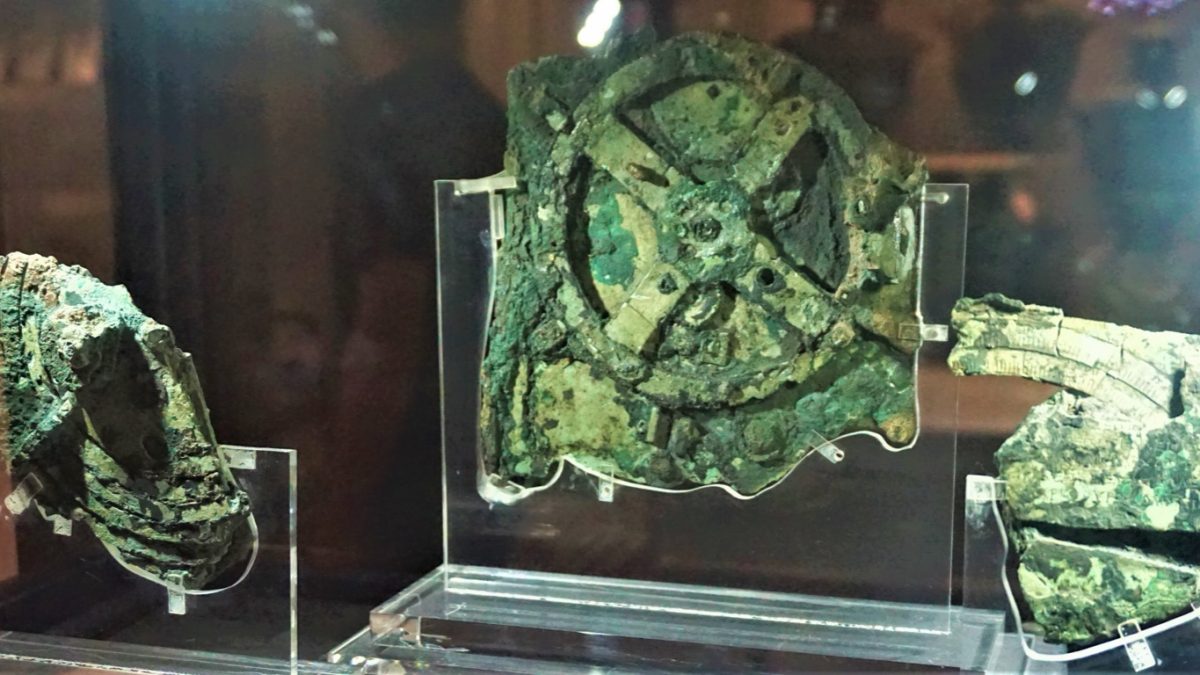
More than two millennia before the invention of the silicon microchip, ancient Mediterranean engineers assembled an apparatus of thirty-seven bronze gears capable of calculating the irregular motions of the Moon, tracking the Olympic games, and predicting solar eclipses decades in advance. The history of computing did not begin in Silicon Valley or Bletchley Park; it began the moment our ancestors realized that the universe obeys mathematical rules—and that those rules could be mechanized inside physical matter.
1. The Prehistory of Number and Externalized Memory
Computation in its purest sense is the systematic transformation of symbolic representations according to deterministic rules. For early hominins, working memory was constrained by biological cognitive bandwidth. To overcome this limitation, humans developed exograms—external physical records that offloaded mental representations onto enduring artifacts.
The oldest known artifacts displaying systematic symbolic counting are notch tallies: the Lebombo bone from Swaziland (~42,000 years old) and the famous Ishango bone from the headwaters of the Nile (~20,000 BCE). The Ishango bone, an incised baboon fibula featuring a quartz tool tip, exhibits three distinct columns of notches arranged in non-random groupings: one column contains prime numbers between 10 and 20 (11, 13, 17, 19), while another exhibits doubling and halving relations ($3 \to 6$, $4 \to 8$, $5 \to 10$). Whether designed as a six-month lunar calendar or a rudimentary calculation tally, it represents humanity’s inaugural step: mapping time and quantity onto a portable physical medium.
| Epoch | Calculating Medium | Radix / Number Base | Computational Capability |
|---|---|---|---|
| ~20,000 BCE | Ishango Bone Notch Columns | Tally marks / Base-10 groupings | Static memory recording, lunar cycle counting |
| ~2700 BCE | Sumerian Clay Tokens & Abacus | Sexagesimal (Base-60) | Linear addition, agrarian inventory subtraction |
| ~300 BCE | Salamis Tablet & Roman Hand Abacus | Bi-quinary (Base-5 and Base-10) | Multi-digit arithmetic, commerce ledger calculation |
| ~150–100 BCE | Antikythera Mechanism | Continuous Differential Gearing | Epicyclic eclipse forecasting, lunar anomaly modeling |
2. Positional Numeration and the Abacus Engine
Calculation cannot scale without positional notation. Roman numerals ($MDCCCLXXXVIII$) require ad-hoc aggregations that make multi-digit multiplication virtually impossible on paper. Ancient civilizations bypassed this bottleneck through mechanical token manipulation: the counting board and the abacus.
In the Roman hand abacus and its eastern counterparts—the Chinese Suanpan and Japanese Soroban—tokens were mounted on parallel rods organized into “upper deck” (representing units of five) and “lower deck” (representing units of one) bi-quinary systems. The fundamental computational insight of the abacus was the register: each wire represented an order of magnitude in base-10:
$$N = \sum_{k=0}^{m} d_k \cdot 10^k \quad \text{where } d_k \in \{0, 1, \dots, 9\}$$By moving beads across a central divider beam, an operator performed additions and carries with $O(1)$ constant time per digit. The abacus was not merely a passive record; it was an interactive state-machine where beads functioned as physical bits.
3. Al-Khwarizmi and the Formalization of the Algorithm
Physical machinery without abstract procedural rules remains blind. In 9th-century Baghdad, mathematician Muhammad ibn Musa al-Khwarizmi published two epochal treatises at the House of Wisdom (*Bayt al-Hikma*): Kitāb al-Jamʿ wa-l-Tafrīq bi-Ḥisāb al-Hind (Book on Addition and Subtraction after the Method of the Indians) and Al-Kitāb al-mukhtaṣar fī ḥisāb al-jabr wa-l-muqābala (The Compendious Book on Calculation by Completion and Balancing).
Al-Khwarizmi introduced the Hindu decimal positional numeral system—including the revolutionary concept of zero as both a place-value holder and a null quantity—to the Mediterranean and European worlds. More importantly, his step-by-step arithmetic operations established the very concept of an algorithm (a Latinized corruption of his name, *Algoritmi*):
“` Algorithm: Euclidean Greatest Common Divisor (GCD) Input: Integers a and b, where a >= b >= 0 Output: Greatest common divisor of a and b function gcd(a, b): while b != 0: remainder = a mod b a = b b = remainder return a “`Al-Khwarizmi demonstrated that complex mathematical operations could be reduced to a finite sequence of mechanical, unambiguous transformations that could be executed blindly without requiring ongoing intuitive divine inspiration. This conceptual leap laid the theoretical foundation for all future software.
4. The Antikythera Mechanism: The Clockwork Cosmos
In 1901, sponge divers off the coast of the Greek island of Antikythera recovered a corroded lump of bronze from a Roman shipwreck dating to the 1st century BCE. Decades of micro-focus X-ray computed tomography by the Antikythera Mechanism Research Project revealed an extraordinary sight: a shoebox-sized wooden frame enclosing a clockwork computer containing at least thirty-seven meshing bronze gears.
The Antikythera mechanism was an analog astronomical computer. By turning an external hand crank, the user rotated a master input axle representing the passage of calendar days. Through precise gear ratios, this rotary input drove an array of front and rear dials:
- The Solar and Zodiac Dial: Tracked the true position of the Sun along the ecliptic across a 365-day Egyptian calendar ring with leap-year adjustments.
- The Metonic Calendar Dial: Displayed the 235-synodic-month Metonic cycle (spanning 19 solar years), synchronizing solar and lunar calendars.
- The Saros Eclipse Predictor: A 223-month spiral dial on the lower rear panel that predicted the exact hour, day, and magnitude of solar and lunar eclipses, alongside whether the eclipse would occur when the Moon was ascending or descending through its orbital nodes.
Mathematical Mechanics: Epicyclic Differential Gearing
The crowning mechanical triumph of the mechanism was its ability to model Keplerian lunar anomaly eighteen centuries before Johannes Kepler. Because the Moon moves in an elliptical orbit, its angular velocity varies according to Kepler’s second law: it accelerates at perigee and decelerates at apogee.
Hellenistic astronomer Hipparchus of Nicaea had approximated this non-uniform motion using an epicyclic “pin-and-slot” mechanism. The Antikythera builders mechanized Hipparchus’s theory with stunning brilliance: two meshing gears were mounted slightly off-center (eccentric) relative to one another. A pin protruding from one gear rode within a radial slot in the second gear:
$$\omega(\theta) = \omega_0 \left( 1 + 2e \cos \theta + O(e^2) \right)$$As the driving gear rotated at a constant angular speed $\omega_0$, the distance between the center of rotation and the pin varied sinusoidally, causing the driven gear to advance and retard its phase angle, reproducing the eccentric variable velocity of the Moon against the stars!
Key Takeaway: The Forgotten Summit
The Antikythera Mechanism proves that human civilization possessed the mathematical and mechanical ability to build sophisticated analog calculating engines before the fall of the Roman Republic. Following the collapse of Classical antiquity, clockwork mechanism of this complexity would not reappear on Earth until the medieval cathedral astronomical clocks of 14th-century Europe.
Primary Academic References
- Freeth, T., et al. (2006). Decoding the ancient Greek astronomical calculator known as the Antikythera Mechanism. Nature, 444(7119), 587–591.
- Price, D. de Solla (1974). Gears from the Greeks: The Antikythera Mechanism—A Calendar Computer from ca. 80 B.C. Transactions of the American Philosophical Society, 64(7), 1–70.
- Ifrah, G. (2000). The Universal History of Computing: From the Abacus to the Quantum Computer. John Wiley & Sons.
- Al-Khwarizmi, M. ibn M. (820). Al-Kitāb al-mukhtaṣar fī ḥisāb al-jabr wa-l-muqābala. English translation by F. Rosen (1831), London.