In the early 1950s, programming an electronic computer was an excruciating clerical ordeal. Programmers wrote raw hexadecimal machine opcodes by hand, memorizing register addresses and manually calculating octal memory offsets. To change the hardware was to throw away every line of software ever written. The modern digital world exists because visionary computer scientists created abstraction layers: compilers that translate human thought into machine voltage, and operating systems that make software immortal.
1. Grace Hopper and the Invention of the Compiler
In 1952, United States Navy mathematician and programmer Grace Brewster Murray Hopper proposed a radical idea while working on the UNIVAC I at Remington Rand: computers could be programmed using English-like words instead of raw numerical machine codes.
Her colleagues dismissed the idea as absurd, claiming that computers were arithmetic instruments, not linguistic translators. Undeterred, Hopper constructed the A-0 System (Arithmetic Language version 0), the world’s first functioning compiler. The A-0 translated symbolic subroutine call specifications into executable binary machine code:
“Nobody believed that,” Hopper later recalled. “I had a running compiler and nobody would touch it. They told me computers could only do arithmetic; they could not do programs.”
Hopper went on to create FLOW-MATIC (1955), the first programming language to use full English verbs (such as COMPUTE, TRANSFER, COMPARE). This work served as the direct conceptual foundation for COBOL (Common Business-Oriented Language, 1959), which powered international banking and corporate ledger processing for decades.
2. The High-Level Genesis: FORTRAN and LISP
Between 1954 and 1958, two epochal high-level languages established the two rival paradigms of software engineering:
- FORTRAN (Formula Translation, John Backus, IBM, 1957): Designed for scientific computing on the IBM 704. Backus proved that a high-level language could generate machine code virtually as efficient as hand-crafted assembly code through compiler optimizations (loop unrolling, register allocation). Backus also introduced Backus-Naur Form (BNF), the formal context-free grammar notation used to define programming language syntax.
- LISP (List Processing, John McCarthy, MIT, 1958): Designed specifically for artificial intelligence research. Grounded in Alonzo Church’s $\lambda$-calculus, LISP treated code and data identically (*homoiconicity*) using nested S-expressions:
(defun factorial (n) (if (<= n 1) 1 (* n (factorial (- n 1))))). McCarthy invented dynamic typing, tree-structured data recursion, and automated garbage collection to reclaim memory without explicit manual deallocation.
3. The 1968 Software Crisis and the Multics Dream
By the late 1960s, hardware capabilities had outpaced software engineering methodologies. Massive software projects—such as IBM’s OS/360, overseen by Fred Brooks—ballooned into multi-year delays and cost millions over budget. At the historic October 1968 NATO Science Committee conference in Garmisch, Germany, computer scientists officially proclaimed the “Software Crisis”: software was notoriously unreliable, unmaintainable, and impossible to predict.
To solve this, MIT, General Electric, and Bell Laboratories embarked on Multics (Multiplexed Information and Computing Service)—an ambitious project to create a massive, multi-user, fault-tolerant computing utility that would operate continuously like the electric power grid. But Multics collapsed under its own bureaucratic bloat and Byzantine architectural complexity. In 1969, Bell Labs pulled out of the project.
4. Ken Thompson, Dennis Ritchie, and the Unix Philosophy
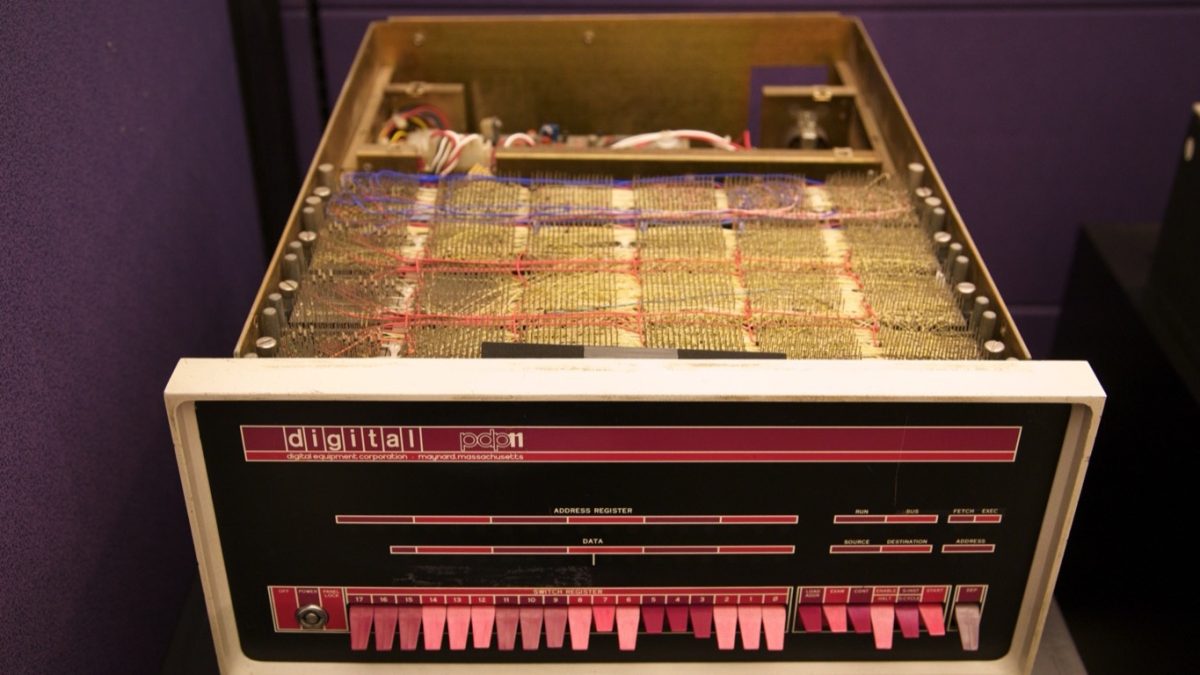
Stranded without an operating system after the Multics pullout, Bell Labs researchers Ken Thompson and Dennis Ritchie decided to build something entirely different on a cast-off, 18-bit Digital Equipment Corporation (DEC) PDP-7 minicomputer with just 8,192 words of memory.
Rather than a colossal, all-encompassing monolith like Multics, Thompson designed a lightweight, interactive, single-user system. Brian Kernighan jokingly dubbed it UNICS (Uniplexed Information and Computing Service), which soon evolved into Unix.
The C Language: Portable Systems Programming
In 1972, to port Unix to the newly acquired 16-bit DEC PDP-11, Dennis Ritchie created the C programming language (evolving from Thompson’s interpreted B language, which derived from BCPL). C provided clean control flow constructs, structured types, and low-level pointer manipulation that mapped directly onto CPU machine instructions while remaining hardware-independent.
In 1973, Thompson and Ritchie took an unprecedented, revolutionary step: they rewrote the entire Unix operating system kernel in C. Prior to Unix, every operating system in the world was written in machine-specific assembly code, forever shackled to the hardware on which it was conceived. By rewriting the kernel in C, Unix became portable: compiling the C code for a new processor architecture ported the entire operating system and its utilities in days.
The Unix Philosophy
Unix introduced architectural design principles codified by Doug McIlroy that remain the bedrock of modern computing infrastructure:
- Write programs that do one thing and do it well. Modularity over monolithic bloat.
- Write programs to work together. Introduced by Ken Thompson in 1973, the pipe (
|) allowed the standard output stream of one program to feed directly into the standard input of another without temporary files:cat access.log | grep "404" | wc -l. - Write programs to handle text streams, because that is a universal interface.
- Everything is a file. Unifying disk files, serial teletypes, memory buffers, and network sockets under a uniform virtual file system hierarchy (
/dev,/etc,/usr).
From Linux servers powering the global cloud, to Apple’s macOS and iOS (Darwin/BSD), to Android smartphones, virtually all non-Windows computing infrastructure on Earth today is a direct descendant of the Unix and C revolution born on a PDP-11 in the corridors of Bell Labs.
Primary Academic References
- Hopper, G. M. (1952). The Education of a Computer. Proceedings of the ACM, May 1952, 243–249.
- Backus, J. W. (1957). The FORTRAN automatic coding system. Western Joint Computer Conference, 188–198.
- McCarthy, J. (1960). Recursive functions of symbolic expressions and their computation by machine, Part I. Communications of the ACM, 3(4), 184–195.
- Ritchie, D. M., & Thompson, K. (1974). The UNIX Time-Sharing System. Communications of the ACM, 17(7), 365–375.