In March 1989, an English software contractor at the European Organization for Nuclear Research (CERN) in Geneva submitted a modest proposal to his supervisor titled “Information Management: A Proposal.” The supervisor, Mike Sendall, scribbled four historic words across the top margin: “Vague but exciting…” From that tentative spark emerged the World Wide Web—a universal, decentralized fabric of linked human knowledge that transformed the internet from an academic pipe into the public square of civilization.
1. The Vision of Linked Thought: From Memex to Hypertext
Long before electronic networks existed, visionaries realized that the human mind does not organize information in rigid, hierarchical filing cabinets. The mind operates by association: leaping effortlessly from an idea, to a memory, to a related concept.
In July 1945, President Roosevelt’s wartime science advisor Vannevar Bush published an essay in The Atlantic Monthly titled As We May Think. Bush conceived the Memex: a mechanized desk fitted with translucent projection screens and microfilms, allowing a researcher to build persistent, interconnected “trails” of documents.
In 1965, countercultural computer pioneer Ted Nelson coined the terms hypertext and hypermedia: non-linear writing where readers dynamically navigate interconnected nodes of text via cross-referenced links. Nelson’s ambitious Project Xanadu sought a global, two-way versioned hypertext repository, but its baroque copyright micropayment architecture prevented practical implementation.
2. Tim Berners-Lee and the CERN Synthesis
By 1989, CERN was the world’s preeminent high-energy particle physics laboratory. Thousands of international scientists from dozens of nations collaborated on massive experiments, but they ran incompatible computers, operating systems, and network protocols (VMS, Unix, DOS, Mac OS). Important research findings were lost in forgotten directories.
English computer scientist Tim Berners-Lee recognized that rather than forcing every computer to adopt a uniform hardware or operating system standard, one could create a lightweight, platform-agnostic application layer riding on top of the existing TCP/IP internet. He synthesized three deceptively simple, brilliant protocols:
| Protocol Element | Full Name | System Responsibility |
|---|---|---|
| URI / URL | Uniform Resource Identifier / Locator | A universal global address space identifying any document on any server: http://info.cern.ch/hypertext/WWW/TheProject.html |
| HTTP | Hypertext Transfer Protocol | A stateless, text-based request-response protocol riding over TCP port 80: GET /index.html HTTP/1.0 |
| HTML | Hypertext Markup Language | A simple semantic document format derived from SGML, containing embedded unidirectional clickable hyperlinks: <a href="..."> |
The NeXTcube and Christmas 1990
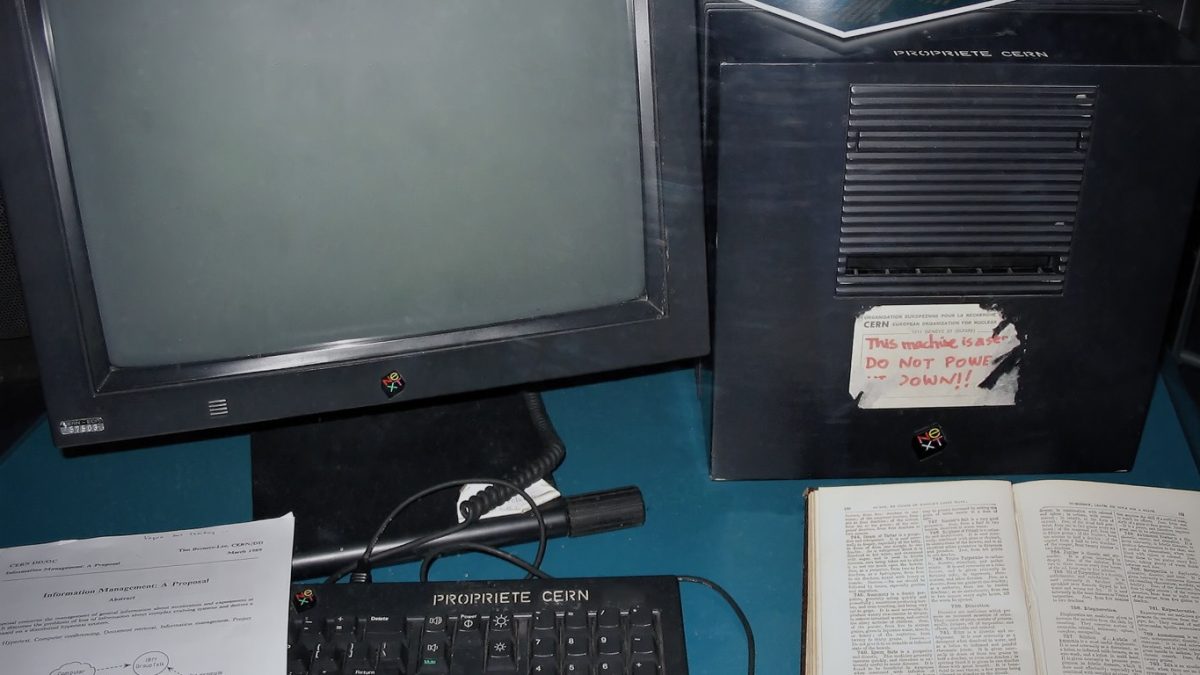
In the autumn of 1990, Berners-Lee received a sleek black NeXTcube computer (created by Steve Jobs’s post-Apple company, NeXT). Powered by the object-oriented NeXTSTEP operating system and Interface Builder, Berners-Lee wrote the entire client-server system in just three months:
- The world’s first HTTP web server program:
httpd. - The world’s first web browser and page editor, named simply WorldWideWeb.
By Christmas Day, 1990, the web was alive inside CERN, serving pages across the local ethernet. To keep the server online, Berners-Lee taped a red handwritten label to the NeXTcube’s front casing: “This machine is a server. DO NOT POWER IT DOWN!”
3. The Gift of Freedom: April 30, 1993
The history of computing is littered with proprietary technologies that withered behind corporate tollbooths (Gopher, Compuserve, AOL, Prodigy). The Web triumphed because Tim Berners-Lee made an extraordinary ethical stand: he insisted that the core protocols of the Web must remain completely free, royalty-free, and unencumbered by patents for all eternity.
On April 30, 1993, CERN issued an official legal declaration placing the World Wide Web software into the public domain. Anyone on Earth could download the source code, run a server, build a browser, or write an HTML page without paying a single penny in licensing fees to CERN or Berners-Lee. This monumental act of technological philanthropy sparked an explosion of human creativity unrivaled in history.
4. Marc Andreessen and the Mosaic Phenomenon
In 1992, browsing the web still required terminal command-lines or rare NeXT workstations. At the National Center for Supercomputing Applications (NCSA) at the University of Illinois Urbana-Champaign, twenty-one-year-old student programmer Marc Andreessen and staff engineer Eric Bina decided to bring the web to ordinary personal computers.
In 1993, they released NCSA Mosaic for Unix, Windows, and Macintosh. Mosaic transformed the web experience through two critical innovations:
- Inlined Color Images: Andreessen introduced the
<img>tag, allowing color graphics (GIFs, JPEGs) to appear directly on the same page alongside text, rather than opening in clumsy external window viewers. - Effortless One-Click Installation: Point-and-click graphical navigation with dedicated back/forward buttons, bookmarks, and a clean URL address bar.
Mosaic turned the Web into an overnight cultural sensation. Andreessen moved to California, teamed with Silicon Graphics founder Jim Clark, and incorporated Netscape Communications. When Netscape launched its initial public offering (IPO) on August 9, 1995, its stock soared from \$28 to \$75 on day one, valuing the sixteen-month-old company at nearly \$3 billion and firing the starting gun of the historic Dot-Com Boom.
Primary Academic References
- Berners-Lee, T. (1989). Information Management: A Proposal. CERN Technical Report.
- Berners-Lee, T., et al. (1994). The World-Wide Web. Communications of the ACM, 37(8), 76–82.
- Bush, V. (1945). As We May Think. The Atlantic Monthly, 176(1), 101–108.
- Berners-Lee, T. (1999). Weaving the Web: The Original Design and Ultimate Destiny of the World Wide Web. HarperSanFrancisco.