“Can machines think?” asked Alan Turing in 1950. Six years later, in the humid summer of 1956, a small band of mathematicians, psychologists, and computer scientists gathered at Dartmouth College with an audacious proposal: that every aspect of learning and intelligence could in principle be so precisely described that a machine could be made to simulate it. In that moment, Artificial Intelligence ceased to be mythology and became a science.
1. Alan Turing’s 1950 Prophecy: The Imitation Game
In October 1950, Alan Turing published his philosophically profound paper Computing Machinery and Intelligence in the philosophical journal Mind. Recognizing that the question “Can machines think?” was hopelessly mired in ambiguous semantic definitions of “machine” and “think,” Turing replaced it with an operational behavioral benchmark: the Imitation Game (now known universally as the Turing Test).
In Turing’s test, a human interrogator sits in a sealed room communicating via teleprinter text terminal with two hidden entities: a human and a digital computer. If the interrogator cannot reliably distinguish between the human and the machine after five minutes of conversation, the machine has demonstrated functional equivalence to human intelligence.
Turing systematically addressed and demolished every major objection to machine intelligence—the theological objection, the “heads in the sand” objection, Lady Lovelace’s objection (machines can only do what we know how to order them to do), and the argument from consciousness. He concluded with a prophetic vision: instead of trying to program the adult mind directly, why not simulate a child’s mind and allow it to learn through reinforcement?
2. Dartmouth 1956: The Birth of a Discipline
In August 1955, young Dartmouth mathematics assistant professor John McCarthy, Harvard cognitive fellow Marvin Minsky, IBM computer designer Nathaniel Rochester, and Bell Labs information theorist Claude Shannon submitted a funding proposal to the Rockefeller Foundation for \$7,500.
McCarthy needed a neutral banner term that would differentiate their conceptual approach from Norbert Wiener’s entrenched mathematical field of Cybernetics. He chose a daring two-word phrase: “Artificial Intelligence”.
“We propose that a 2 month, 10 man study of artificial intelligence be carried out during the summer of 1956 at Dartmouth College in Hanover, New Hampshire… The study is to proceed on the basis of the conjecture that every aspect of learning or any other feature of intelligence can in principle be so precisely described that a machine can be made to simulate it.”
The workshop ran throughout July and August 1956. Among the attendees were Allen Newell and political scientist Herbert Simon of Carnegie Mellon University, who brought along an authentic, running software demonstration that stole the conference: the Logic Theorist.
3. Logic Theorist and the General Problem Solver
Developed with programmer Cliff Shaw on the RAND Corporation’s JOHNNIAC computer, Newell and Simon’s Logic Theorist (1955–1956) was the world’s first working artificial intelligence program. Rather than executing brute-force numeric arithmetic, it performed heuristic symbolic manipulation.
Newell and Simon tasked the program with proving mathematical theorems from Chapter 2 of Alfred North Whitehead and Bertrand Russell’s monumental Principia Mathematica. The program utilized a backward reasoning tree, working from the target conjecture toward known axioms using means-ends analysis and substitution rules:
“` Logic Theorist Proof Search Tree: Target Theorem: (p v p) -> p Axiom 1: (A v A) -> A [Direct Axiom Match] Apply Substitution Rule: Let A = p Q.E.D. (Proved in 1 Step) “`The Logic Theorist successfully proved 38 of the first 52 theorems in the Principia. Amazingly, for Theorem 2.85, the machine discovered a proof that was significantly shorter and more elegant than the one Whitehead and Russell had published by hand four decades earlier. Russell himself was delighted, though the journal Journal of Symbolic Logic rejected a paper co-authored by the machine because “an automaton cannot author an academic paper.”
The Heuristic Paradigm
Newell and Simon established the Physical Symbol System Hypothesis: a physical symbol system has the necessary and sufficient means for general intelligent action. Intelligence, in this early paradigm, was defined as heuristic graph search across a combinatorial state space:
$$f(n) = g(n) + h(n)$$where $g(n)$ is the exact cost from the start state to node $n$, and $h(n)$ is an intuitive heuristic estimate of the remaining distance to the goal.
4. Shakey the Robot: Embodied Symbolic Reasoning
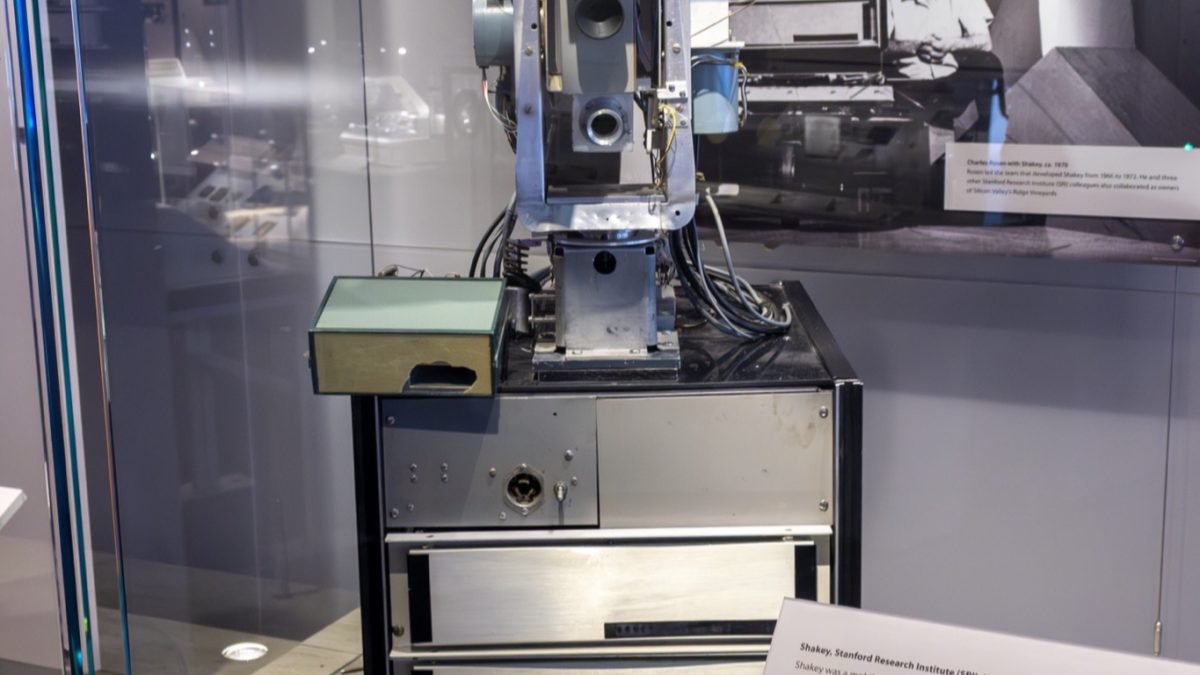
Between 1966 and 1972, the Artificial Intelligence Center at Stanford Research Institute (SRI) constructed Shakey the Robot—the first mobile machine to integrate perception, spatial reasoning, and real-world physical action.
Nicknamed “Shakey” because of the violent shuddering of its tall camera mast when stopping, the robot contained an on-board television camera, optical range-finder, and cat-whisker bump sensors, linked via high-speed radio link to a room-sized SDS 940 computer. Shakey pioneered three foundational computer science algorithms that power modern AI to this day:
- The $A^*$ Search Algorithm (Hart, Nilsson, Raphael, 1968): An optimal, complete graph traversal algorithm that uses admissible heuristics to find the shortest collision-free path through a physical room.
- STRIPS (Stanford Research Institute Problem Solver): An automated logical planner that represents world states and actions as preconditions and postconditions (add-lists and delete-lists).
- The Hough Transform: A computer vision technique for detecting straight edges and geometric surfaces from raw, noisy camera pixels.
When given a high-level natural language command like “Push the red block off the platform,” Shakey did not follow a hardcoded script. Its STRIPS planner decomposed the goal into a tree of sub-goals, used $A^*$ to navigate around obstacles, verified the scene visually with its TV camera, and pushed the block down. Symbolic AI had touched physical reality.
Primary Academic References
- Turing, A. M. (1950). Computing Machinery and Intelligence. Mind, 59(236), 433–460.
- McCarthy, J., Minsky, M. L., Rochester, N., & Shannon, C. E. (1955). A Proposal for the Dartmouth Summer Research Project on Artificial Intelligence.
- Newell, A., & Simon, H. A. (1956). The logic theory machine–A complex information processing system. IRE Transactions on Information Theory, 2(3), 61–79.
- Nilsson, N. J. (1984). Shakey the Robot. SRI International Technical Note 323.