Throughout the 1950s and 1960s, computers were deaf, mute, isolated islands. A researcher wishing to run a program on a computer at Stanford had to physically travel to California or mail a stack of punched cards. In the shadow of Cold War nuclear fears, engineers created a radically resilient architecture that decomposed human knowledge into self-routing fragments of digital data, birthing the global internet.
1. The Circuit vs. Packet Paradigm
Traditional telecommunication was built on the century-old principle of circuit switching established by Alexander Graham Bell’s telephone network: when person A called person B, an uninterrupted, dedicated physical copper circuit was switched open between them. If a single central telephone exchange was destroyed or severed, all communication collapsed.
In 1960, researcher Paul Baran at the RAND Corporation proposed a radical survival architecture for military communications during a nuclear strike: a distributed network with no central command node. Simultaneously and independently, British physicist Donald Davies at the National Physical Laboratory (NPL) conceived the identical concept for civilian resource sharing, coining the immortal term packet switching.
The Mechanics of a Packet
Instead of locking a dedicated channel open for an entire session, Baran and Davies proposed breaking messages into small, uniform digital chunks called packets. Each packet carried:
- Header: Source address, destination address, sequence number, and packet length.
- Payload: A fragment of the actual data message (typically 128 to 1,024 bytes).
- Checksum (Error Detection): Cyclic Redundancy Check (CRC) bits verifying transmission integrity.
Packets traveled independently across dynamic routes through intermediate node switches using store-and-forward routing. If a link along path A was severed or congested, packets automatically dynamically routed around the failure across path B, reassembling in correct order at the destination.
2. Kleinrock’s Queuing Theory and ARPANET Node 1
In 1962 at MIT, Leonard Kleinrock published the mathematical foundation of packet communication in his doctoral dissertation, modeling packet delays using queuing theory ($M/M/1$ queues). Kleinrock proved that by statistically multiplexing bursty computer traffic across a shared channel, network utilization surged dramatically compared to idle, dedicated telephone circuits:
$$T = \frac{1}{\mu C – \lambda}$$where $T$ is average packet delay, $C$ is channel capacity in bits/sec, $\lambda$ is packet arrival rate, and $\mu$ is average packet length.
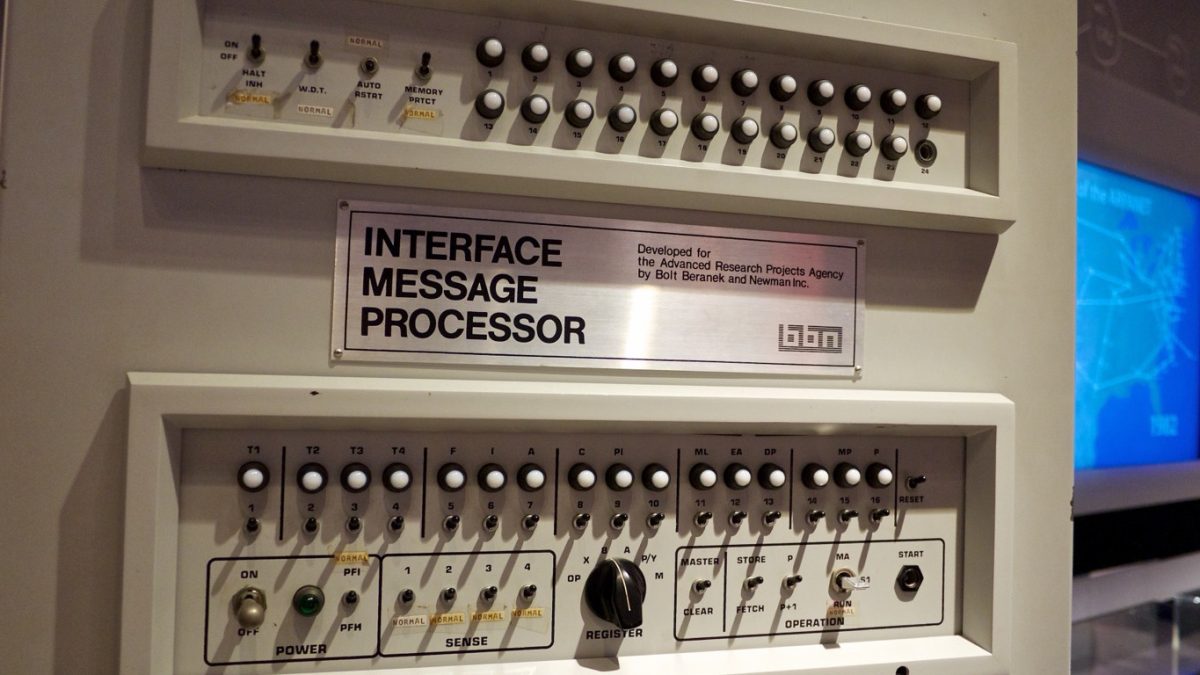
In 1968, Bob Taylor, director of the Information Processing Techniques Office (IPTO) at the Pentagon’s Defense Advanced Research Projects Agency (DARPA), secured \$1 million to construct the ARPANET. Project manager Larry Roberts contracted Cambridge engineering firm Bolt, Beranek and Newman (BBN) to build dedicated network gateway routers: the Interface Message Processors (IMPs).
October 29, 1969: “LO”
On August 30, 1969, BBN delivered IMP Node 1 to Leonard Kleinrock’s Network Measurement Center at UCLA. A month later, IMP Node 2 arrived at Douglas Engelbart’s Augmentation Research Center at Stanford Research Institute (SRI).
At 10:30 PM on October 29, 1969, UCLA student programmer Charley Kline sat at a teletype terminal linked across a 50 kbps leased telephone line to SRI. He typed the letter L; over the telephone headset, SRI confirmed: “Got the L.” Kline typed O; SRI confirmed: “Got the O.” Kline typed G… and the system crashed!
The first message ever transmitted across the internet was simply: “LO”—an accidental, biblical prophecy (“Lo and behold!”). An hour later, the bug was patched, and the full word LOGIN succeeded. By December 1969, ARPANET linked four university nodes: UCLA, SRI, UC Santa Barbara, and the University of Utah.
3. Vint Cerf, Bob Kahn, and the TCP/IP Architecture
As the 1970s progressed, new packet networks proliferated: packet satellite (SATNET), packet mobile radio (PRNET), and local area networks (Ethernet). But each network ran different packet formats, baud rates, and hardware constraints. They could not communicate with one another.
In 1973, DARPA program manager Robert Kahn and Stanford computer scientist Vinton Cerf collaborated to solve the problem of internetworking (connecting heterogeneous networks). In May 1974, they published their masterpiece: A Protocol for Packet Network Intercommunication.
The End-to-End Principle
Cerf and Kahn divided network responsibilities into a layered hierarchy governed by the End-to-End Principle: the underlying network routers (gateways) should be simple, stateless, and do nothing except move raw datagrams as fast as possible (“best-effort delivery”). All complexity—error correction, packet reordering, flow control, and retransmission—was pushed to the end hosts.
The protocol was bifurcated into two distinct layers:
- IP (Internet Protocol): The stateless datagram layer responsible for global 32-bit addressing (IPv4) and routing packets across autonomous network hops without connection state.
- TCP (Transmission Control Protocol): The connection-oriented transport layer establishing reliable virtual circuits via the Three-Way Handshake (SYN, SYN-ACK, ACK) and managing congestion via sliding window flow control.
4. January 1, 1983: Flag Day and the Modern Internet
On January 1, 1983, DARPA executed a mandatory “Flag Day”: the legacy Network Control Program (NCP) was permanently severed, and every computer on the ARPANET was required to switch over simultaneously to TCP/IP. The internet was officially born.
Because TCP/IP was open, unencumbered by proprietary corporate patents, and designed from the ground up to unite alien networks, it scaled without friction. When optical fiber, cellular wireless, and personal computers arrived, the simple, resilient architecture conceived by Cerf and Kahn absorbed them effortlessly, transforming the human species into an interconnected planetary superorganism.
Primary Academic References
- Baran, P. (1964). On Distributed Communications: I. Introduction to Distributed Communications Network. RAND Corporation RM-3420-PR.
- Kleinrock, L. (1964). Communication Nets: Stochastic Message Flow and Delay. McGraw-Hill.
- Cerf, V. G., & Kahn, R. E. (1974). A Protocol for Packet Network Intercommunication. IEEE Transactions on Communications, 22(5), 637–648.
- Abbate, J. (1999). Inventing the Internet. MIT Press.