Before humanity could analyze the electrochemistry of thoughts or construct artificial neural networks, it confronted an existential enigma: where does the ‘I’ reside? Inside the bone vault of the skull, or within the warm, pulsing chambers of the beating heart? The history of neuroscience begins not in modern laboratories, but in Neolithic burial mounds where healers scraped circular holes into living skulls with flint knives, and in the sun-baked scribal schools of ancient Egypt where the word for ‘brain’ was inscribed for the very first time in human history.
Neolithic Trepanation: Prehistoric Brain Surgery
Archaeological digs across France, Peru, and North Africa have unearthed thousands of prehistoric human skulls dating from 10,000 to 4,000 BCE exhibiting deliberate cranial perforations: trepanation. Far from being crude post-mortem mutilations, micro-computed tomography of the bone margins reveals smooth, rounded edges of osteogenesis (bone remodeling)—proving that a astonishing percentage of these stone-age patients survived the operation for years.
Whether performed to relieve intracranial pressure from traumatic club wounds or to expel malevolent spirits causing intractable headaches and epileptic convulsions, trepanation represents humanity’s earliest intuitive recognition that the contents of the cranium dictate physical vitality and mental equilibrium.
The Edwin Smith Papyrus: The First Written Word for Brain
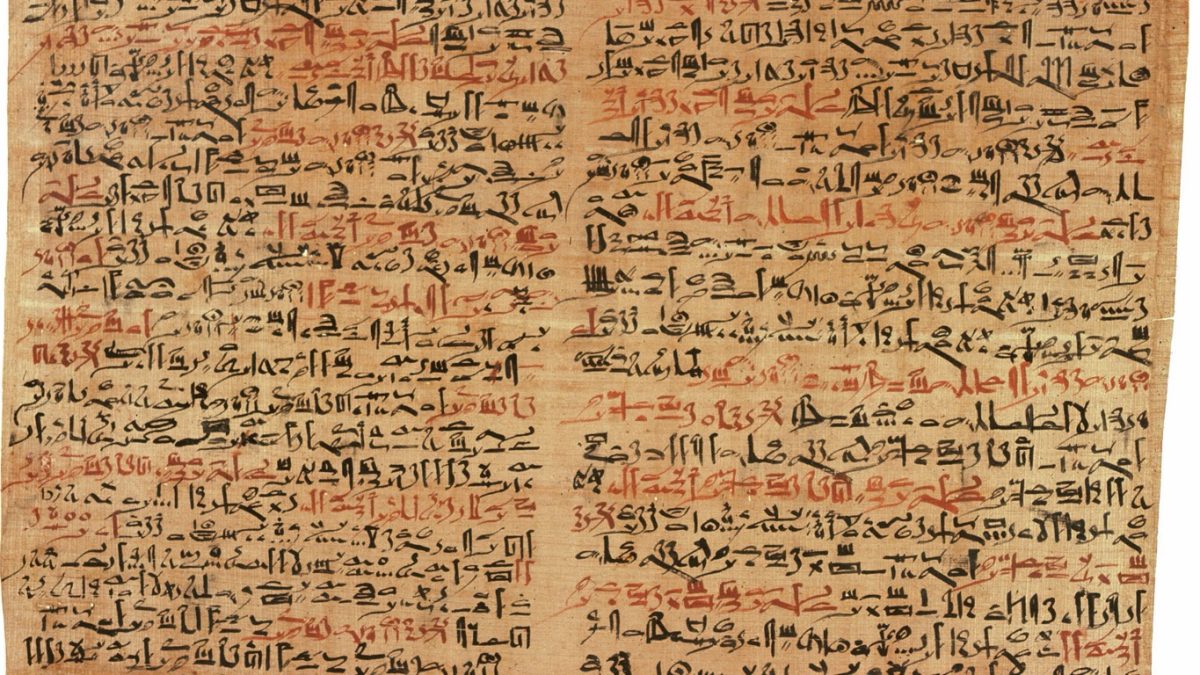
Purchased in Luxor in 1862 by American Egyptologist Edwin Smith, a 4.68-meter hieratic papyrus scroll dating to the Seventeenth Dynasty (c. 1600 BCE)—likely copied from Old Kingdom texts authored by legendary physician-architect Imhotep (c. 2700 BCE)—contains forty-eight clinical trauma cases organized methodically from head to toe.
In Case 6, describing an open comminuted fracture of the skull, the author records the earliest known observation of human cerebral anatomy:
“If thou examinest a man having a gaping wound in his head, penetrating to the bone, smashing his skull, and rending open the brain of his skull… thou shouldst find those corrugations which form in molten copper, and something therein throbbing and fluttering under thy fingers, like the weak place of an infant’s crown before it is knit.”
Here, the ancient Egyptian physician recognized the meninges, the pulsating cerebrovascular blood flow, the cranial sutures, and the corrugated convolutions of the cerebral gyri. Yet culturally, the Egyptians remained fiercely cardiocentric: during mummification, the heart was meticulously preserved in the thorax to be weighed against the feather of Ma’at in the underworld, while the brain was liquefied with bronze hooks through the nostrils and discarded as useless cranial mucus.
The Classical Greek Schism: Heart versus Brain
In Classical Greece, the localization of the soul ignited a philosophical war that lasted two thousand years:
- Alcmaeon of Croton (c. 500 BCE): Dissecting animal optic nerves, Alcmaeon boldly proposed the cephalocentric hypothesis: the brain is the central seat of sensory synthesis (sensorium commune) and intellect.
- Hippocrates of Kos (c. 460–370 BCE): In his treatise On the Sacred Disease (epilepsy), Hippocrates demolished mystical explanations of seizures: “Men ought to know that from nothing else but the brain come joys, delights, laughter and sports, and sorrows, griefs, despondency, and lamentations… by the same organ we become mad and delirious.”
- Aristotle (384–322 BCE): Contradicting his predecessor, Aristotle placed the seat of intellect (psyche) firmly in the warm, responsive heart. The cold, bloodless brain, Aristotle reasoned, was merely a secondary sponge-like radiator designed to condense the heated vapors rising from the cardiovascular furnace!
Galen of Pergamon and the Ventricular Doctrine
The cephalocentric view triumphed empirically in the second century CE through the anatomist Galen of Pergamon (129–216 CE). Serving as physician to the gladiators of Pergamon and court physician to Roman Emperor Marcus Aurelius, Galen observed that severing the recurrent laryngeal nerve abolished a pig’s squeal without touching its heart, and pressing directly on the exposed cerebrum induced immediate stupor.
Galen synthesized animal anatomy into the Ventricular Doctrine: vital spirits (pneuma zotikon) generated in the heart were pumped to the base of the brain (the rete mirabile), where they were refined into subtle animal spirits (pneuma psychikon). These psychic vapors filled the fluid-filled cerebral ventricles, flowing through hollow nerves to inflate muscles and carry sensory impressions. While anatomically flawed, Galen cemented the brain as the undisputed sovereign organ of human consciousness for the next millennium and a half.