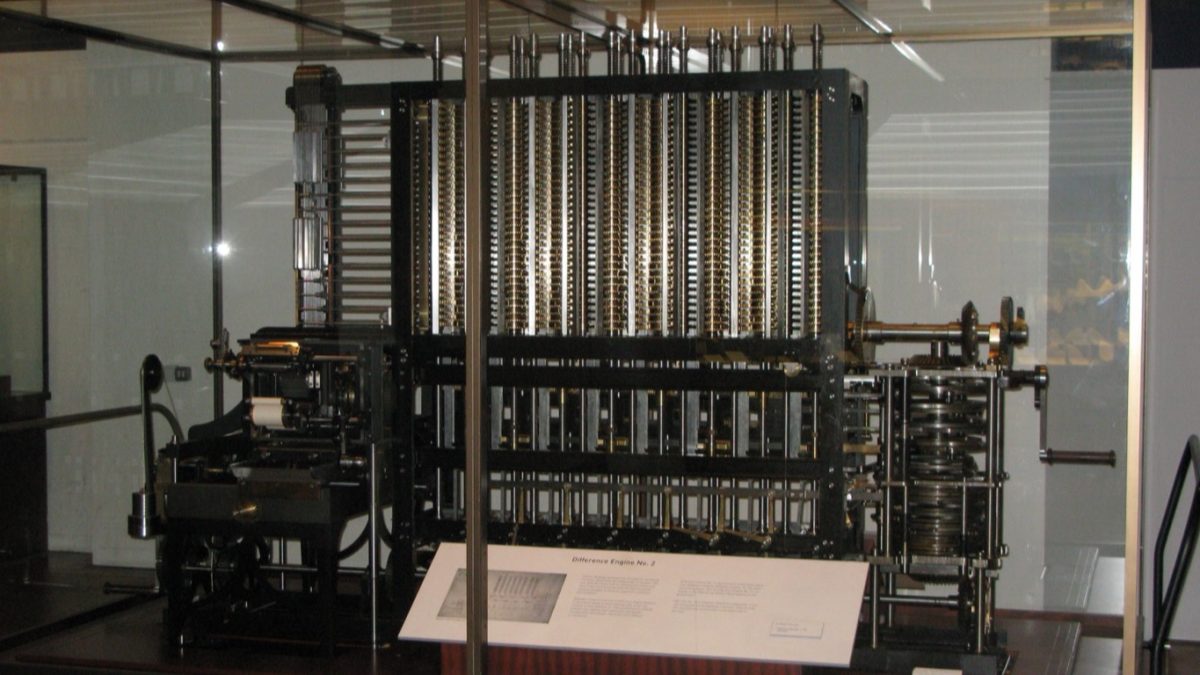
In the soot-choked London of the Industrial Revolution, mathematician Charles Babbage and visionary analyst Ada Lovelace conceived a steam-powered calculating colossus that anticipated the architecture of modern digital computers by more than a century. Babbage saw brass gears capable of banishing human error from navigation tables; Lovelace saw something infinitely grander: a machine capable of weaving symbolic patterns, composing music, and giving birth to software.
1. The Crisis of the Mathematical Tables
In early 19th-century Britain, maritime navigation, artillery ballistics, astronomy, and actuarial insurance rested entirely upon printed mathematical tables: logarithms, sines, tangents, and gravitational ephemerides. These tables were computed manually by human clerks designated by their job title: “computers”.
Human computers made catastrophic errors. A single misplaced digit in a lunar distance table could ground a Royal Navy galleon on submerged reefs. In 1821, while checking tables with astronomer John Herschel, an exasperated Babbage famously exclaimed: “I wish to God these calculations had been executed by steam!”
2. The Difference Engine: Polynomials in Brass
To eliminate human error, Babbage designed the Difference Engine. Rather than performing arbitrary multiplication or division, the Difference Engine computed polynomial functions using the method of finite differences. By evaluating differences between successive terms, any continuous function approximated by a Taylor series could be computed entirely through repeated addition:
$$P(x) = a_n x^n + a_{n-1} x^{n-1} + \dots + a_1 x + a_0 \implies \Delta^n P(x) = \text{Constant}$$Consider the simple quadratic polynomial $f(x) = 2x^2 + 3$:
| $x$ | $f(x)$ | First Difference $\Delta_1$ | Second Difference $\Delta_2$ (Constant) |
|---|---|---|---|
| 1 | 5 | — | — |
| 2 | 11 | 6 | — |
| 3 | 21 | 10 | 4 |
| 4 | 35 | 14 | 4 |
| 5 | 53 | 18 | 4 |
Because the second difference is invariant ($\Delta_2 = 4$), computing successive values required zero multiplication: each step simply added the constant difference to $\Delta_1$, and $\Delta_1$ to $f(x)$. Babbage mechanized this with vertical stacks of rotating toothed wheels. Furthermore, to eliminate human transcription errors, Babbage incorporated an automated typesetting mechanism that pressed the resulting numbers directly into soft copper plates for printing.
3. The Analytical Engine: The First General-Purpose Computer
In 1834, before Difference Engine No. 1 could be completed, Babbage had a profound realization. Instead of building a specialized machine locked into calculating one specific difference equation, he could build a universal, programmable engine. He called it the Analytical Engine.
The Analytical Engine was the direct intellectual ancestor of the modern computer. Babbage separated the machine into distinct functional components that map perfectly to the 1945 Von Neumann architecture:
- The Store (Memory): A column of 1,000 vertical brass shafts capable of holding 1,000 numbers of 50 decimal digits each.
- The Mill (CPU / ALU): A massive central apparatus of bevel gears and barrel controllers capable of performing the four arithmetic operations under mechanical logic.
- The Control Mechanism: Borrowed from Joseph Marie Jacquard’s automated textile loom, the Engine read strings of punched cards: Operation Cards (specifying $+$, $-$, $\times$, $\div$) and Variable Cards (specifying which memory registers to fetch from and write to).
- Conditional Branching: The Mill possessed a sensing lever linked to the sign of the accumulator. If a subtraction yielded a negative result, the engine tripped a carriage to jump forward or backward in the punched card sequence—the mechanical invention of the
IF...THENconditional loop.
4. Ada Lovelace and the Birth of Computer Programming
In 1842, Italian military engineer Luigi Menabrea attended Babbage’s lectures in Turin and published a French paper describing the Analytical Engine. Augusta Ada King, Countess of Lovelace (the daughter of Romantic poet Lord Byron and mathematically trained Anne Isabella Milbanke), undertook the translation of Menabrea’s paper into English.
Encouraged by Babbage, Lovelace appended seven extensive personal essays—titled simply Notes A through G—which tripled the length of the original publication. Published in 1843 under the initials “A.A.L.”, these notes established Lovelace as the world’s first computer programmer.
Note G: The Bernoulli Algorithm
In Note G, Lovelace designed an algorithm to calculate Bernoulli numbers ($B_n$), an important sequence of rational numbers appearing in the Taylor expansion of trigonometric and hyperbolic functions:
$$\frac{x}{e^x – 1} = \sum_{n=0}^{\infty} B_n \frac{x^n}{n!}$$Lovelace developed an iterative recurrence formula, mapped it onto the physical registers of the Analytical Engine, and published a complete trace table showing the exact operational steps, variable assignments, and loop iterations:
“` Lovelace’s Execution Trace for Bernoulli Numbers: Step 1: Set Variables (V1 = 1, V2 = 2, V3 = n) Step 2: Mill computes (2n – 1) / (2n + 1) Step 3: Operation Card shifts punched sequence Step 4: Check conditional branch (V3 == 0 ?) Step 5: Write intermediate product into Store register V7 “`This was not a theoretical musing; it was an authentic, working computer program with variables, arithmetic logic, and control loops designed for a physical machine.
The Poetic Science: Beyond Calculation to Software
Lovelace’s most profound insight transcended Babbage’s own understanding. While Babbage viewed his engine strictly as a machine for calculating numbers, Lovelace recognized that the engine operated on symbols:
“The Analytical Engine,” Lovelace wrote, “weaves algebraical patterns just as the Jacquard-loom weaves flowers and leaves… Supposing, for instance, that the fundamental relations of pitched sounds in the science of harmony and of musical composition were susceptible of such expression and adaptations, the engine might compose elaborate and scientific pieces of music of any degree of complexity or extent.”
Here was the conceptual leap from a calculator to a general-purpose computer: the realization that any abstract domain—whether music, logic, language, or graphics—can be encoded as symbols and manipulated algorithmically.
Primary Academic References
- Babbage, C. (1864). Passages from the Life of a Philosopher. Longman, Green, Longman, Roberts, & Green, London.
- Lovelace, A. A. (1843). Sketch of the Analytical Engine Invented by Charles Babbage, by L. F. Menabrea, with notes upon the Memoir by the Translator. Taylor’s Scientific Memoirs, 3, 666–731.
- Swade, D. (2000). The Cogwheel Brain: Charles Babbage and the Quest to Think. Little, Brown.
- Fuegi, J., & Francis, J. (2003). Lovelace & Babbage and the creation of the 1843 ‘notes’. IEEE Annals of the History of Computing, 25(4), 16–26.