Before the winter of 1943, computing machines moved at the sluggish speed of mechanical brass and electromechanical relays. The existential desperation of total warfare shattered that barrier. In the top-secret huts of Bletchley Park and the cavernous basement of the University of Pennsylvania, engineers harnessed the near-instantaneous flight of electrons through glowing vacuum tubes, giving birth to the electronic digital age.
1. The Cryptanalytic Crisis: Breaking the Tunny Cipher
While Alan Turing’s electromechanical Bombe cracked the German military Enigma cipher, an even more formidable cipher machine guarded the high-command communications between Adolf Hitler and his field marshals: the Lorenz SZ40/42 (codenamed “Tunny” by British intelligence). Unlike Enigma’s three or four rotors, Lorenz employed twelve pin-wheels operating on 5-bit Baudot teleprinter code, generating $10^{131}$ possible cryptographic keys.
Breaking Tunny required comparing intercepted ciphertext streams against simulated pseudo-random wheel patterns at staggering speeds. Max Newman’s mathematical section constructed an electromechanical reader nicknamed the “Heath Robinson,” which read two loops of paper tape simultaneously using optical photocells at 2,000 characters per second. But the paper tapes stretched, tore, and fell out of synchronization under mechanical stress.
2. Tommy Flowers and Colossus: The First Electronic Computer
British Post Office telecommunications engineer Thomas “Tommy” Flowers proposed an audacious solution that conventional military engineers dismissed as impossible: eliminate one paper tape entirely and generate the German rotor permutations electronically using an array of thermionic valves (vacuum tubes).
Flowers built Colossus Mark 1 in just eleven months at the Post Office Research Station at Dollis Hill. Operational at Bletchley Park in February 1944, Colossus was the world’s first programmable electronic digital computer:
- Electronic Switching Speed: Contained 1,500 vacuum tubes (expanded to 2,400 tubes in Colossus Mark 2), performing Boolean logic operations at 5,000 characters per second.
- Optical Papertape Reader: Read punched ciphertext tape at 30 miles per hour (5,000 characters/sec) using an optical beam focused on five photocells.
- Parallel Processing: Colossus Mark 2 incorporated a 5-way parallel shift register, achieving an effective processing throughput of 25,000 characters per second.
- Programmability: Reconfigured for different cryptanalytic attacks via patch cords, telephone jack plugs, and banks of selector switches.
Colossus deciphered the highest-level German military teleprinter messages, confirming to General Dwight D. Eisenhower that Hitler expected the Allied invasion at Pas-de-Calais rather than Normandy, ensuring the success of D-Day. Because of extreme wartime secrecy, Churchill ordered all Colossus machines dismantled into scrap iron after the war, obscuring Flowers’s historic priority for over three decades.
3. Mauchly, Eckert, and the Genesis of ENIAC
Across the Atlantic, the United States Army faced a desperate ballistics crisis. The Ballistic Research Laboratory (BRL) at Aberdeen Proving Ground had to calculate firing tables for new artillery guns deployed across desert sands, muddy trenches, and sub-zero mountains. Computing a single 60-second artillery shell trajectory required over 750 individual multiplications, consuming 20 hours of manual labor by human computers using desk calculators.
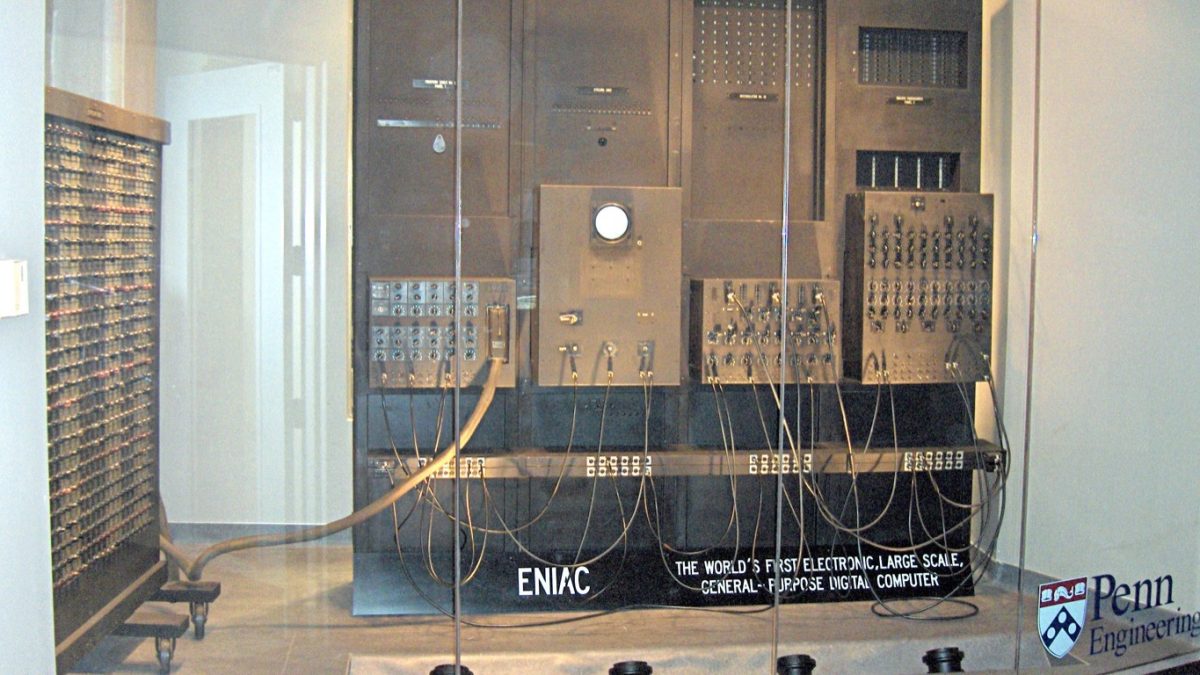
Physicist John Mauchly and electrical engineer J. Presper Eckert Jr. at the Moore School of Electrical Engineering proposed constructing an all-electronic calculating behemoth: the ENIAC (Electronic Numerical Integrator and Computer). Funded under Army contract in June 1943, ENIAC was a triumph of brute-force vacuum-tube engineering.
| Specification Metric | ENIAC Technical Parameters |
|---|---|
| Thermionic Vacuum Tubes | 17,468 dual-triodes and pentodes |
| Crystal Diodes & Relays | 7,200 crystal diodes, 1,500 relays, 70,000 resistors, 10,000 capacitors |
| Physical Footprint & Weight | 1,800 square feet (U-shaped room), 30 tons |
| Power Dissipation | 150 kilowatts (often rumored to dim the lights of Philadelphia) |
| Clock Rate & Speed | 100 kHz master clock (10-phase cycling unit); 5,000 additions per second |
| Decimal Accumulators | 20 ten-digit decimal accumulators using 10-stage electronic ring counters |
The Physics of Tube Reliability
Critics had predicted that with over 17,000 vacuum tubes, ENIAC would suffer a tube failure every few seconds, making continuous calculation impossible. Presper Eckert solved this with brilliant conservative electrical engineering: he operated the vacuum tubes at only 25% of their rated plate voltage and reduced filament heater currents by 10%. Under this de-rated thermal regime, tube failures dropped to less than one every two days, allowing ENIAC to execute uninterrupted runs lasting dozens of hours.
4. The ENIAC Six: The Unsung Pioneers of Programming
While Eckert and Mauchly designed the hardware, the monumental task of making ENIAC compute fell to six brilliant female mathematicians recruited from the human computing pool: Kathleen McNulty, Frances Bilas, Betty Jean Jennings, Ruth Lichterman, Elizabeth Snyder, and Marlyn Wescoff.
Because no programming languages, compilers, or operating systems existed, programming ENIAC required physically rewiring the machine. The six programmers had to study the engineering schematics, map differential equations onto the 20 accumulators, wire heavy black patch cords across trunk lines, and calibrate 3,000 function-table rotary switches:
“` ENIAC Patch-Cord Routing Trace: 1. Signal Pulse from Master Programmer triggers Trunk Line 1 2. Accumulator 1 reads initial velocity v_0 from Function Table A 3. Multiplier Unit receives drag coefficient C_d via Constant Transmitter 4. Resulting decrement wired to Accumulator 2 (Gravitational acceleration g) 5. Digit pulse emitted; triggers oscilloscope verification display “`When ENIAC was officially unveiled to the public on February 15, 1946, it calculated a complex artillery trajectory in just 20 seconds—faster than the physical shell took to fly through the air. The electronic computer had arrived.
Primary Academic References
- Flowers, T. H. (1983). The Design of Colossus. Annals of the History of Computing, 5(3), 239–252.
- Eckert, J. P., & Mauchly, J. W. (1945). The ENIAC (Electronic Numerical Integrator and Computer). Moore School of Electrical Engineering, University of Pennsylvania.
- Light, J. S. (1999). When computers were women. Technology and Culture, 40(3), 455–483.
- Copeland, B. J. (2006). Colossus: The Secrets of Bletchley Park’s Codebreaking Computers. Oxford University Press.