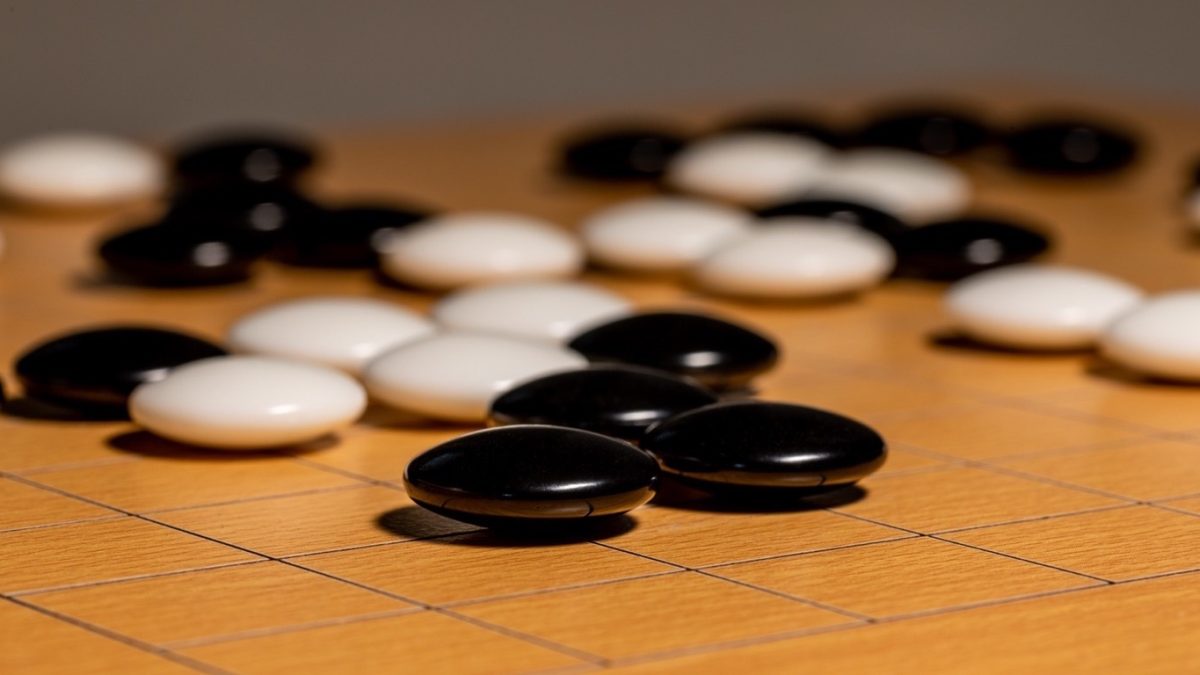
For three thousand years, the ancient East Asian game of Go was regarded as the ultimate bastion of human intuition. With more legal board configurations than there are atoms in the observable universe, Go could not be cracked by brute-force silicon calculation like Deep Blue. In March 2016, in a hotel ballroom in Seoul, an artificial intelligence developed by DeepMind named AlphaGo played a move so alien, profound, and beautiful that it fundamentally redefined humanity’s understanding of strategic creativity.
1. The Reinforcement Learning Paradigm
While supervised deep learning trains models to predict labels from human-curated datasets, Reinforcement Learning (RL) mimics how biological organisms learn: through autonomous trial, error, and delayed reward. Formalized by Richard Sutton and Andrew Barto, RL models an agent interacting with an environment across discrete time steps $t$ within a Markov Decision Process (MDP) defined by the 5-tuple $\langle \mathcal{S}, \mathcal{A}, \mathcal{P}, \mathcal{R}, \gamma \rangle$.
The agent seeks to maximize the expected cumulative discounted future return $G_t = \sum_{k=0}^{\infty} \gamma^k R_{t+k+1}$, governed by the foundational Bellman Optimality Equation:
$$Q^*(s, a) = \mathbb{E} \left[ R_{t+1} + \gamma \max_{a’} Q^*(S_{t+1}, a’) \;\middle|\; S_t = s, A_t = a \right]$$Deep Q-Networks (DQN): Raw Pixels to Mastery (2013–2015)
In 2013, a London startup founded by Demis Hassabis, Shane Legg, and Mustafa Suleyman—DeepMind Technologies—achieved an extraordinary breakthrough published on the cover of Nature in 2015: Human-level control through deep reinforcement learning.
DeepMind constructed the Deep Q-Network (DQN), an end-to-end convolutional neural network that learned to play 49 vintage Atari 2600 video games (such as Breakout, Space Invaders, and Pong) directly from raw $84 \times 84$ screen pixels and game scores, without access to internal game rules. To overcome the fatal instability of combining non-linear deep networks with reinforcement learning, DeepMind introduced two architectural techniques:
- Experience Replay: Storing state transitions $e_t = (s_t, a_t, r_t, s_{t+1})$ in a massive cyclic replay buffer $\mathcal{D}$ and sampling random mini-batches for training, breaking catastrophic temporal correlations between consecutive video frames.
- Target Network: Maintaining a separate, slowly updated parameter set $\theta^-$ to compute target $Q$-values, preventing destabilizing feedback loops between the current estimate and the objective.
2. The Fortress of Go
Unlike chess—which has an average branching factor of $b \approx 35$ and games lasting ~80 plies—the game of Go is played on a massive $19 \times 19$ grid. Go exhibits an average branching factor of $b \approx 250$ and lasts over 150 moves. The total search tree size exceeds $10^{360}$ states—a combinatorial expanse so vast that evaluating game trees by brute force is physically impossible.
Human Go masters relied upon “gam” (aesthetic intuition)—an instinctive, visual feeling for territorial balance and stone harmony honed over decades of monastic study. Mainstream AI researchers predicted that a computer would not defeat a human 9-dan professional for at least another two to three decades.
3. The Architecture of AlphaGo
Led by David Silver and Demis Hassabis, DeepMind conquered Go not by calculating all possible moves, but by synthesizing deep neural networks with Monte Carlo Tree Search (MCTS):
- Policy Network ($p_\sigma, p_\rho$): A 13-layer deep convolutional network that looked at the $19 \times 19$ board and generated a probability distribution over legal moves: $P(a \mid s)$. It narrowed the search tree width from 250 branches down to a handful of human-like moves.
- Value Network ($v_\theta$): A deep convolutional network that evaluated board positions directly, outputting a scalar prediction $V(s) \in [-1, +1]$ of the winning probability from that state, dramatically pruning search depth.
- Self-Play Reinforcement Learning: After pre-training on 30 million moves from human expert games, AlphaGo played millions of games against cloned versions of itself, updating policy weights via policy gradients: $\Delta \theta \propto \nabla_\theta \log p_\theta(a \mid s) (z – v(s))$.
During live play, MCTS simulated thousands of prospective games by balancing the Policy network prior with the Value network static evaluation, guided by the Upper Confidence Bound for Trees (PUCT):
$$a_t = \arg\max_{a} \left( Q(s_t, a) + u(s_t, a) \right), \quad u(s, a) = c_{puct} P(s, a) \frac{\sqrt{\sum_b N(s, b)}}{1 + N(s, a)}$$4. The Seoul Match and Move 37
In March 2016, AlphaGo faced legendary 18-time world champion Lee Sedol in a five-game match at the Four Seasons Hotel in Seoul, South Korea, broadcast live to hundreds of millions worldwide.
Move 37: The Ghost in the Machine
The turning point of artificial intelligence history arrived during Game 2 on March 10, 2016. On move 37, playing with black, AlphaGo spent an agonizing minute calculating before placing a stone on the fifth line: Move 37.
Commentators gasped in disbelief. In classical Go theory, placing a stone on the fifth line early in the opening is considered a fatal beginner blunder. Lee Sedol stared at the board in shock, stood up, and left the room to compose himself. AlphaGo had calculated that human Go players would play that move with a probability of less than 1 in 10,000. It had discovered an entirely new strategic paradigm: sacrificing local edge territory to dominate global influence across the center of the board.
AlphaGo won Game 2, went on to win the match 4–1, and was awarded an honorary 9-dan professional certificate by the Korean Baduk Association. In 2017, DeepMind unveiled AlphaGo Zero, which learned entirely *tabula rasa*—starting with zero human knowledge, knowing only the basic rules of the game. In just 40 days of self-play on 4 Google TPUs, AlphaGo Zero surpassed all previous versions, defeating the original AlphaGo 100 games to zero. The age of machine intuition was born.
Primary Academic References
- Mnih, V., et al. (2015). Human-level control through deep reinforcement learning. Nature, 518(7540), 529–533.
- Silver, D., et al. (2016). Mastering the game of Go with deep neural networks and tree search. Nature, 529(7587), 484–489.
- Silver, D., et al. (2017). Mastering the game of Go without human knowledge. Nature, 550(7676), 354–359.
- Sutton, R. S., & Barto, A. G. (2018). Reinforcement Learning: An Introduction. MIT Press.