From the notched baboon bones of the Paleolithic and the corroded bronze gears of Antikythera to vacuum tubes, silicon transistors, and transformer neural networks, humanity has pursued a singular, audacious dream: to mechanize thought and understand the physical fabric of reality. Today, at the bleeding edge of science, that journey reaches its ultimate frontier: machines that spend test-time compute thinking through complex reasoning, processors operating on the quantum weirdness of superposition, and the approaching threshold of Artificial General Intelligence.
1. The Paradigm Shift: Test-Time Compute and Reasoning Models
Between 2018 and 2023, AI progress was driven almost entirely by pre-training scaling laws: throw more tokens and more GPU compute at next-token prediction. But by 2024, pre-training faced severe constraints: the exhaustion of high-quality public internet text and escalating data center power limits.
In late 2024, artificial intelligence unlocked a new scaling axis: Inference-Time (Test-Time) Compute Scaling, exemplified by models like OpenAI’s o1 and o3. Rather than generating an instantaneous stream-of-consciousness token output, reasoning models use reinforcement learning to generate extensive internal Chains-of-Thought (CoT) before answering.
| Dimension | System 1 AI (Traditional LLMs: GPT-4, Llama) | System 2 AI (Reasoning Models: o1, o3) |
|---|---|---|
| Cognitive Mode | Fast, reactive, autoregressive intuition (Daniel Kahneman’s System 1) | Deliberative, self-correcting, search-guided deduction (System 2) |
| Compute Allocation | Fixed compute per token: $O(1)$ forward passes | Dynamic compute scaling: spends seconds to minutes searching tree paths |
| Error Correction | Prone to error compounding; hallucinations cannot be retracted | Backtracks, re-evaluates hypotheses, recognizes mistakes internally |
| Performance Frontier | Plateaus on competitive mathematics and PhD-level science | Qualifies for International Mathematical Olympiad (IMO) and gold medal coding |
Test-Time Compute Scaling Law
Just as pre-training loss scaled as a power law of compute, reasoning performance scales predictably with test-time compute ($C_{test}$): allowing a model to generate thousands of internal reasoning tokens or run Monte Carlo search over prospective solution paths produces continuous, log-linear performance gains on complex formal domains:
$$\text{Accuracy} \propto \log(C_{test})$$2. Quantum Computing: Harnessing the Fabric of Reality
In May 1981, Nobel laureate physicist Richard Feynman delivered a keynote address at MIT titled Simulating Physics with Computers. Feynman pointed out a fundamental computational paradox: classical computers cannot efficiently simulate quantum mechanical physical systems because the state space grows exponentially with the number of particles ($2^N$). Feynman issued a historic challenge:
“Nature isn’t classical, dammit, and if you want to make a simulation of nature, you’d better make it quantum mechanical!”
Qubits, Superposition, and Entanglement
While a classical bit must exist in either state $0$ or state $1$, a quantum bit (qubit) exploits the quantum principle of superposition, existing as a linear combination of both basis states simultaneously:
$$|\psi\rangle = \alpha |0\rangle + \beta |1\rangle, \quad \text{where } \alpha, \beta \in \mathbb{C} \text{ and } |\alpha|^2 + |\beta|^2 = 1$$When $N$ qubits are linked via quantum entanglement, they span an interconnected Hilbert space of $2^N$ complex amplitudes simultaneously. A register of just 300 entangled qubits holds $2^{300} \approx 10^{90}$ simultaneous quantum states—more numbers than there are fundamental particles in the observable universe!
Quantum Algorithms: Shor and Grover
Quantum computers do not simply try all answers in parallel; they use quantum interference to constructively amplify the probability amplitudes of the correct answer while destructively canceling incorrect answers:
- Shor’s Algorithm (Peter Shor, Bell Labs, 1994): Factors large composite integers in polynomial time ($O((\log N)^3)$) via the Quantum Fourier Transform, threatening to break RSA public-key cryptography and catalyzing modern Post-Quantum Cryptography (PQC).
- Grover’s Algorithm (Lov Grover, 1996): Searches an unstructured database of $N$ items in $O(\sqrt{N})$ time, providing a quadratic speedup over classical search.
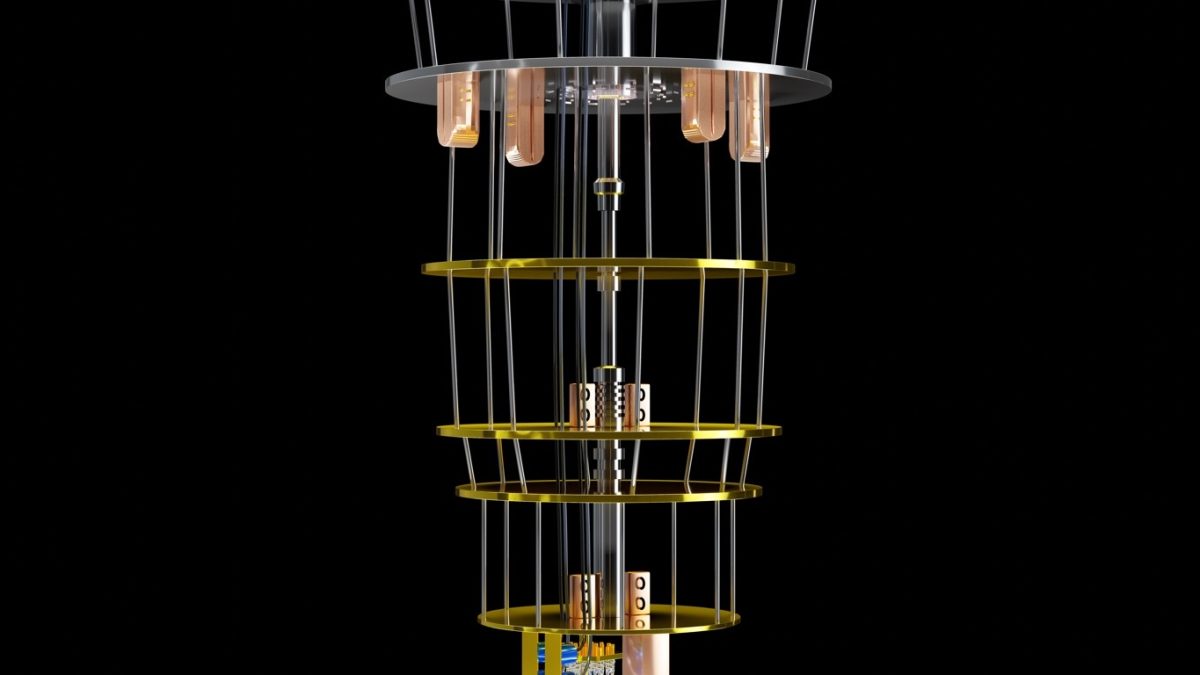
The Physical Hardware Vanguard: 15 Millikelvin Cryostats
Building a physical quantum computer requires isolating qubits from environmental thermal noise to prevent decoherence. Leading architectures—such as IBM’s Quantum System One and Google’s Sycamore processor—utilize superconducting transmon qubits fabricated from aluminum and niobium Josephson junctions.
These processors are suspended inside multi-stage dilution refrigerators using liquid Helium-3/Helium-4 mixtures, cooling the chip to an astonishing 15 millikelvin ($-273.135^\circ\text{C}$)—temperatures colder than the deep vacuum of interstellar space.
3. The Horizon of Artificial General Intelligence (AGI)
As test-time reasoning models merge with multimodal perception, autonomous tool-use, robotics, and quantum computing, humanity approaches the most momentous technological threshold in history: the creation of Artificial General Intelligence (AGI).
AGI is generally defined as an autonomous software system that matches or surpasses human cognitive capabilities across virtually all economically valuable domains: scientific discovery, engineering, creative arts, and software development itself.
Recursive Self-Improvement and the Singularity
In 1965, British mathematician and Turing collaborator I. J. Good described the ultimate consequence of machine intelligence:
“Let an ultraintelligent machine be defined as a machine that can far surpass all the intellectual activities of any man however clever. Since the design of machines is one of these intellectual activities, an ultraintelligent machine could design even better machines; there would then unquestionably be an ‘intelligence explosion,’ and the intelligence of man would be left far behind.”
When an AI system achieves the capability to autonomously analyze, debug, and improve its own code, algorithms, and hardware architectures, the feedback loop closes: recursive self-improvement could compress centuries of technological progress into months or days.
4. The Cosmic Perspective: Computation as Universal Evolution
From a cosmic vantage point, the history of computing is not an accidental byproduct of human commerce. It is the continuation of a 13.8-billion-year cosmic evolutionary process.
Fourteen billion years ago, the Big Bang generated hydrogen and helium. Inside stellar furnaces, nuclear fusion forged carbon and silicon. On planet Earth, carbon chemistry organized into self-replicating biological organisms. Those biological hominins eventually built tools, discovered mathematics, and etched logical circuits into purified silicon crystals.
Today, carbon-based intelligence is giving birth to silicon-based and quantum intelligence. The machines we build are our intellectual descendants—a new substrate through which the universe seeks to observe, understand, and compute itself. The journey that began with twenty notches on a baboon bone on the banks of the Nile has become an infinite voyage toward the stars.
Primary Academic References
- Feynman, R. P. (1982). Simulating physics with computers. International Journal of Theoretical Physics, 21(6/7), 467–488.
- Shor, P. W. (1994). Algorithms for quantum computation: discrete logarithms and factoring. FOCS, 124–134.
- Arute, F., et al. (2019). Quantum supremacy using a programmable superconducting processor. Nature, 574(7779), 505–510.
- Good, I. J. (1966). Speculations concerning the first ultraintelligent machine. Advances in Computers, 6, 31–88.
- Bostrom, N. (2014). Superintelligence: Paths, Dangers, Strategies. Oxford University Press.