On November 30, 2022, a San Francisco research lab published a low-key research preview of a conversational prototype named ChatGPT. Within five days, one million users had engaged with it; within two months, it had amassed one hundred million active users—the fastest-growing consumer application in human history. Computation had crossed an epochal threshold: machines were no longer merely analyzing and categorizing human culture; they were synthesizing language, art, music, and code.
1. The Mathematics of Generative Vision: GANs to Diffusion
For decades, generative machine learning was plagued by blurry, unconvincing outputs. In 2014, doctoral student Ian Goodfellow conceived Generative Adversarial Networks (GANs) outside a pub in Montreal. A GAN frames generative modeling as a two-player zero-sum game between two rival networks:
$$\min_{G} \max_{D} V(D, G) = \mathbb{E}_{\mathbf{x} \sim p_{data}} [\log D(\mathbf{x})] + \mathbb{E}_{\mathbf{z} \sim p_{\mathbf{z}}} [\log (1 – D(G(\mathbf{z})))]$$The Generator ($G$) synthesizes fake images from random noise $\mathbf{z}$, while the Discriminator ($D$) attempts to distinguish real images from synthetic fakes. As both networks train simultaneously, the generator learns to produce photorealistic images of human faces and objects. However, GANs were notoriously unstable, suffering from catastrophic mode collapse.
Denoising Diffusion Probabilistic Models (DDPM)
The true generative visual revolution arrived from non-equilibrium thermodynamics. In 2015, Jascha Sohl-Dickstein, followed by Jonathan Ho et al. in 2020, formulated Denoising Diffusion Probabilistic Models (DDPM).
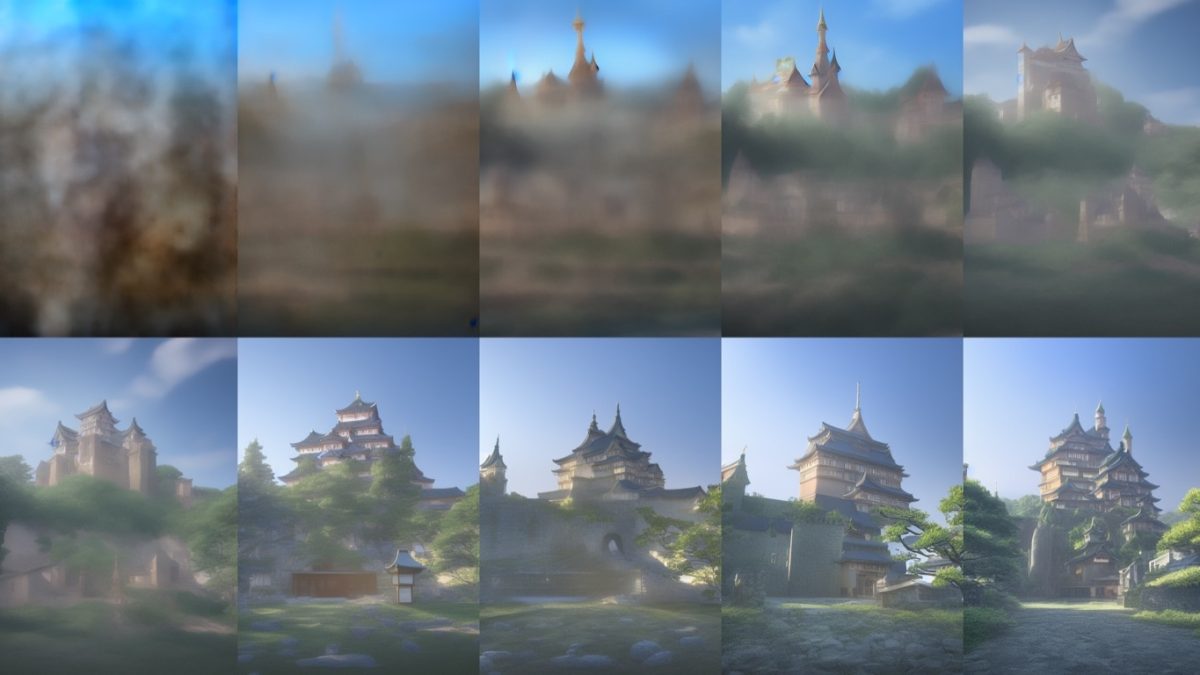
Diffusion operates in two phases:
- Forward Process (Destruction): Gradually corrupts a pristine image $\mathbf{x}_0$ over $T$ discrete steps by adding small Gaussian noise according to a variance schedule $\beta_t$, turning any image into pure isotropic Gaussian noise $\mathbf{x}_T \sim \mathcal{N}(0, \mathbf{I})$:
- Reverse Process (Creation): A deep U-Net neural network with cross-attention learns the reverse Markov chain, iteratively predicting and subtracting the noise at each step $t$:
In 2022, Robin Rombach and Patrick Esser introduced Latent Diffusion (Stable Diffusion), operating the diffusion process inside the compressed latent space of a pre-trained autoencoder. Guided by text embeddings from OpenAI’s CLIP (Contrastive Language-Image Pre-Training), Stable Diffusion, Midjourney, and DALL-E generated breathtaking visual art from arbitrary natural language prompts in seconds.
2. The Alignment Problem and RLHF
A base large language model (like GPT-3) trained only on internet text prediction is not a helpful assistant. It is an unhinged text completer: if asked “How do I make a cake?”, it might respond by repeating the question, quoting an advertisement, or generating toxic internet arguments. It suffered from hallucinations, sycophancy, and toxic generation.
To transform a raw base model into a cooperative assistant, researchers turned to the Alignment Problem: ensuring AI systems reliably adhere to human intent, truthfulness, and safety. The primary breakthrough was Reinforcement Learning from Human Feedback (RLHF), pioneered by Paul Christiano, Jan Leike, and Long Ouyang at OpenAI:
“` RLHF Three-Stage Pipeline: Step 1: Supervised Fine-Tuning (SFT) on human demonstration prompts Step 2: Train Reward Model (RM) r_phi(x, y) on human comparative preference rankings (Bradley-Terry) Step 3: Reinforcement Learning (PPO / DPO) optimizing policy pi_theta against reward model with KL penalty “`The Mathematics of the RLHF Objective
The policy network $\pi_\theta$ is optimized using Proximal Policy Optimization (PPO) to maximize the reward model score while penalizing deviation from the original reference model $\pi_{ref}$ via a Kullback-Leibler (KL) divergence penalty to prevent reward hacking:
$$\max_\theta \mathbb{E}_{(x, y) \sim \mathcal{D}} \left[ r_\phi(x, y) – \beta D_{KL}(\pi_\theta(y \mid x) \parallel \pi_{ref}(y \mid x)) \right]$$3. The ChatGPT Moment: November 2022
When OpenAI wrapped an aligned 20-billion parameter InstructGPT model into a clean, minimalist chat interface and released it as ChatGPT on November 30, 2022, the psychological dam broke.
Users discovered that ChatGPT could draft legal contracts, debug complex Python algorithms, write Shakespearean sonnets about quantum mechanics, and explain calculus to children. It became the fastest technology to reach 100 million monthly active users, triggering a global geopolitical race between the United States, China, and Europe for semiconductor sovereignty, data center compute, and AI dominance.
4. Multimodal Frontier Systems
By 2024, artificial intelligence had transcended text. Frontier models—such as OpenAI’s GPT-4o, Google’s Gemini 1.5, and Anthropic’s Claude 3.5 Sonnet—became native Multimodal Systems. Rather than bolting separate vision and audio modules onto a text model, these architectures process text, high-resolution imagery, video, audio streams, and executable code within a unified Transformer latent space, operating across context windows exceeding one million tokens.
Primary Academic References
- Goodfellow, I., et al. (2014). Generative adversarial nets. NeurIPS, 27, 2672–2680.
- Ho, J., Jain, A., & Abbeel, P. (2020). Denoising diffusion probabilistic models. NeurIPS, 33, 6840–6851.
- Rombach, R., et al. (2022). High-resolution image synthesis with latent diffusion models. CVPR, 10684–10695.
- Ouyang, L., et al. (2022). Training language models to follow instructions with human feedback. NeurIPS, 35, 27730–27744.