While Deutsch-Jozsa demonstrated an exponential separation between quantum computing and deterministic classical algorithms, classical computers using randomized sampling (bounded-error BPP) can solve Deutsch-Jozsa with high probability in just a few queries. In 1994, Daniel Simon published an algorithm that closed this loophole forever. Simon’s Algorithm was the first to establish a rigorous, provable exponential speedup over all classical algorithms, including randomized BPP. Simon’s mathematical formulation—sampling orthogonal linear equations over the group $(mathbb{Z}_2)^n$—served as the direct intellectual catalyst that inspired Peter Shor just months later to develop his world-changing factoring algorithm.
1. Simon’s Hidden Periodicity Problem
We are given an unknown oracle function $f: {0, 1}^n to {0, 1}^n$ with a guaranteed 2-to-1 structural symmetry. There exists a secret non-zero bitstring $s in {0, 1}^n$ such that for any inputs $x, y$:
$$f(x) = f(y) iff x oplus y in {0^n, s} iff y = x oplus s$$
Every output value corresponds to exactly two inputs separated by bitwise XOR addition with the secret mask $s$. The objective is to determine the secret string $s$.
The Classical Complexity Bound: The Birthday Paradox
A classical algorithm can learn $s$ only by discovering a collision: two distinct queries $x$ and $y$ that yield identical outputs $f(x) = f(y)$, whereupon $s = x oplus y$. By the classical Birthday Paradox, selecting random queries from an output space of size $2^n$ requires querying at least:
$$Q_{text{classical}} = Omegaleft(2^{n/2}right) quad text{queries}$$
Even with randomized probabilistic guessing, finding a 128-bit secret $s$ classically requires $approx 2^{64} approx 1.8 times 10^{19}$ function evaluations.
2. Simon’s Quantum Subroutine Architecture
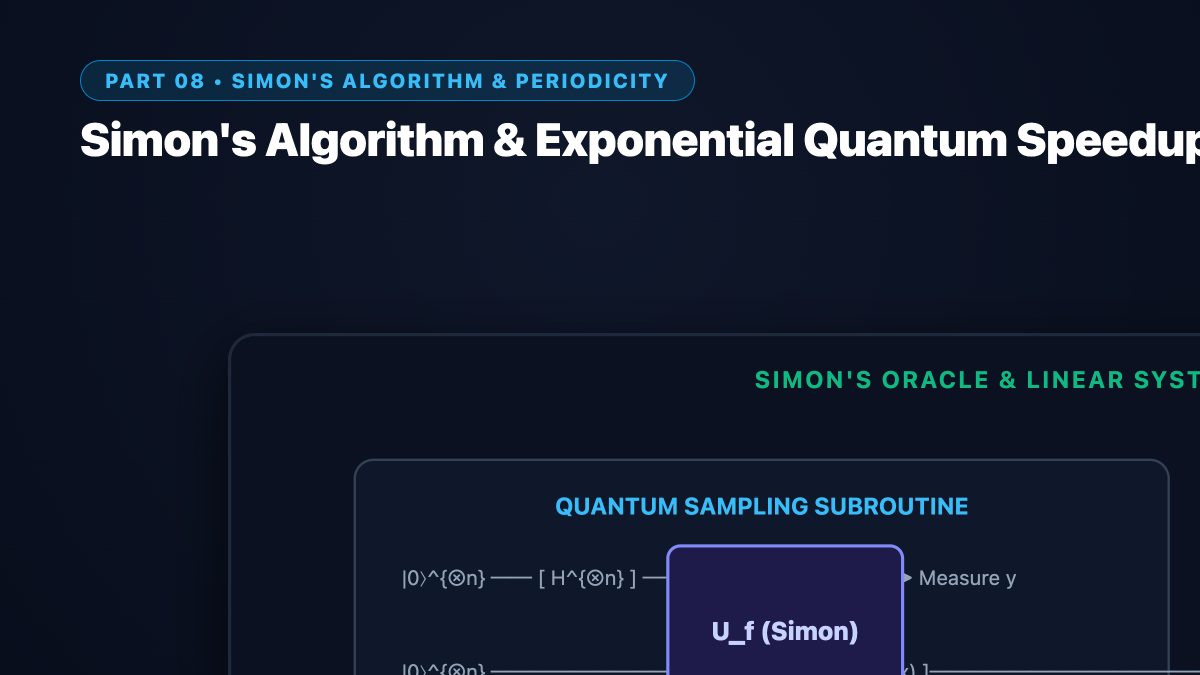
Simon’s algorithm uses two $n$-qubit registers initialized to $|0rangle^{otimes n}|0rangle^{otimes n}$ and executes the following protocol:
- Hadamard Superposition: Apply $H^{otimes n}$ to the first register:
$$|psi_1rangle = frac{1}{sqrt{2^n}}sum_{x in {0,1}^n} |xrangle |0rangle^{otimes n}$$ - Oracle Evaluation: Query the unitary oracle $U_f |xrangle |0rangle = |xrangle |f(x)rangle$:
$$|psi_2rangle = frac{1}{sqrt{2^n}}sum_{x in {0,1}^n} |xrangle |f(x)rangle$$ - Measurement of Register 2: Measuring the second register yields some random output value $f(x_0)$. By the 2-to-1 property of $f$, this measurement collapses the first register onto an entangled superposition of exactly the two pre-images that map to $f(x_0)$:
$$|psi_3rangle = frac{|x_0rangle + |x_0 oplus srangle}{sqrt{2}}$$ - Second Hadamard Transform: Apply $H^{otimes n}$ to the first register:
$$|psi_4rangle = frac{1}{sqrt{2}} left( frac{1}{sqrt{2^n}}sum_y (-1)^{x_0 cdot y} |yrangle + frac{1}{sqrt{2^n}}sum_y (-1)^{(x_0 oplus s) cdot y} |yrangle right) = frac{1}{sqrt{2^{n+1}}} sum_{y in {0,1}^n} (-1)^{x_0 cdot y} left( 1 + (-1)^{s cdot y} right) |yrangle$$
3. Quantum Interference & The Orthogonality Invariant
Examine the interference factor in the sum: $left( 1 + (-1)^{s cdot y} right)$:
- If $s cdot y equiv 1 pmod 2 implies 1 + (-1)^1 = 0$ (Destructive Interference). The probability of observing such a $y$ is strictly zero.
- If $s cdot y equiv 0 pmod 2 implies 1 + (-1)^0 = 2$ (Constructive Interference).
Therefore, measuring the first register yields a bitstring $y in {0, 1}^n$ drawn uniformly at random from the set of all vectors that are orthogonal to the secret $s$ over the finite field $text{GF}(2)$:
$$y cdot s = y_1 s_1 oplus y_2 s_2 oplus dots oplus y_n s_n = 0 pmod 2$$
4. Classical Post-Processing via Gaussian Elimination
A single run of Simon’s quantum subroutine provides one linear equation: $y^{(1)} cdot s = 0$. To solve for all $n$ bits of $s$, we need $n – 1$ linearly independent vectors.
Each independent run of the quantum circuit produces a new random vector $y$. Probability theory guarantees that with probability exceeding $1 – 2^{-k}$, running the quantum circuit:
$$M = n + k quad text{times} quad (text{e.g. } n + 20 text{ iterations})$$
yields a system of $n-1$ linearly independent equations in $n$ unknowns. The classical computer then executes standard Gaussian Elimination over $text{GF}(2)$ in:
$$mathcal{O}(n^3) quad text{classical operations}$$
yielding the unique non-trivial solution for $s$.
5. Historical Legacy: The Bridge to Shor’s Factoring Algorithm
Simon’s algorithm demonstrated that quantum computers excel at discovering hidden periodicities in algebraic groups—in this case, the Abelian group $(mathbb{Z}_2)^n$. When Peter Shor read Simon’s paper in early 1994, he realized that the discrete Fourier transform over $mathbb{Z}_2^n$ could be generalized to the cyclic group $mathbb{Z}_N$ via the Quantum Fourier Transform, directly leading to the polynomial-time factorization of integers and the breaking of RSA encryption.