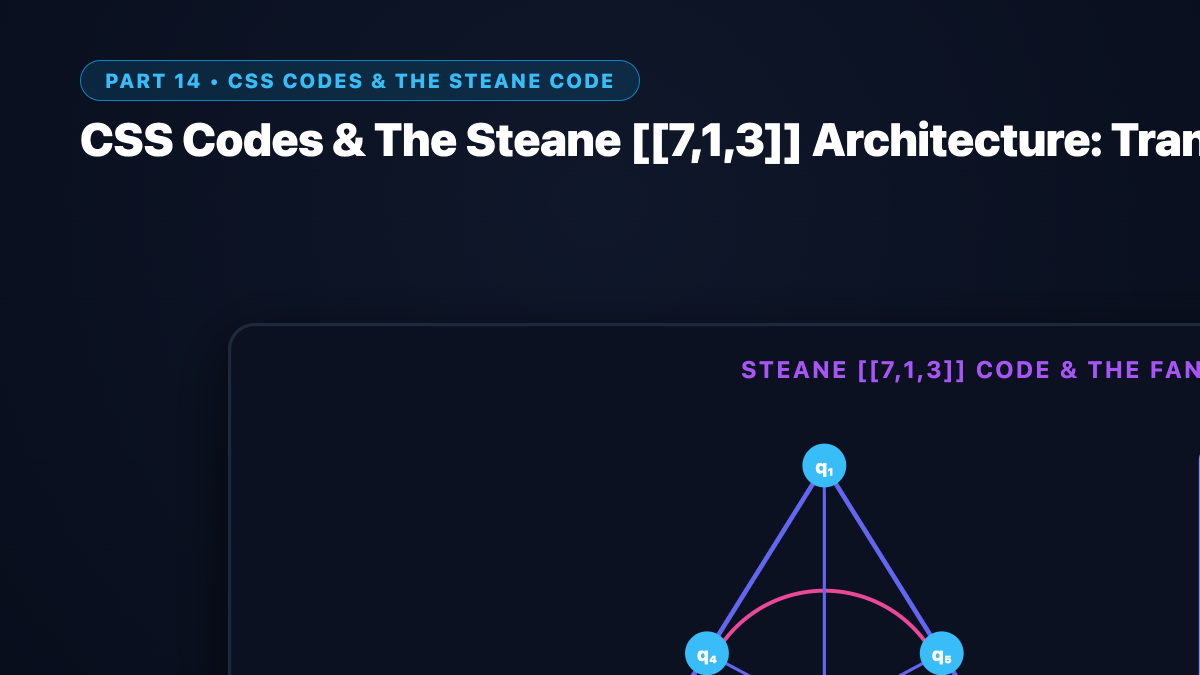
Following Shor’s 9-qubit discovery, Robert Calderbank, Peter Shor, and Andrew Steane independently formulated the CSS (Calderbank-Shor-Steane) code framework. CSS codes established a profound bridge between classical algebraic coding theory (specifically linear dual codes) and quantum error correction. The flagship CSS implementation—the Steane $[[7, 1, 3]]$ code—embeds one logical qubit into seven physical qubits, possessing the extraordinary structural property of transversal Clifford gates, which fundamentally simplifies fault-tolerant quantum logic.
1. The Algebraic Construction of CSS Codes
Let $C_1$ and $C_2$ be two classical $[n, k_1]$ and $[n, k_2]$ linear binary codes such that $C_2^perp subset C_1$, where $C_2^perp$ is the dual code of $C_2$. A CSS code constructed from $(C_1, C_2)$ encodes $k = k_1 – k_2$ logical qubits into $n$ physical qubits with code distance:
[
d ge min(d(C_1), d(C_2^perp))
]
For each codeword $w in C_1 / C_2^perp$, the logical quantum basis codeword is defined as an equal superposition over the coset of $C_2^perp$:
[
|w + C_2^perprangle = frac{1}{sqrt{|C_2^perp|}} sum_{y in C_2^perp} |w + yrangle
]
The parity check matrix $H(C_1)$ defines the $Z$-type stabilizers (detecting bit-flips $X$), while $H(C_2)$ defines the $X$-type stabilizers (detecting phase-flips $Z$). Because $C_2^perp subset C_1$, all $X$-type and $Z$-type stabilizers commute identically!
2. The Steane 7-Qubit Code: Classical Hamming Geometry
The Steane code is derived by setting both $C_1$ and $C_2$ to the classical $[7, 4, 3]$ Hamming code, which has generator and parity check matrices related by $C^perp subset C$. The parity check matrix $H$ of the $[7, 4, 3]$ Hamming code is:
[
H = begin{pmatrix}
0 & 0 & 0 & 1 & 1 & 1 & 1 \
0 & 1 & 1 & 0 & 0 & 1 & 1 \
1 & 0 & 1 & 0 & 1 & 0 & 1
end{pmatrix}
]
In the quantum $[[7, 1, 3]]$ Steane code, these three rows generate three $Z$-stabilizers and three $X$-stabilizers, totaling 6 stabilizer generators:
[
begin{aligned}
S_{Z1} &= I I I Z Z Z Z, & S_{X1} &= I I I X X X X \
S_{Z2} &= I Z Z I I Z Z, & S_{X2} &= I X X I I X X \
S_{Z3} &= Z I Z I Z I Z, & S_{X3} &= X I X I X I X
end{aligned}
]
Since each generator contains an even number of overlapping Pauli positions (specifically, $4 times 4$ overlaps with $2$ shared ones), all $S_Z$ and $S_X$ commute. With $7$ qubits and $6$ independent stabilizer generators, the code space dimension is $2^{7 – 6} = 2^1 = 2$, encoding exactly $1$ logical qubit with distance $d = 3$ (capable of correcting any arbitrary single physical qubit error).
3. Transversal Quantum Gates and Fault-Tolerance
The monumental architectural advantage of CSS codes—and the Steane code in particular—is transversality. A logical gate $U_L$ is transversal if it can be implemented as a tensor product of single-qubit physical operations on corresponding physical qubits:
[
U_L = bigotimes_{i=1}^n U_i
]
Transversal operations prevent the catastrophic propagation of hardware errors: if an error occurs on physical qubit $i$, it cannot cascade into a multi-qubit error on the other physical qubits within the same code block.
In the Steane code, the entire Clifford group can be executed transversally:
- Logical Pauli Gates: $X_L = X^{otimes 7}$, $Z_L = Z^{otimes 7}$.
- Logical Hadamard Gate: $H_L = H^{otimes 7}$ (since CSS interchanges $X$ and $Z$ symmetrically).
- Logical Phase Gate ($S$): $S_L = (S^dagger)^{otimes 7}$.
- Logical CNOT Gate: For two logical code blocks $A$ and $B$, $text{CNOT}_L = bigotimes_{i=1}^7 text{CNOT}_{A_i to B_i}$.
Because CNOT acts pairwise between physical qubits across different code blocks, a single failure in a CNOT gate can at most cause one error in block $A$ and one error in block $B$, both of which are independently corrected!
4. The Eastin-Knill Theorem and Non-Clifford Magic States
If all quantum gates could be implemented transversally, fault-tolerant quantum computing would be solved. However, in 2009, Bryan Eastin and Emanuel Knill proved the definitive Eastin-Knill Theorem: No quantum error-correcting code can implement a universal set of quantum gates using strictly transversal operations.
Since the Clifford group alone is classically simulable in polynomial time by the Gottesman-Knill theorem, CSS codes require a non-transversal resource gate—typically the $pi/8$ gate $T = text{diag}(1, e^{ipi/4})$—to achieve universal quantum computation. Implementing $T_L$ without breaking fault-tolerance requires Magic State Distillation, where noisy ancillary states are purified via stabilizer circuits.