In the early 1990s, many distinguished physicists believed scalable quantum computation was fundamentally impossible. Their skepticism rested on three seemingly insurmountable physical barriers: the No-Cloning Theorem forbids duplicating unknown quantum states for classical majority voting; quantum errors are continuous (infinitesimal phase drifts $theta in [0, 2pi]$) rather than discrete bit flips; and projective measurement collapses delicate quantum superpositions. In 1995, Peter Shor shattered these objections by formulating the first Quantum Error Correcting Code (QECC), demonstrating that quantum information can be non-locally distributed across entangled subspaces such that errors can be diagnosed discretely without measuring the encoded logical data.
1. The 3-Qubit Bit-Flip Code
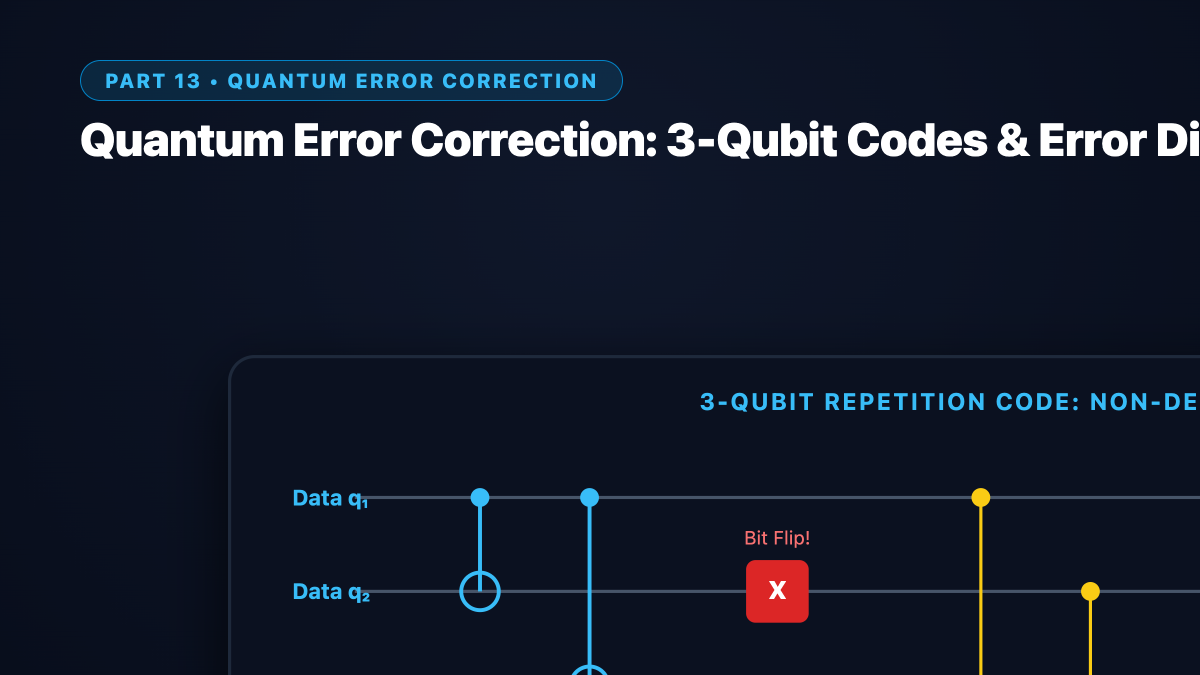
To understand the mechanics of QECC, consider the simplest error model: an isolated bit flip channel where the environment applies a Pauli $X$ operator with probability $p$. The 3-qubit code embeds a single logical qubit $|psi_Lrangle = alpha |0_Lrangle + beta |1_Lrangle$ into a 3-qubit subspace:
[
|0_Lrangle = |000rangle, quad |1_Lrangle = |111rangle
]
The encoding is achieved using two CNOT gates with the data qubit as control:
[
(alpha |0rangle + beta |1rangle)|00rangle xrightarrow{text{CNOT}_{1to 2},, text{CNOT}_{1to 3}} alpha |000rangle + beta |111rangle
]
Notice that no cloning has occurred: we have not created $|psirangle|psirangle|psirangle$, but rather an entangled 3-qubit state.
Syndrome Measurement Without State Collapse
If an arbitrary single-qubit bit-flip occurs (e.g., $X_1$ flips the first qubit to $alpha |100rangle + beta |011rangle$), we cannot measure the qubits directly. Instead, we measure two multi-qubit commuting observables called stabilizers or syndrome operators:
[
S_1 = Z_1 Z_2 = Z otimes Z otimes I, quad S_2 = Z_2 Z_3 = I otimes Z otimes Z
]
Since the eigenvalues of Pauli $Z$ are $pm 1$, the eigenvalue of $Z_i Z_j$ is $+1$ if qubits $i$ and $j$ have identical computational basis values, and $-1$ if they differ. The syndrome table uniquely diagnoses the error:
| Error $E$ | Corrupted State | Syndrome $(S_1, S_2)$ | Correction Operation |
|---|---|---|---|
| $I$ (No error) | $alpha |000rangle + beta |111rangle$ | $(+1, +1)$ | $I$ |
| $X_1$ (Qubit 1 flip) | $alpha |100rangle + beta |011rangle$ | $(-1, +1)$ | Apply $X_1$ |
| $X_2$ (Qubit 2 flip) | $alpha |010rangle + beta |101rangle$ | $(-1, -1)$ | Apply $X_2$ |
| $X_3$ (Qubit 3 flip) | $alpha |001rangle + beta |110rangle$ | $(+1, -1)$ | Apply $X_3$ |
Crucially, because $langle psi_L | S_i | psi_L rangle$ carries no information regarding $alpha$ or $beta$, the syndrome measurement projects the error into a discrete Pauli operator while leaving the superposition perfectly intact!
2. The 3-Qubit Phase-Flip Code
In addition to bit flips ($X$), quantum systems suffer from phase flips ($Z |0rangle = |0rangle, Z |1rangle = -|1rangle$). By rotating the computational basis into the Hadamard basis ${|+rangle, |-rangle}$ where $X |+rangle = |+rangle$ and $X |-rangle = -|-rangle$, the phase flip operator $Z$ acts as a bit flip:
[
H Z H = X
]
The 3-qubit phase-flip code encodes the logical states as:
[
|0_Lrangle = |+++rangle, quad |1_Lrangle = |—rangle
]
The syndrome operators are transformed by Hadamard gates into $X_1 X_2$ and $X_2 X_3$. Measuring these stabilizers detects and corrects any single phase flip $Z_i$.
3. Shor’s 9-Qubit Code: Concatenation and Arbitrary Error Discretization
To simultaneously protect against arbitrary bit flips ($X$), phase flips ($Z$), and combined flips ($Y = iXZ$), Shor concatenated the 3-qubit phase-flip code with the 3-qubit bit-flip code. Each logical basis state is first encoded into three phase-flip blocks, and each block is then encoded into three bit-flip qubits:
[
|0_Lrangle = frac{1}{2sqrt{2}} (|000rangle + |111rangle)(|000rangle + |111rangle)(|000rangle + |111rangle)
]
[
|1_Lrangle = frac{1}{2sqrt{2}} (|000rangle – |111rangle)(|000rangle – |111rangle)(|000rangle – |111rangle)
]
Shor’s $[[9, 1, 3]]$ code utilizes 8 stabilizer generators (six $Z_i Z_{i+1}$ within blocks and two $X_1 X_2 X_3 X_4 X_5 X_6$ across blocks) to protect $1$ logical qubit with code distance $d = 3$.
How does Shor’s code protect against an infinitesimal, continuous rotation error $U_theta = e^{i theta vec{n} cdot vec{sigma}} = costheta I + i sintheta (sum_k n_k sigma_k)$?
When the syndrome measurement is performed, the quantum state is projected onto one of the discrete eigenspaces of the stabilizers. If the syndrome indicates a bit flip on qubit 1, the continuous superposition collapses entirely onto the discrete state $X_1 |psi_Lrangle$ with probability $sin^2theta n_x^2$. Applying $X_1$ restores the pristine logical state $|psi_Lrangle$!
Thus, quantum measurement digitizes continuous errors: by measuring whether an error occurred, the quantum processor forces nature to choose between no error or a discrete Pauli error.