In classical computer science, information replication is trivial: copying a bit string $x mapsto (x, x)$ requires negligible energy, forming the foundation of data storage, parity backups, and internet routing. In quantum mechanics, copying an unknown quantum state is strictly, mathematically forbidden. Discovered independently by William Wootters and Wojciech Zurek, and Dennis Dieks in 1982, the No-Cloning Theorem is one of the most profound conservation laws in theoretical physics. It directly dictates the architectural constraints of quantum computing: classical redundancy is impossible, necessitating non-destructive error correction. When quantum systems lose coherence to their surrounding environment, state vectors fail, requiring the broader mathematical formalism of Density Matrices and Von Neumann Entropy.
1. The Formal Proof of the No-Cloning Theorem
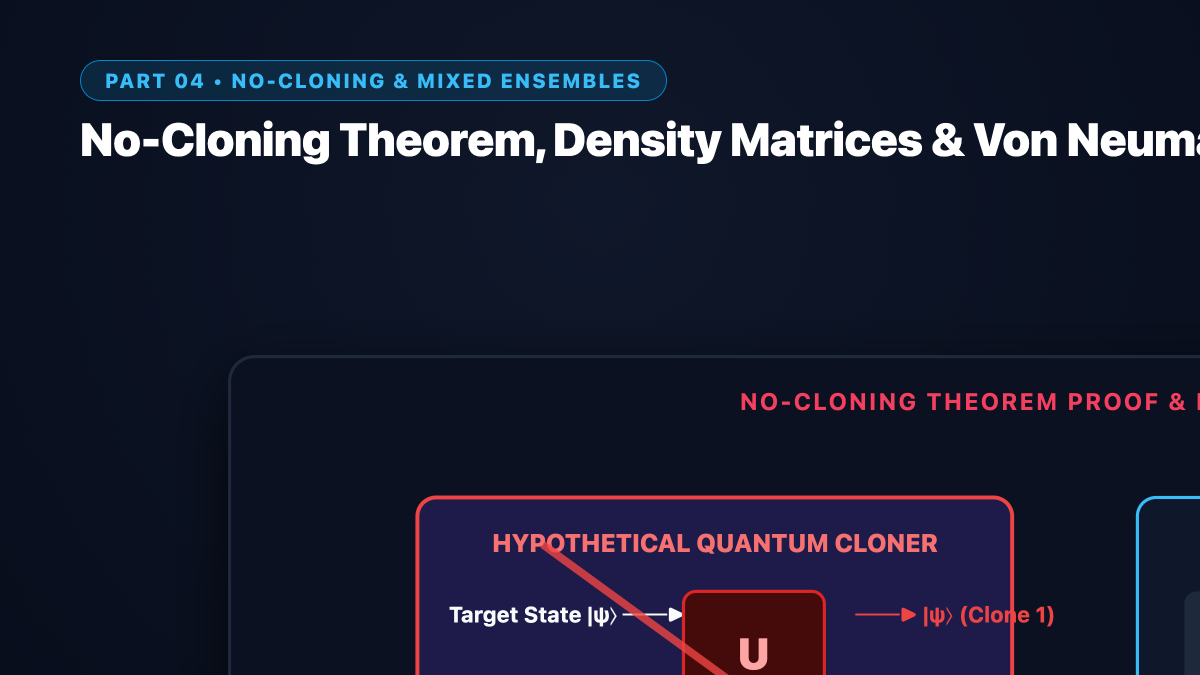
Suppose there exists a unitary operator $U$ acting as a universal quantum cloner. Given an arbitrary unknown quantum state $|psirangle in mathcal{H}$ and a standard blank initialization state $|0rangle in mathcal{H}$, the cloner must map:
$$U(|psirangle otimes |0rangle) = |psirangle otimes |psirangle$$
Similarly, for another arbitrary quantum state $|phirangle in mathcal{H}$:
$$U(|phirangle otimes |0rangle) = |phirangle otimes |phirangle$$
Now, let us compute the inner product of these two output states using the fundamental definition of the adjoint operator. Because $U$ is unitary ($U^dagger U = I$), it preserves inner products strictly:
$$langle psi otimes 0 | U^dagger U | phi otimes 0 rangle = langle psi otimes 0 | phi otimes 0 rangle = langle psi | phi rangle langle 0 | 0 rangle = langle psi | phi rangle$$
However, evaluating the inner product of the cloned target states directly yields:
$$(langle psi | otimes langle psi |) (|phirangle otimes |phirangle) = langle psi | phi rangle langle psi | phi rangle = (langle psi | phi rangle)^2$$
Equating both expressions gives the fundamental algebraic condition:
$$langle psi | phi rangle = (langle psi | phi rangle)^2 iff langle psi | phi rangle (1 – langle psi | phi rangle) = 0$$
This equation holds if and only if:
$$langle psi | phi rangle = 0 quad (text{states are strictly orthogonal}) quad text{or} quad |langle psi | phi rangle| = 1 quad (text{states are identical})$$
Therefore, a unitary operator can copy only a set of mutually orthogonal known states (such as classical bits ${|0rangle, |1rangle}$). No unitary operator can ever clone an arbitrary unknown quantum superposition. Linearity of quantum mechanics unconditionally forbids perfect cloning.
2. Density Operators & The Mixed State Ensembles
State vectors $|psirangle$ describe isolated, pure quantum systems. In laboratory reality, qubits interact with thermal noise, laser fluctuations, and imperfect state preparation, producing a statistical ensemble of states ${ (p_i, |psi_irangle) }$, where the system has probability $p_i$ of being in state $|psi_irangle$. Such states cannot be described by a state vector; they require the Density Operator (Matrix) $rho$ (John von Neumann, 1927):
$$rho = sum_{i} p_i |psi_irangle langle psi_i| quad text{where} quad p_i ge 0, quad sum_i p_i = 1$$
Axiomatic Properties of Density Matrices
- Hermiticity: $rho^dagger = rho$.
- Positive Semi-Definiteness: For any state $|phirangle$, $langle phi | rho | phi rangle ge 0$ (all eigenvalues $lambda_k ge 0$).
- Unit Trace: $text{Tr}(rho) = sum_k lambda_k = 1$ (sum of all probabilities equals unity).
The expectation value of any physical observable $hat{A}$ on a mixed state is given by the elegant matrix trace formula:
$$langle hat{A} rangle = text{Tr}(rho hat{A})$$
3. Purity & The Bloch Ball Interior
The degree of quantum mixedness is quantified by the Purity parameter $gamma$:
$$gamma = text{Tr}(rho^2) = sum_k lambda_k^2$$
- Pure State: $text{Tr}(rho^2) = 1$. The density matrix is a projection operator ($rho^2 = rho$). The Bloch vector has length $|vec{r}| = 1$, residing on the surface of the Bloch sphere.
- Mixed State: $frac{1}{d} le text{Tr}(rho^2) < 1$ (for a $d$-dimensional Hilbert space). The Bloch vector has length $|vec{r}| < 1$, residing in the interior of the Bloch ball:
$$rho = frac{1}{2}(I + vec{r} cdot vec{sigma}) quad text{with} quad |vec{r}| < 1$$ - Maximally Mixed State: $rho = frac{1}{2}I$, Bloch vector $vec{r} = (0, 0, 0)$ situated at the dead center of the sphere, representing complete ignorance (entropy is maximal).
4. The Partial Trace & Subsystem Entanglement
When analyzing a bipartite system $rho_{AB} in mathcal{H}_A otimes mathcal{H}_B$, an observer with access only to subsystem $A$ describes their local physics via the Reduced Density Operator $rho_A$, obtained by taking the Partial Trace over subsystem $B$:
$$rho_A = text{Tr}_B(rho_{AB}) = sum_k (I_A otimes langle k|_B) rho_{AB} (I_A otimes |krangle_B)$$
Consider the pure entangled Bell state $|Phi^+rangle = frac{1}{sqrt{2}}(|00rangle + |11rangle)$, with density operator $rho_{AB} = |Phi^+ranglelanglePhi^+|$. Tracing out Bob’s qubit yields:
$$rho_A = text{Tr}_B(|Phi^+ranglelanglePhi^+|) = frac{1}{2}|0ranglelangle 0| + frac{1}{2}|1ranglelangle 1| = frac{1}{2}begin{pmatrix} 1 & 0 \ 0 & 1 end{pmatrix} = frac{1}{2}I_A$$
This is a fundamental hallmark of quantum entanglement: even though the total global system is in a perfectly pure state ($S(rho_{AB}) = 0$), each individual subsystem is completely mixed ($S(rho_A) = ln 2$). Complete knowledge of the universe does not imply knowledge of its parts!
5. Von Neumann Entropy
Extending Claude Shannon’s classical entropy $H = -sum p_i log_2 p_i$ to quantum density operators, Von Neumann Entropy measures the degree of quantum uncertainty and entanglement:
$$S(rho) = -text{Tr}(rho log_2 rho) = -sum_k lambda_k log_2 lambda_k$$
For any pure state, $S(rho) = 0$. For an entangled pure bipartite state $|Psi_{AB}rangle$, the Von Neumann entropy of the reduced density operator $S(rho_A) = S(rho_B)$ serves as the unique, rigorous mathematical measure of the Entanglement of Formation between systems $A$ and $B$.