The fundamental obstacle preventing the immediate realization of large-scale quantum computers is not computational complexity, but environmental physics: Quantum Decoherence. A quantum register cannot remain isolated from its physical environment. Fluctuating electromagnetic fields, cosmic rays, thermal phonons, and nuclear spin baths continuously entangle with the qubits, leaking quantum phase information and degrading delicate superpositions into classical statistical mixtures. To analyze and mitigate this degradation, quantum mechanics abandons the unitary Schrödinger equation in favor of the theory of Open Quantum Systems and the Lindblad Master Equation.
1. The Total Hamiltonian and the Density Matrix Evolution
Consider a quantum system $S$ coupled to an external thermal environment (bath/reservoir) $B$. The total composite Hilbert space is $mathcal{H} = mathcal{H}_S otimes mathcal{H}_B$, governed by the global closed-system Hamiltonian:
[
H = H_S otimes I_B + I_S otimes H_B + H_{SB}
]
where $H_S$ is the system Hamiltonian, $H_B$ is the bath Hamiltonian, and $H_{SB}$ describes the interaction between system and reservoir degrees of freedom. The global density matrix $rho_{SB}(t)$ evolves unitarily according to the von Neumann-Liouville equation:
[
frac{drho_{SB}(t)}{dt} = -frac{i}{hbar} [H, rho_{SB}(t)]
]
Because the bath contains an effectively infinite number of degrees of freedom ($10^{23}$ atoms or modes), we cannot track the bath state. The physical state of the quantum processor alone is obtained by evaluating the partial trace over the environment:
[
rho_S(t) = text{Tr}_B left( rho_{SB}(t) right)
]
Due to the non-zero interaction $H_{SB}$, the reduced dynamics of $rho_S(t)$ is generally non-unitary, irreversibly increasing the von Neumann entropy of the system.
2. Born-Markov Approximations and The GKSL Generator
Under three standard physical assumptions:
- Weak Coupling (Born Approximation): The interaction $H_{SB}$ is sufficiently weak such that the state factorizes as $rho_{SB}(t) approx rho_S(t) otimes rho_B$, with the bath remaining in thermal equilibrium at temperature $T$.
- Short Memory Time (Markov Approximation): The correlation time of bath fluctuations $tau_B$ is infinitesimal compared to the system relaxation time scale $tau_R$ ($tau_B ll tau_R$), rendering the evolution memoryless.
- Secular Approximation (Rotating Wave Approximation): Rapidly oscillating non-secular terms average to zero over the coarse-grained time step.
The time evolution of the reduced density operator $rho(t) equiv rho_S(t)$ obeys the most general completely positive, trace-preserving (CPTP) Markovian master equation, formulated independently by Gorini, Kossakowski, Sudarshan (1976) and Lindblad (1976)—the GKSL Master Equation:
[
frac{drho}{dt} = -frac{i}{hbar} [H_S, rho] + sum_k gamma_k left( L_k rho L_k^dagger – frac{1}{2} {L_k^dagger L_k, rho} right)
]
where:
- $-frac{i}{hbar} [H_S, rho]$ is the unitary coherent Hamiltonian driving.
- $L_k$ are the Lindblad jump operators, representing distinct dissipative physical error channels.
- $gamma_k ge 0$ are the decay rates corresponding to each jump process.
- ${A, B} = AB + BA$ denotes the anti-commutator, which enforces $text{Tr}(rho) = 1$ for all $t$.
3. Physical Decoherence Channels: $T_1$ and $T_2$ Dynamics
In physical qubits (such as superconducting transmons or trapped ions), decoherence is characterized by two distinct fundamental relaxation times:
A. Longitudinal Relaxation ($T_1$ Time – Amplitude Damping)
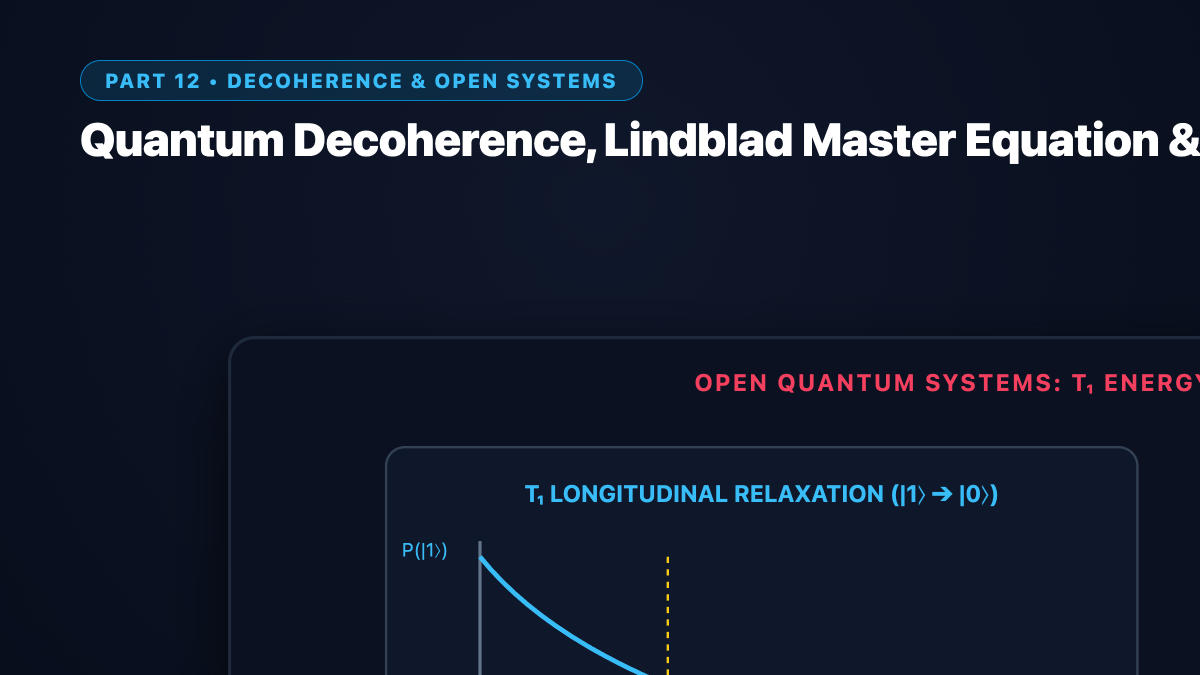
Amplitude damping represents the inelastic loss of energy from the qubit to the cold environment, causing an excited state $|1rangle$ to decay spontaneously to the ground state $|0rangle$. The single jump operator is the lowering operator:
[
L_1 = sigma^- = |0ranglelangle 1| = begin{pmatrix} 0 & 1 \ 0 & 0 end{pmatrix}, quad gamma_1 = frac{1}{T_1}
]
Solving the Lindblad equation for the diagonal population elements yields exponential decay:
[
rho_{11}(t) = rho_{11}(0) e^{-t / T_1}, quad rho_{00}(t) = 1 – rho_{11}(t)
]
Here, $T_1$ is the energy relaxation time (spontaneous emission lifetime).
B. Transverse Relaxation ($T_2$ Time – Phase Damping)
Phase damping (pure dephasing) occurs when low-frequency fluctuations in the external parameters (e.g., magnetic field noise, charge noise) randomly modulate the energy splitting $hbar omega_{01}$ without exchanging energy with the bath. The jump operator is the Pauli $Z$ operator:
[
L_phi = sigma_z = begin{pmatrix} 1 & 0 \ 0 & -1 end{pmatrix}, quad gamma_phi = frac{1}{2 T_phi}
]
Pure dephasing destroys the off-diagonal coherence terms $rho_{01}(t)$ while leaving the populations $rho_{00}, rho_{11}$ entirely unaffected:
[
rho_{01}(t) = rho_{01}(0) e^{-i omega_{01} t} e^{-t / T_2}
]
Combining the amplitude damping channel ($T_1$) and the pure dephasing channel ($T_phi$), the total transverse decoherence rate $1/T_2$ is governed by:
[
frac{1}{T_2} = frac{1}{2 T_1} + frac{1}{T_phi}
]
In the idealized physical limit where pure dephasing is completely eliminated ($T_phi to infty$), the coherence time reaches its absolute theoretical ceiling:
[
T_2 = 2 T_1
]
In real experimental hardware, high-frequency charge or flux noise typically ensures $T_phi ll T_1$, leading to $T_2 ll 2T_1$. Measuring $T_1$ via inversion recovery and $T_2^*$ via Ramsey interferometry and Hahn spin-echo sequences represents the standard benchmark for any quantum processor.
4. The Classical Emergence and the Path to Error Correction
As the Lindblad dissipator drives the off-diagonal coherence terms $rho_{01}(t) to 0$, the quantum superposition state:
[
|psirangle = alpha |0rangle + beta |1rangle implies rho = begin{pmatrix} |alpha|^2 & alpha beta^* \ alpha^* beta & |beta|^2 end{pmatrix}
]
is inexorably transformed into a classical probabilistic mixture:
[
rho(t gg T_2) to begin{pmatrix} |alpha|^2 & 0 \ 0 & |beta|^2 end{pmatrix}
]
This reveals decoherence as the microscopic mechanism of the quantum-to-classical transition: nature continuously measures the qubit through environmental entanglement. Overcoming this spontaneous classical collapse requires the architecture of Quantum Error Correction, where logical qubits are non-locally distributed across macroscopic entangled code spaces.