While small block codes like Steane $[[7, 1, 3]]$ establish theoretical foundations, building a macroscopic quantum computer containing millions of physical qubits requires local, nearest-neighbor 2D connectivity. In 1997, Alexei Kitaev revolutionized quantum information with the introduction of the Toric Code, demonstrating that quantum memory can be topologically protected by mapping information onto the homology of 2D manifolds. Today, its planar manifestation—the Surface Code—stands as the primary architectural blueprint adopted by Google Quantum AI, IBM Quantum, and Rigetti, distinguished by its phenomenally high $sim 1%$ fault-tolerant error threshold.
1. Kitaev’s Toric Code: Stabilizers on a 2-Torus
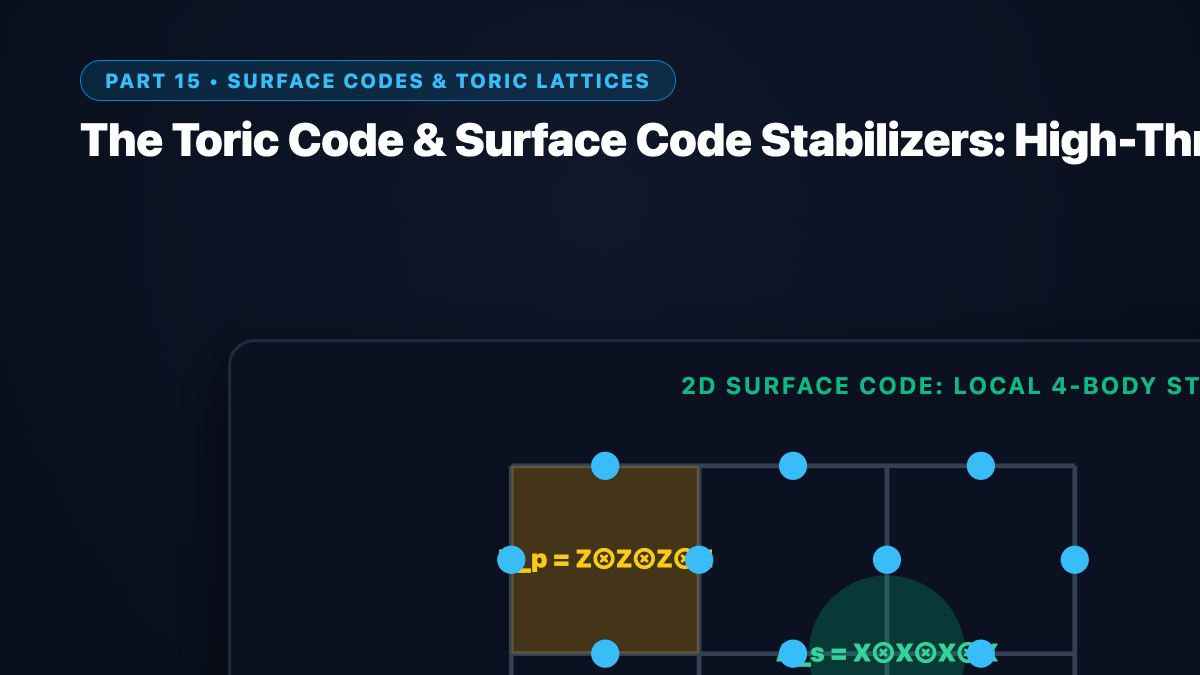
Consider a square lattice discretized on the surface of a two-dimensional torus $T^2$. Qubits reside on the edges $e in E$ of the lattice. The stabilizer group is generated by two sets of geometrically local operators defined at each vertex $s$ (star) and face $p$ (plaquette):
- Star Operators ($A_s$): Defined as the product of Pauli $X$ operators on the four edges meeting at vertex $s$:
[
A_s = prod_{j in text{star}(s)} X_j = X_1 X_2 X_3 X_4
] - Plaquette Operators ($B_p$): Defined as the product of Pauli $Z$ operators on the four edges bounding face $p$:
[
B_p = prod_{j in partial p} Z_j = Z_1 Z_2 Z_3 Z_4
]
Because any star and any plaquette share either $0$ or $2$ common edges, all generators commute identically: $[A_s, B_p] = 0, forall s, p$. The protected code space $mathcal{C}$ is defined as the joint $+1$ eigenspace of all stabilizers:
[
mathcal{C} = { |psirangle : A_s |psirangle = |psirangle, , B_p |psirangle = |psirangle, , forall s, p }
]
Topological Ground State Degeneracy
On a torus with $V$ vertices, $E$ edges, and $F$ faces, the Euler characteristic is $chi = V – E + F = 0$, meaning $E = V + F$. Because $prod_s A_s = I$ and $prod_p B_p = I$, there are $V – 1$ independent star generators and $F – 1$ independent plaquette generators. The number of encoded logical qubits is:
[
k = E – (V – 1) – (F – 1) = E – V – F + 2 = 2 – chi = 2
]
The code stores exactly 2 logical qubits. The logical operators are non-trivial homological Wilson loops winding non-contractibly around the cycles of the torus: $bar{Z}_1, bar{Z}_2$ wind along dual homology cycles, and $bar{X}_1, bar{X}_2$ wind along primal cycles. Local hardware noise cannot change the topological winding number!
2. Planar Surface Codes: 2D Nearest-Neighbor Geometry
Because physical quantum chips cannot be folded into a torus, modern architectures unfold the torus onto a flat 2D plane with alternating rough ($X$) and smooth ($Z$) boundaries. In a rotated surface code of code distance $d$:
- A single logical qubit is encoded into $n = d^2 + (d-1)^2$ physical qubits (data qubits and syndrome ancillas).
- Every syndrome check requires only nearest-neighbor CNOT couplings on a planar 2D grid.
- The code distance $d$ equals the minimum length of an error chain connecting opposing boundaries.
3. The $sim 1%$ Threshold Theorem
The historical significance of the surface code is encapsulated in the Threshold Theorem. If physical gate error rates $p$ are below a critical threshold $p_{th}$, increasing the code distance $d$ suppresses the logical error rate $p_L$ exponentially:
[
p_L propto left( frac{p}{p_{th}} right)^{(d+1)/2}
]
While concatenated CSS codes exhibit low thresholds around $10^{-4}$ to $10^{-5}$, planar surface codes with phenomenological noise achieve an extraordinary threshold of:
[
p_{th} approx 1.0% quad (approx 0.7% text{ for full circuit-level noise})
]
This $1%$ threshold brought fault-tolerant quantum computing from the realm of science fiction into engineering reality, as contemporary superconducting transmons achieve physical two-qubit gate fidelities exceeding $99.5%$ ($p approx 0.005$).
4. Syndrome Decoding: Minimum Weight Perfect Matching (MWPM)
When physical errors occur, they flip stabilizer syndromes at the endpoints of the error chains, creating pairs of point-like excitations (anyonic defects). The software challenge of quantum error correction is decoding: pairing these defects to determine the most probable correction operator.
Jack Edmonds’ Blossom Minimum-Weight Perfect Matching (MWPM) algorithm constructs a complete graph whose vertices are syndrome defect detections and edge weights represent Dijkstra graph distances $w_{ij} = -ln(p_{ij})$. MWPM identifies the minimum-weight matching in polynomial time $mathcal{O}(V^3)$ (further accelerated by PyMatching to $mathcal{O}(V log V)$), executing real-time decoding within microsecond FPGA cycles.