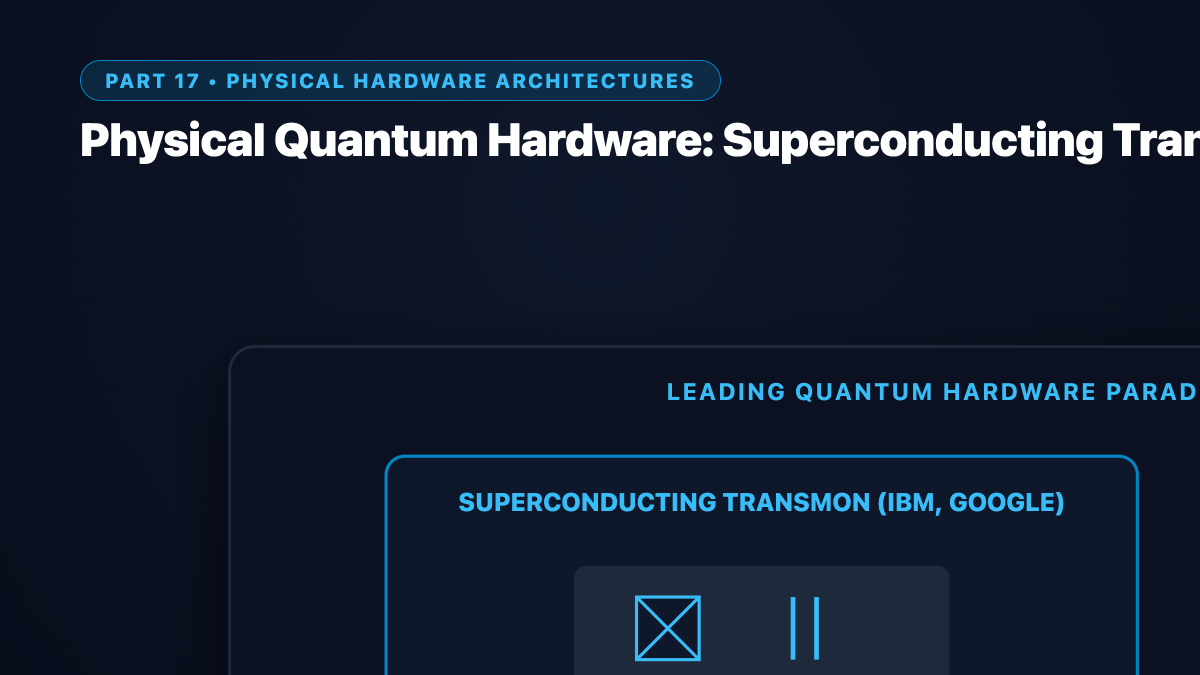
While quantum algorithms operate on abstract Hilbert spaces, physical quantum computers must be fabricated out of matter subject to thermodynamic fluctuations. The engineering race to build scalable quantum processors has crystallized around distinct physical paradigms, each navigating a fundamental trade-off between fast gate execution and long coherence lifetimes. The two dominant hardware platforms—Superconducting Transmon Circuits and Trapped-Ion Processors—approach this challenge from opposite ends of atomic physics and solid-state condensed matter.
1. Superconducting Qubits: Macroscopic Quantum Circuits
Superconducting qubits are macroscopic artificial atoms fabricated on silicon or sapphire substrates using lithographic techniques. When cooled below the critical transition temperature ($T_c approx 1.2 text{ K}$ for Aluminum) inside a dilution refrigerator at $10 text{ mK}$, electrons bind into bosonic Cooper pairs that condense into a single macroscopic quantum wave function $Psi = sqrt{n_s} e^{itheta}$.
The Josephson Junction as Non-Linear Inductor
A standard LC harmonic oscillator has equally spaced energy levels $E_n = hbar omega_0 (n + 1/2)$, making it impossible to isolate a two-level qubit system using microwave pulses without exciting higher states ($|2rangle, |3rangle$). To break this degeneracy, the linear inductor is replaced with a Josephson Junction—two superconducting electrodes separated by a sub-nanometer insulating barrier ($text{Al}/text{AlO}_x/text{Al}$). The Josephson relations:
[
I(t) = I_c sin phi(t), quad V(t) = frac{hbar}{2e} frac{dphi(t)}{dt}
]
yield a non-linear inductive energy $U(phi) = -E_J cos phi$, where $E_J = frac{hbar I_c}{2e}$ is the Josephson coupling energy. The Hamiltonian of the Cooper Pair Box is:
[
H = 4 E_C (hat{n} – n_g)^2 – E_J cos hat{phi}
]
where $E_C = frac{e^2}{2C}$ is the charging energy, $hat{n}$ is the Cooper-pair number operator, and $n_g = C_g V_g / (2e)$ represents environmental offset charge fluctuations.
The Transmon Regime: Suppressing Charge Noise
In 2007, Koch et al. engineered the Transmon (Transmission-line shunted plasma oscillation qubit) by shunting the junction with a massive capacitive pad, pushing the ratio to:
[
frac{E_J}{E_C} gg 1 quad (text{typically } 50 text{ to } 80)
]
In this regime, the charge dispersion (sensitivity of transition frequencies to fluctuating offset charges $n_g$) drops exponentially:
[
epsilon_m approx (-1)^m E_C frac{2^{4m+5}}{m!} sqrt{frac{2}{pi}} left(frac{E_J}{2E_C}right)^{frac{m}{2} + frac{3}{4}} expleft(-sqrt{frac{8E_J}{E_C}}right)
]
Meanwhile, the anharmonicity $alpha = omega_{12} – omega_{01} approx -E_C$ decreases only as a weak power law ($sim -E_C$). This enables clean single-qubit microwave control pulses of duration $10 text{–} 30 text{ ns}$ while operating in circuit quantum electrodynamics (cQED) readout cavities.
2. Trapped-Ion Processors: Identical Pristine Atoms
Rather than engineering artificial circuits, trapped-ion computing employs naturally identical singly charged ions (e.g., $^{171}text{Yb}^+$, $^{43}text{Ca}^+$, $^{9}text{Be}^+$) suspended in ultra-high vacuum ($10^{-11} text{ Torr}$) by dynamic radiofrequency (RF) electric quadrupole fields—the Paul Trap.
The pseudopotential $Phi_{eff}(vec{r})$ confines the ions into a linear 1D crystal where Coulomb repulsion balances the trapping force. The qubit states $|0rangle$ and $|1rangle$ are defined on long-lived hyperfine clock transitions that are first-order insensitive to magnetic fields, exhibiting coherence times $T_2$ exceeding hours!
Two-Qubit Entanglement: The Mølmer-Sørensen Gate
Because direct magnetic dipole-dipole interactions between ions are negligible at micrometer separations, entangling gates are mediated by the quantized collective vibrations of the ion chain—the phonons of the center-of-mass (COM) or stretch motional modes.
The Mølmer-Sørensen gate illuminates two targeted ions simultaneously with a bichromatic laser field detuned from the upper and lower motional sidebands by $pm delta$. The effective interaction Hamiltonian generates an evolution operator:
[
U_{MS}(theta) = expleft( -i frac{theta}{4} X_1 X_2 right)
]
When the optical laser pulses execute a closed loop in the motional phase space $(hat{x}, hat{p})$, the phonons disentangle completely from the internal atomic states, leaving behind a pure geometric Berry phase that creates maximal entanglement (such as a Bell state) with two-qubit gate fidelities exceeding $99.9%$.
| Hardware Metric | Superconducting Transmons (Google, IBM) | Trapped Ions (Quantinuum, IonQ) |
|---|---|---|
| Qubit Nature | Lithographic artificial solid-state circuits | Naturally identical pristine atoms/ions |
| Single-Qubit Gate Time | $approx 10 text{–} 20 text{ ns}$ (Ultrafast) | $approx 1 text{–} 10 text{ }mutext{s}$ (Moderate) |
| Two-Qubit Gate Time | $approx 30 text{–} 200 text{ ns}$ | $approx 30 text{–} 200 text{ }mutext{s}$ |
| Coherence Time ($T_2$) | $approx 50 text{–} 300 text{ }mutext{s}$ | $approx 1 text{–} 100 text{ seconds}$ (up to hours) |
| Two-Qubit Gate Fidelity | $99.4% text{–} 99.8%$ | $99.8% text{–} 99.94%$ (World record) |
| Qubit Connectivity | Nearest-neighbor 2D planar planar grid | All-to-all reconfigurable ion shuffling |
| Primary Scalability Barrier | Cryogenic thermal load & coaxial wiring bottlenecks | Slow optical shuttling & optical phase drift |
3. Alternative Frontiers: Neutral Atoms and Silicon Spin Qubits
Two rapidly advancing alternative hardware modalities bridge the strengths of transmons and ions:
- Neutral Atom Arrays (QuEra, Harvard): Hundreds of neutral atoms trapped in 2D and 3D optical tweezer arrays using spatial light modulators. Entangling operations are triggered by exciting atoms into high-principal-quantum-number Rydberg states ($n approx 70$), where massive van der Waals dipole-dipole interactions ($V(R) = C_6 / R^6$) induce a Rydberg Blockade, preventing simultaneous excitation within radius $R_b$.
- Silicon Spin Qubits (Intel, UNSW): Electrostatic quantum dots defined in isotopically purified $^{28}text{Si}$ silicon-MOS or Si/SiGe heterostructures, trapping single electron or hole spins. Leveraging existing semiconductor fabrication foundries, silicon spin qubits achieve sub-micron footprints and long spin coherence.