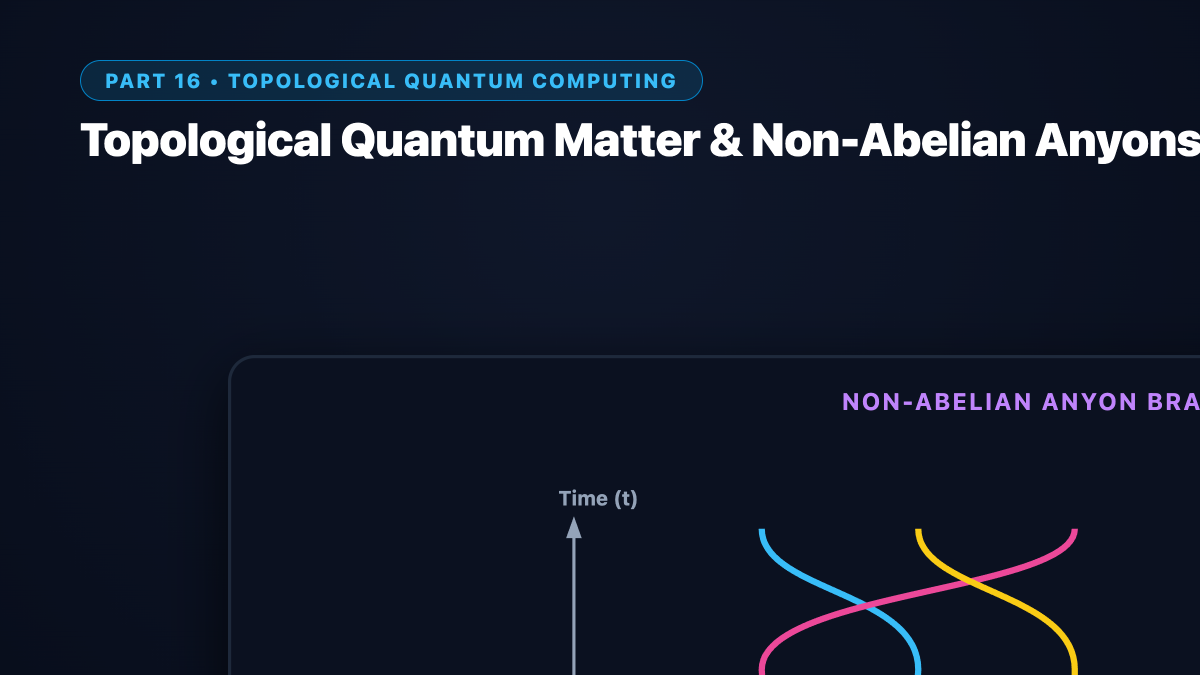
In 3D physical space, the quantum statistics of identical particles is strictly dichotomous: particles are either bosons (symmetric under wave function exchange) or fermions (antisymmetric). In two spatial dimensions, however, the fundamental topology of paths changes entirely: particle worldlines form knots and braids in $(2+1)$-dimensional spacetime. Particles whose exchanges yield arbitrary complex phase factors or non-commuting unitary matrix transformations are called Anyons. Pioneered by Alexei Kitaev and Michael Freedman, Topological Quantum Computing harnesses Non-Abelian anyons to encode quantum information in non-local topological invariants, rendering qubits intrinsically immune to local environmental decoherence without requiring active error correction cycles.
1. The Topology of Particle Exchange in Two Dimensions
Consider the configuration space $C_N(mathbb{R}^d)$ of $N$ indistinguishable particles in $d$ spatial dimensions:
[
C_N(mathbb{R}^d) = left( (mathbb{R}^d)^N setminus Delta right) / S_N
]
where $Delta = {(x_1, dots, x_N) : x_i = x_j text{ for some } i neq j}$ represents the collision set, and $S_N$ is the symmetric group of permutations. The fundamental group $pi_1(C_N(mathbb{R}^d))$ dictates the quantum statistics of identical particles:
- For $d ge 3$: $pi_1(C_N(mathbb{R}^d)) cong S_N$. The only one-dimensional unitary representations are the trivial representation (bosons, $psi to +psi$) and the alternating representation (fermions, $psi to -psi$).
- For $d = 2$: $pi_1(C_N(mathbb{R}^2)) cong B_N$, the Artin Braid Group on $N$ strands!
The braid group $B_N$ is infinite and generated by elementary braid operations $sigma_1, dots, sigma_{N-1}$ satisfying the Artin relations:
[
sigma_i sigma_{i+1} sigma_i = sigma_{i+1} sigma_i sigma_{i+1}, quad sigma_i sigma_j = sigma_j sigma_i quad (|i – j| ge 2)
]
2. Abelian vs. Non-Abelian Anyons
Anyons are categorized by their algebraic transformation under spatial exchange:
- Abelian Anyons: Exchanging two identical particles multiplies the many-body wave function by an arbitrary complex phase factor $e^{itheta}$ ($theta in [0, 2pi)$). Observed in the Fractional Quantum Hall Effect (FQHE) at filling fractions $nu = 1/3, 2/5$.
- Non-Abelian Anyons: A system of $N$ well-separated anyons with fixed spatial coordinates possesses an exponentially degenerate ground state subspace $mathcal{V}_N$ of dimension $D > 1$. Adiabatically braiding one anyon around another acts as a non-commuting unitary matrix rotation $U in U(D)$ on this degenerate space:
[
|psi_arangle xrightarrow{sigma_i} sum_{b=1}^D [R_i]_{ab} |psi_brangle
]
Quantum information is stored in the topological state space $mathcal{V}_N$, and quantum computation is executed entirely by braiding the worldlines of anyons!
3. Majorana Zero Modes in Condensed Matter
The most experimentally accessible non-Abelian anyons are Majorana Zero Modes (MZMs), which are localized zero-energy quasiparticle excitations that are their own antiparticles ($gamma = gamma^dagger$).
In a 1D semiconductor nanowire (such as InAs or InSb) with strong spin-orbit coupling, proximitized by an s-wave superconductor (Al) under an axial Zeeman magnetic field $B > B_c = sqrt{Delta^2 + mu^2}$, the nanowire enters a topologically non-trivial superconducting phase. A pair of isolated Majorana zero modes emerges at the two endpoints of the wire, governed by the Clifford algebra:
[
{gamma_i, gamma_j} = 2delta_{ij}, quad gamma_i^dagger = gamma_i
]
Two Majoranas $gamma_1, gamma_2$ combine to form a standard non-local Dirac fermion: $c = frac{1}{2}(gamma_1 + igamma_2)$. Exchanging two Majoranas produces the non-Abelian braiding operator:
[
R_{12} = expleft( frac{pi}{4} gamma_1 gamma_2 right) = frac{1}{sqrt{2}}(1 + gamma_1 gamma_2)
]
While Majorana braiding generates the Clifford gates (isomorphic to Ising anyons), it cannot generate the non-Clifford $pi/8$ gate $T$. Therefore, Majorana hardware must still rely on magic state distillation for universal computation.
To achieve fully universal quantum computing without magic states, condensed matter physics seeks Fibonacci Anyons (hypothesized in FQHE at $nu = 12/5$). Fibonacci anyons possess a single non-trivial topological charge $tau$ obeying the fusion rule:
[
tau otimes tau = 1 oplus tau
]
The quantum dimension of $tau$ is the golden ratio $phi = frac{1 + sqrt{5}}{2} approx 1.618$. By the Freedman-Larsen-Wang theorem (2002), the braid group representation of Fibonacci anyons is dense in $SU(2)$, meaning any arbitrary single-qubit quantum gate can be compiled to arbitrary precision $epsilon$ purely by braiding paths of length $mathcal{O}(log(1/epsilon))$!
4. The Hardware Fault-Tolerance Paradigm
Topological quantum computing eliminates the massive $1000:1$ physical-to-logical qubit overhead required by surface codes. Because the ground state degeneracy is topological, any local perturbation Hamiltonian $H_{pert} = int d^2x V(x)$ has matrix elements that decay exponentially with the spatial separation $L$ between anyons:
[
|langle psi_a | H_{pert} | psi_b rangle| le c , e^{-L / xi}
]
where $xi$ is the superconducting coherence length. By maintaining $L gg xi$, environmental decoherence is suppressed at the fundamental hardware level, representing the ultimate physical frontier of quantum information.