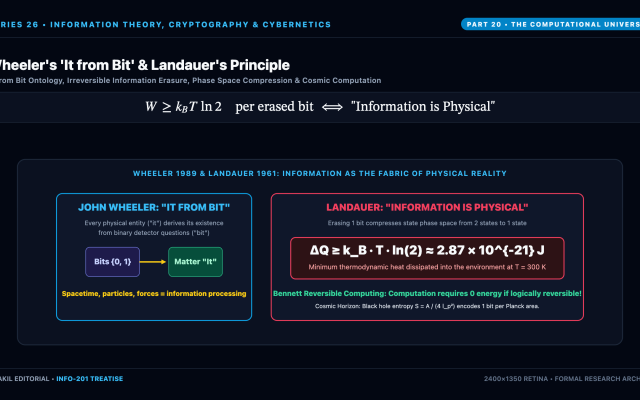
In 1935, Albert Einstein, Boris Podolsky, and Nathan Rosen published their seminal paper challenging the completeness of quantum mechanics (the EPR Paradox). Einstein famously derided quantum non-locality as “spooky action at a distance” (spukhafte Fernwirkung), postulating that quantum probabilities must be an artifact of deterministic, yet unobserved, Local Hidden Variables (LHV). For nearly three decades, this dispute remained a metaphysical philosophical debate. In 1964, Northern Irish physicist John Stewart Bell shattered this impasse by proving that the predictions of quantum mechanics are mathematically incompatible with any local realist theory. Through Bell’s Theorem and the CHSH Inequality, the non-locality of Quantum Entanglement moved from philosophy to experimentally verifiable physics.
1. Multi-Qubit States & The Tensor Product Space
When two isolated quantum systems $A$ and $B$ interact, their joint state resides not in the direct sum, but in the Tensor Product Space of their individual Hilbert spaces:
$$mathcal{H}_{AB} = mathcal{H}_A otimes mathcal{H}_B cong mathbb{C}^2 otimes mathbb{C}^2 cong mathbb{C}^4$$
The standard four-dimensional computational basis is given by:
$$|00rangle = begin{pmatrix} 1 \ 0 \ 0 \ 0 end{pmatrix}, quad |01rangle = begin{pmatrix} 0 \ 1 \ 0 \ 0 end{pmatrix}, quad |10rangle = begin{pmatrix} 0 \ 0 \ 1 \ 0 end{pmatrix}, quad |11rangle = begin{pmatrix} 0 \ 0 \ 0 \ 1 end{pmatrix}$$
The Formal Definition of Entanglement
A bipartite pure quantum state $|Psirangle in mathcal{H}_{AB}$ is defined as Separable (Product State) if and only if there exist individual single-qubit states $|psirangle_A in mathcal{H}_A$ and $|phirangle_B in mathcal{H}_B$ such that:
$$|Psirangle = |psirangle_A otimes |phirangle_B$$
Conversely, a state is Entangled if it cannot be factored into a product of individual sub-states:
$$|Psirangle neq |psirangle_A otimes |phirangle_B$$
2. The Maximally Entangled Bell Basis
The canonical examples of bipartite entanglement are the four orthonormal Bell States (EPR Pairs):
$$|Phi^pmrangle = frac{1}{sqrt{2}}(|00rangle pm |11rangle), quad |Psi^pmrangle = frac{1}{sqrt{2}}(|01rangle pm |10rangle)$$
Consider the state $|Phi^+rangle = frac{1}{sqrt{2}}(|00rangle + |11rangle)$. The state exhibits complete correlation: if Alice measures her qubit in the computational basis and observes $|0rangle$, Bob’s qubit collapses instantaneously to $|0rangle$ with probability $1$. If Alice observes $|1rangle$, Bob’s qubit collapses to $|1rangle$. Crucially, prior to Alice’s measurement, neither qubit possessed a definite value: each individual qubit was in a maximally mixed state with zero local information.
3. Local Realism & The CHSH Inequality
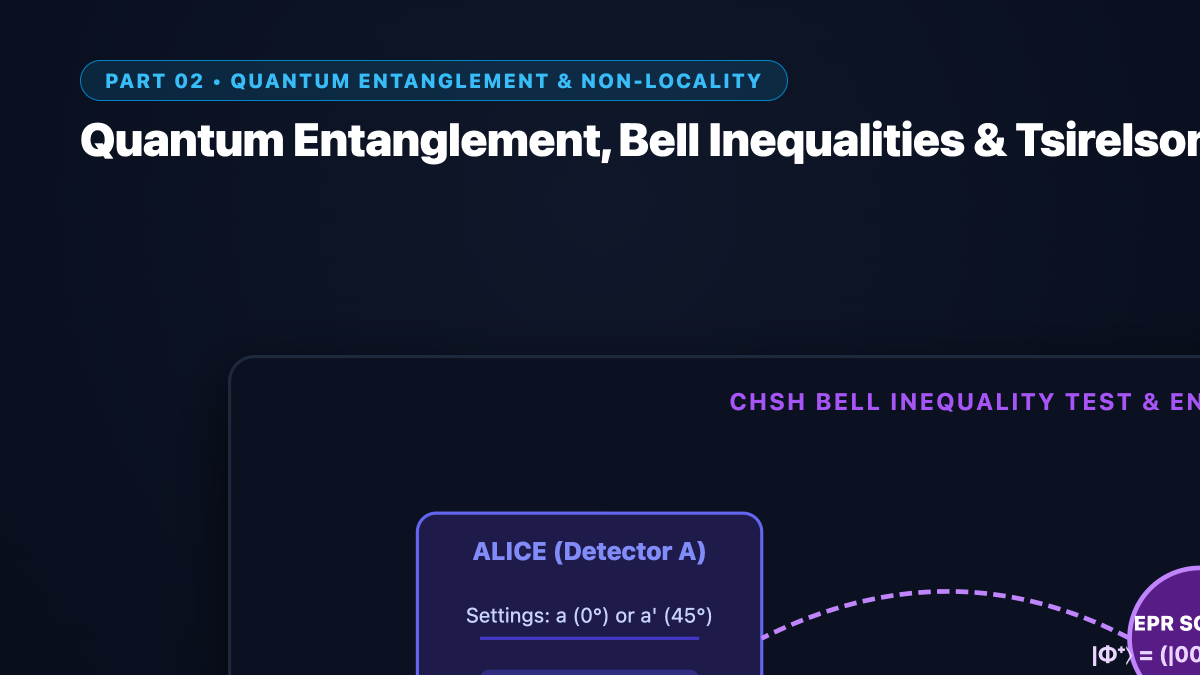
To mathematically test Einstein’s hypothesis that particles carry pre-determined classical hidden variables $lambda sim rho(lambda)$, John Clauser, Michael Horne, Abner Shimony, and Richard Holt (CHSH, 1969) formulated an operational experiment.
Alice and Bob are separated by space-like intervals. Alice randomly selects one of two detector angle settings $a$ or $a’$, producing binary outcomes $A in {+1, -1}$. Bob randomly selects setting $b$ or $b’$, producing $B in {+1, -1}$. Under Local Realism, Alice’s outcome $A(a, lambda)$ is independent of Bob’s setting $b$, and vice versa.
We define the correlation expectation value $E(a, b) = int A(a, lambda) B(b, lambda) rho(lambda) dlambda$. Consider the algebraic quantity:
$$C = A(a) B(b) – A(a) B(b’) + A(a’) B(b) + A(a’) B(b’) = A(a)[B(b) – B(b’)] + A(a’)[B(b) + B(b’)]$$
Because $B(b), B(b’) in {+1, -1}$, one of the bracketed terms must equal $pm 2$ and the other must equal $0$. Since $A in {+1, -1}$, it follows that $C = pm 2$ for every individual trial $lambda$. Taking expectations yields the CHSH Inequality:
$$|S_{text{classical}}| = |E(a, b) – E(a, b’) + E(a’, b) + E(a’, b’)| le 2$$
4. The Quantum Violation & Tsirelson’s Bound
In quantum mechanics, measurement settings correspond to Pauli spin observables $hat{A} = vec{a} cdot vec{sigma}$ and $hat{B} = vec{b} cdot vec{sigma}$. For the singlet state $|Psi^-rangle$, the quantum correlation function is:
$$E_Q(vec{a}, vec{b}) = langle Psi^- | (vec{a} cdot vec{sigma}) otimes (vec{b} cdot vec{sigma}) | Psi^- rangle = -vec{a} cdot vec{b} = -cos(theta_{ab})$$
By orienting detectors in the $XZ$ plane at angles:
$$a = 0, quad a’ = frac{pi}{2}, quad b = frac{pi}{4}, quad b’ = frac{3pi}{4}$$
the angles between settings are all $Deltatheta = pi/4$, yielding:
$$E(a,b) = frac{sqrt{2}}{2}, quad E(a,b’) = -frac{sqrt{2}}{2}, quad E(a’,b) = frac{sqrt{2}}{2}, quad E(a’,b’) = frac{sqrt{2}}{2}$$
Evaluating the CHSH parameter reveals a dramatic violation of local realism:
$$S_{text{quantum}} = frac{sqrt{2}}{2} – left(-frac{sqrt{2}}{2}right) + frac{sqrt{2}}{2} + frac{sqrt{2}}{2} = 4 left( frac{sqrt{2}}{2} right) = 2sqrt{2} approx 2.828 > 2$$
Tsirelson’s Theorem (1980)
Can a physical theory violate CHSH even further, reaching the algebraic maximum of $S = 4$? Boris Tsirelson proved that $2sqrt{2}$ is the absolute upper mathematical bound achievable in quantum mechanics:
$$max_{rho, hat{A}, hat{B}} |langle mathcal{B}_{text{CHSH}} rangle| = 2sqrt{2}$$
This bound stems directly from the algebraic norm of the anti-commutator of Pauli operators: $mathcal{B}_{text{CHSH}}^2 = 4I – [hat{A}_1, hat{A}_2][hat{B}_1, hat{B}_2] implies |mathcal{B}_{text{CHSH}}|^2 le 4 + 4 = 8 implies |mathcal{B}_{text{CHSH}}| le 2sqrt{2}$.
5. Why Entanglement Forbids Faster-Than-Light Signaling
Despite instantaneous non-local wavefunction collapse across interstellar distances, quantum entanglement cannot be used to transmit classical information faster than light (The No-Communication Theorem). Alice’s local reduced density operator $rho_A = text{Tr}_B(|Phi^+ranglelanglePhi^+|) = frac{1}{2}I$ is completely independent of Bob’s measurement setting or outcome. Until Alice and Bob meet or communicate over a conventional, subluminal speed-of-light channel, Alice observes only random, fifty-fifty coin flips.