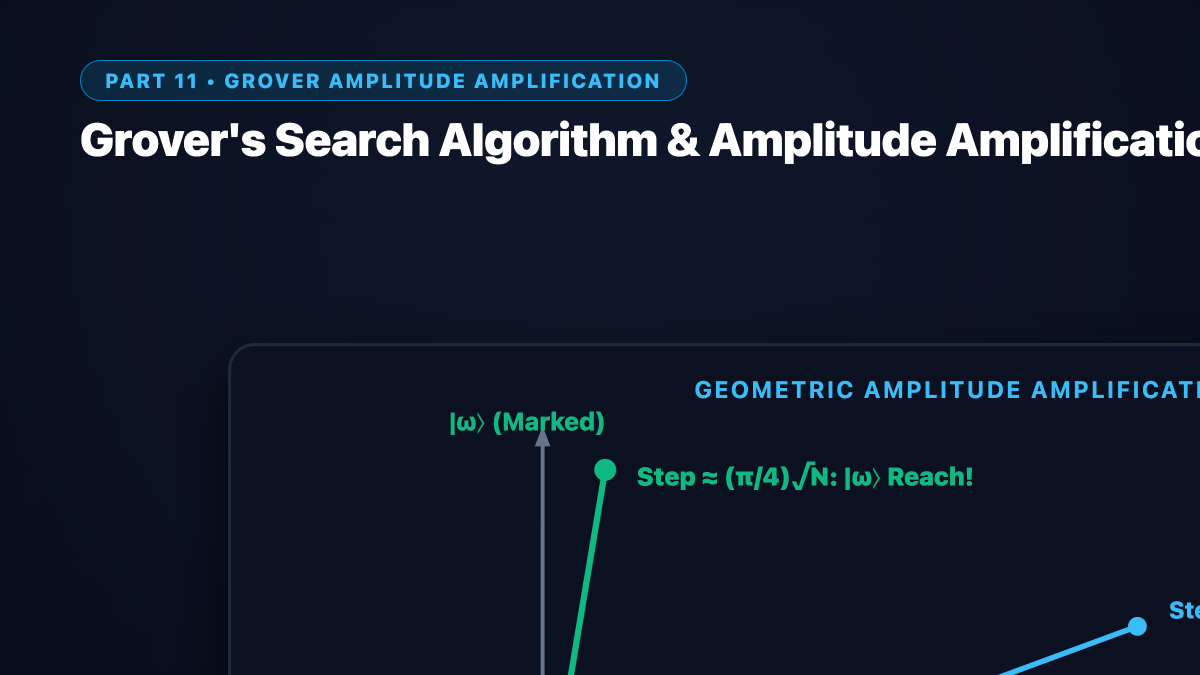
While Shor’s algorithm provides an exponential speedup for problems possessing hidden abelian group structure, Grover’s Algorithm (formulated by Lov Grover in 1996) addresses completely unstructured search problems. For an unsorted database of $N$ items, any classical deterministic or randomized algorithm requires $Omega(N)$ query evaluations in the worst and average cases. Grover’s algorithm achieves quadratic speedup, locating the unique target item in precisely $mathcal{O}(sqrt{N})$ queries—a bound rigorously proven to be the absolute physical limit permitted by quantum mechanics.
1. The Unstructured Search Problem and The Oracle
Consider an unsorted search space of size $N = 2^n$, indexed by $n$-bit integers $x in {0, 1}^n$. We are provided a black-box boolean oracle function $f: {0, 1}^n to {0, 1}$ such that:
[
f(x) = begin{cases} 1 & text{if } x = omega text{ (the target item)} \ 0 & text{if } x neq omega end{cases}
]
Classically, locating $omega$ requires querying the oracle $N/2$ times on average, and $N-1$ times in the worst case. In the quantum realm, the function is encapsulated within a unitary phase oracle $O_omega$:
[
O_omega |xrangle = (-1)^{f(x)} |xrangle = begin{cases} -|omegarangle & text{if } x = omega \ |xrangle & text{if } x neq omega end{cases}
]
In matrix notation, the oracle acts as a reflection across the hyperplane orthogonal to the target state $|omegarangle$:
[
O_omega = I – 2|omegaranglelangleomega|
]
2. Geometric Formulation: The Two-Dimensional Subspace
The operational mechanics of Grover’s algorithm are best understood not through high-dimensional linear algebra, but as a rigid 2D planar rotation. The algorithm begins by initializing an $n$-qubit register into the uniform superposition state $|srangle$ using Hadamard gates:
[
|srangle = H^{otimes n} |0rangle^{otimes n} = frac{1}{sqrt{N}} sum_{x=0}^{N-1} |xrangle
]
We decompose $|srangle$ into a target component $|omegarangle$ and an orthogonal superposition $|s’rangle$ consisting of all non-target states:
[
|s’rangle = frac{1}{sqrt{N-1}} sum_{x neq omega} |xrangle
]
The uniform state $|srangle$ can now be expressed within the orthonormal basis ${|s’rangle, |omegarangle}$:
[
|srangle = sqrt{frac{N-1}{N}} |s’rangle + frac{1}{sqrt{N}} |omegarangle = cosleft(frac{theta}{2}right) |s’rangle + sinleft(frac{theta}{2}right) |omegarangle
]
where the fundamental angle $theta$ is defined by:
[
sinleft(frac{theta}{2}right) = frac{1}{sqrt{N}} implies theta approx frac{2}{sqrt{N}} quad (text{for } N gg 1)
]
3. The Grover Iteration and Diffusion Operator
A single Grover iteration $G$ consists of two successive unitary reflections:
[
G = D cdot O_omega
]
where $D$ is the Grover Diffusion Operator (also known as inversion about the average):
[
D = 2|sranglelangle s| – I = H^{otimes n} (2|0ranglelangle 0| – I) H^{otimes n}
]
Geometrically, the composition of two reflections across lines separated by an angle $theta/2$ produces a pure counter-clockwise rotation by the full angle $theta$. Thus, within the ${|s’rangle, |omegarangle}$ plane:
[
G = begin{pmatrix} costheta & -sintheta \ sintheta & costheta end{pmatrix}
]
Applying the Grover operator $k$ times to the initial state rotates the state vector by $ktheta$:
[
G^k |srangle = cosleft(frac{2k+1}{2} thetaright) |s’rangle + sinleft(frac{2k+1}{2} thetaright) |omegarangle
]
To maximize the probability of measuring the target state $|omegarangle$, we must align the state vector as close as possible to $|omegarangle$, requiring:
[
frac{2R + 1}{2} theta approx frac{pi}{2} implies R = leftlfloor frac{pi}{2theta} – frac{1}{2} rightrceil approx leftlfloor frac{pi}{4} sqrt{N} rightrceil
]
For large $N$, performing precisely $R approx frac{pi}{4}sqrt{N}$ iterations yields a measurement success probability:
[
P(text{success}) = sin^2left(frac{2R+1}{2} thetaright) ge 1 – frac{1}{N}
]
If the algorithm continues beyond $R$ iterations, the state over-rotates, causing the success probability to oscillate sinusoidally back toward zero!
4. The BBBV Theorem: Proof of Quantum Optimality
Can a quantum algorithm locate an item in $mathcal{O}(log N)$ or $mathcal{O}(N^{1/4})$ queries? In 1997, Bennett, Bernstein, Brassard, and Vazirani (BBBV) established that Grover’s algorithm is strictly asymptotically optimal.
Let $|psi_k^xrangle$ be the state of a quantum computer after $k$ queries to an oracle that marks item $x$. Consider the Euclidean distance between the actual evolution and the empty oracle evolution $|psi_k^emptysetrangle$:
[
D_k = sum_{x=0}^{N-1} | |psi_k^xrangle – |psi_k^emptysetrangle |^2
]
By Cauchy-Schwarz inequality, each oracle query can increase $D_k$ by at most $4$. Therefore, after $T$ queries:
[
D_T le 4 T^2
]
However, for the quantum computer to distinguish between all $N$ possible target states with probability at least $2/3$, information theory requires that $D_T = Omega(N)$. Combining these inequalities:
[
4 T^2 ge c N implies T = Omega(sqrt{N})
]
Hence, no quantum algorithm operating on a black-box oracle can ever exceed the quadratic speedup of Grover search.
5. Generalization: Amplitude Amplification and Counting
Grover search generalizes directly to Quantum Amplitude Amplification (Brassard et al., 2000). If any quantum heuristic algorithm $mathcal{A}$ succeeds with classical probability $p$, amplitude amplification enhances that success probability to near certainty in $mathcal{O}(1/sqrt{p})$ repetitions, rather than the classical $mathcal{O}(1/p)$. Combined with Quantum Phase Estimation, Quantum Counting can determine the exact number of marked solutions $M$ in $mathcal{O}(sqrt{N/M})$ queries, bridging combinatorial search and spectral analysis.