Classical computation relies on irreversible Boolean logic gates—such as the NAND and AND gates—which consume physical energy and destroy mathematical information in accordance with Landauer’s Principle ($E_{text{min}} = k_B T ln 2$ per erased bit). In quantum mechanics, isolated closed quantum systems evolve according to the linear, time-dependent Schrödinger equation: $ihbar frac{d}{dt}|psi(t)rangle = hat{H}|psi(t)rangle$. Because the Hamiltonian operator $hat{H}$ is Hermitian ($hat{H}^dagger = hat{H}$), time evolution is strictly Unitary ($U = exp(-ihat{H}t/hbar)$). Quantum computation is therefore fundamentally reversible, preserving information and probability norms. To execute arbitrary quantum algorithms, we must construct complex multi-qubit unitaries from a compact, finite set of Universal Quantum Logic Gates.
1. The Unitary Requirement & The Pauli Group
A quantum logic gate acting on $n$ qubits is represented by a $2^n times 2^n$ complex matrix $U$. To preserve the Hilbert space inner product $langle Upsi | Uphi rangle = langle psi | U^dagger U | phi rangle = langle psi | phi rangle$, the operator must satisfy the Unitarity Condition:
$$U^dagger U = U U^dagger = I_{2^n}$$
The Single-Qubit Pauli Matrices
The fundamental generators of the Lie algebra $mathfrak{su}(2)$ are the three traceless, Hermitian, unitary Pauli matrices $mathcal{P}_1 = {I, X, Y, Z}$:
$$X = begin{pmatrix} 0 & 1 \ 1 & 0 end{pmatrix}, quad Y = begin{pmatrix} 0 & -i \ i & 0 end{pmatrix}, quad Z = begin{pmatrix} 1 & 0 \ 0 & -1 end{pmatrix}$$
The Pauli gates satisfy the fundamental algebraic relations:
$$X^2 = Y^2 = Z^2 = I, quad XY = iZ, quad YZ = iX, quad ZX = iY, quad {X, Z} = XZ + ZX = 0$$
Geometrically on the Bloch sphere, $X$ corresponds to a $pi$ ($180^circ$) rotation around the X-axis (the quantum bit-flip, $|0rangle leftrightarrow |1rangle$), $Z$ corresponds to a $pi$ rotation around the Z-axis (the phase-flip, $|1rangle mapsto -|1rangle$), and $Y = iXZ$ executes both simultaneously.
2. Fundamental Single-Qubit Gates
The Hadamard Gate ($H$)
The Hadamard transform is the gateway to quantum parallelism, creating an equal-weight superposition of basis states:
$$H = frac{1}{sqrt{2}}begin{pmatrix} 1 & 1 \ 1 & -1 end{pmatrix} = frac{X + Z}{sqrt{2}}$$
$$H|0rangle = frac{|0rangle + |1rangle}{sqrt{2}} = |+rangle, quad H|1rangle = frac{|0rangle – |1rangle}{sqrt{2}} = |-rangle$$
Geometrically, $H$ is a $180^circ$ rotation around the diagonal $(X+Z)/sqrt{2}$ axis, swapping the computational Z-basis with the transversal X-basis.
Phase Rotation Gates: $S$ and $T$
Arbitrary rotations around the Z-axis are executed by the phase operator:
$$R_z(theta) = begin{pmatrix} 1 & 0 \ 0 & e^{itheta} end{pmatrix}$$
- The Phase Gate ($S$): $S = R_z(pi/2) = begin{pmatrix} 1 & 0 \ 0 & i end{pmatrix} = sqrt{Z}$. Maps $|+rangle mapsto |+irangle$.
- The $pi/8$ Gate ($T$): $T = R_z(pi/4) = begin{pmatrix} 1 & 0 \ 0 & e^{ipi/4} end{pmatrix} = sqrt{S}$. The $T$ gate is a Non-Clifford operation, indispensable for universal quantum computation.
3. Two-Qubit Entangling Gates
Single-qubit operations can navigate individual state vectors across the Bloch sphere, but they can never create entanglement. Quantum advantage requires multi-qubit entangling gates.
The Controlled-NOT (CNOT) Gate
The CNOT (or Controlled-X) gate acts on two qubits—a control qubit $c$ and a target qubit $t$. It applies an $X$ flip to the target if and only if the control qubit is in state $|1rangle$:
$$text{CNOT}|c, trangle = |c, t oplus crangle$$
$$text{CNOT} = |0ranglelangle 0| otimes I + |1ranglelangle 1| otimes X = begin{pmatrix} 1 & 0 & 0 & 0 \ 0 & 1 & 0 & 0 \ 0 & 0 & 0 & 1 \ 0 & 0 & 1 & 0 end{pmatrix}$$
Applying a CNOT gate to a superposition state generates maximally entangled Bell pairs directly:
$$text{CNOT}(H otimes I)|00rangle = text{CNOT}left(frac{|00rangle + |10rangle}{sqrt{2}}right) = frac{|00rangle + |11rangle}{sqrt{2}} = |Phi^+rangle$$
4. The Clifford Hierarchy & Universal Gate Sets
The Clifford Group $mathcal{C}_n$ is defined as the normalizer of the $n$-qubit Pauli group $mathcal{P}_n$ in the unitary group $U(2^n)$:
$$mathcal{C}_n = { U in U(2^n) mid U P U^dagger in mathcal{P}_n, , forall P in mathcal{P}_n }$$
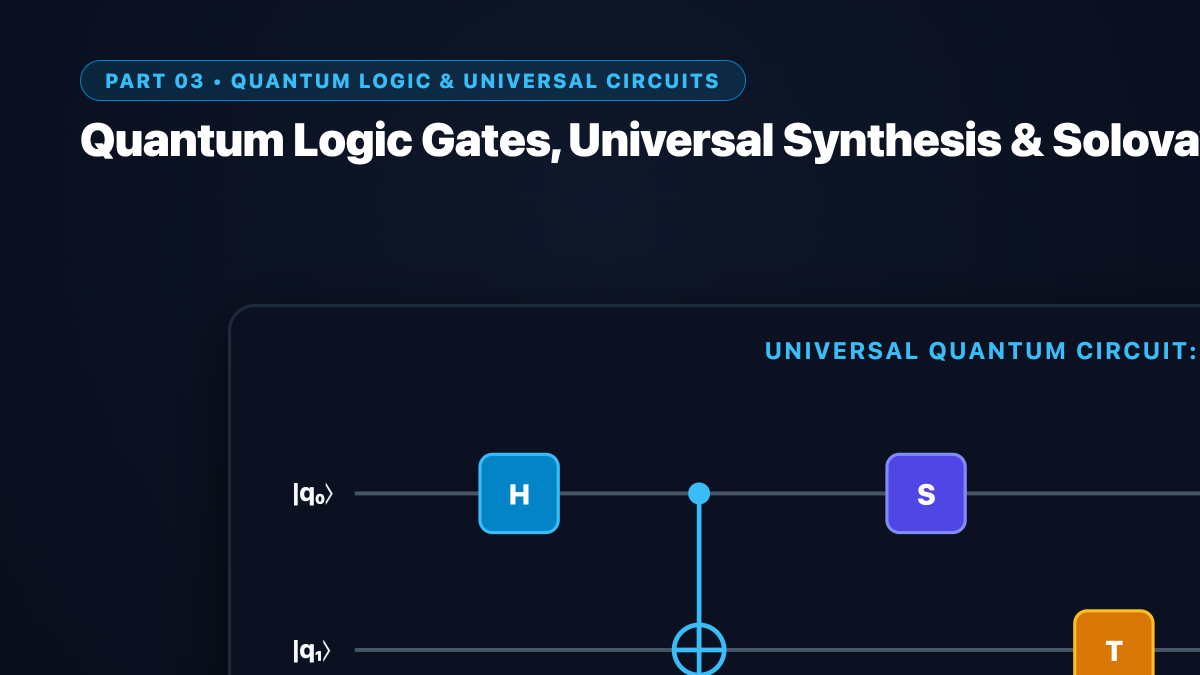
The Clifford group is generated entirely by ${H, S, text{CNOT}}$. According to the Gottesman-Knill Theorem (1998), any quantum circuit composed exclusively of Clifford gates, Pauli state preparations, and computational basis measurements can be perfectly simulated on a classical computer in polynomial time $mathcal{O}(n^2)$. Thus, Clifford operations alone cannot provide a quantum computational speedup!
To achieve universal quantum computation, we must augment the Clifford set with at least one non-Clifford gate. The standard canonical universal set is:
$$mathcal{G}_{text{univ}} = {H, S, text{CNOT}, T} quad (text{Clifford} + T)$$
5. The Solovay-Kitaev Theorem
In classical digital circuits, gates are exact. In quantum computing, an arbitrary single-qubit rotation $R_{hat{n}}(theta)$ involves continuous angles that cannot be represented by a finite set of discrete gates. How efficiently can a continuous unitary $U in SU(2)$ be approximated by a discrete universal set $mathcal{G} = {H, T}$?
Robert Solovay and Alexei Kitaev independently proved the fundamental Solovay-Kitaev Theorem:
Let $mathcal{G}$ be a universal discrete gate set generating a dense subgroup of $SU(2)$. For any target gate $U in SU(2)$ and any desired error tolerance $epsilon > 0$, there exists a sequence of gates $S = g_1 g_2 dots g_m$ from $mathcal{G}$ such that $|S – U| le epsilon$, where the sequence length scales polylogarithmically:
$$m = mathcal{O}left( log^cleft(frac{1}{epsilon}right) right) quad text{with } c approx 3.97$$
The Solovay-Kitaev theorem guarantees that continuous quantum rotations can be approximated to arbitrary precision with astonishingly low gate overhead, establishing the theoretical bedrock for practical quantum compilers and fault-tolerant quantum algorithms.