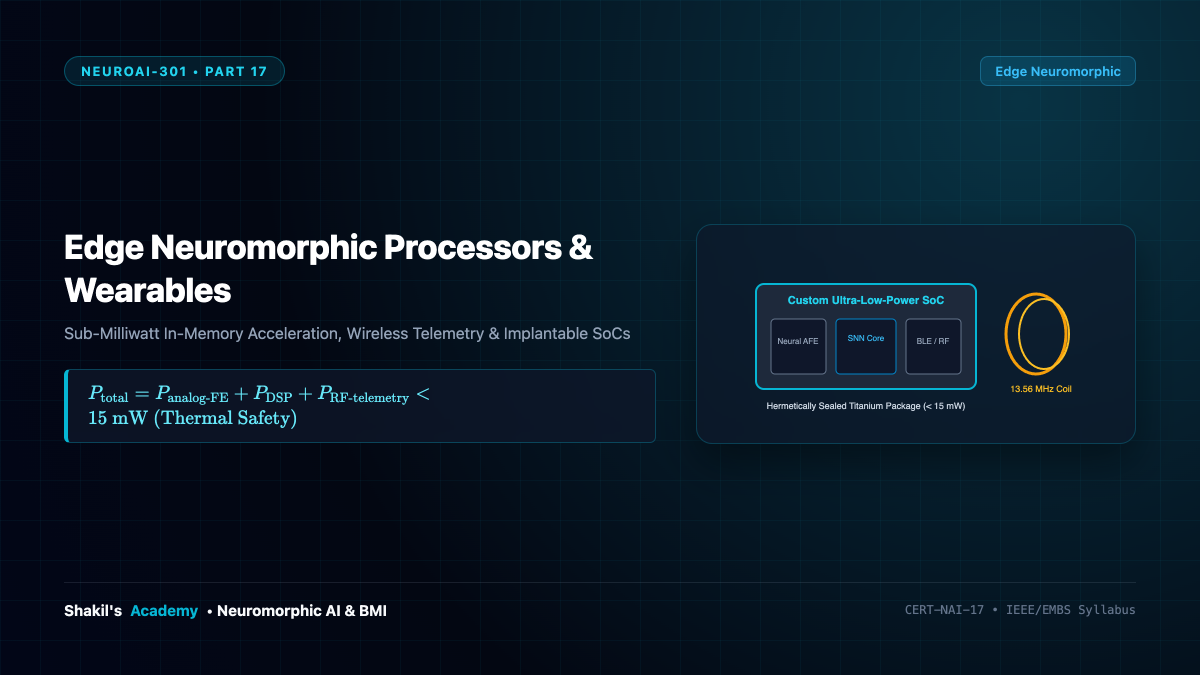
Fully implantable and wearable brain-machine interfaces operate under severe physical constraints that have no equivalent in server or desktop computing. Because biological brain tissue is exceptionally vulnerable to thermal injury, international medical device standards (ISO 14708) strictly mandate that no chronic implant may raise the temperature of surrounding cortex by more than (1.0^circ ext{C}) (limiting chronic power dissipation to under (15 ext{ to } 20 ext{ mW})). Fulfilling this requirement demands Edge Neuromorphic Systems-on-Chip (SoCs) that integrate analog front-ends, in-memory spiking neural network accelerators, and wireless inductive telemetry onto a single silicon die.
1. The Strict Thermal Safety Budget of Neural Implants
The relationship between steady-state implant power dissipation (P_{ ext{total}}) and cortical temperature rise (Delta T) is modeled by Pennes’ bioheat transfer equation:
[
ho c rac{partial T}{partial t} =
abla cdot (k
abla T) – omega_b c_b (T – T_a) + q_m + q_p
]
where (omega_b) is blood perfusion rate, (k) is tissue thermal conductivity, and (q_p = P / V) is device heat generation. For an implant resting against the cortical surface:
[
Delta T_{ ext{max}} approx rac{P_{ ext{total}}}{2 pi k R_{ ext{eff}}} le 1.0^circ ext{C} implies P_{ ext{total}} < 15 ext{ mW}
]
This 15 mW power envelope must cover all subsystems simultaneously: Analog Front-End (AFE) amplification, multi-channel analog-to-digital conversion (ADC), DSP feature extraction, spiking neural network inference, and RF telemetry.
2. Analog Front-End (AFE) Power Minimization
In a 1024-channel intracortical interface (such as Neuralink’s N1 ASIC), dedicating just (15 mu ext{W}) per channel would entirely consume the 15 mW power budget before running a single arithmetic operation! Engineers achieve extreme front-end efficiency through:
- Subthreshold Operational Transconductance Amplifiers (OTAs): Biasing input differential pairs in weak inversion maximizes the transconductance-to-current ratio:
[
rac{g_m}{I_D} approx rac{q}{n k_B T} approx 28 ext{V}^{-1}
]
delivering high open-loop gain with nanoamp bias currents. - Noise Efficiency Factor (NEF): A standardized figure of merit evaluating amplifier trade-off between input-referred noise (V_{n, ext{in}}) and total current (I_{ ext{tot}}):
[
ext{NEF} = V_{n, ext{in}} sqrt{rac{2 I_{ ext{tot}}}{pi cdot U_T cdot 4 k_B T cdot ext{BW}}}
]
Cutting-edge neural AFEs achieve ( ext{NEF} le 1.8) (close to the theoretical limit of 1.0 for a single BJT), reducing per-channel power to (< 5 mu ext{W}).
3. Mixed-Signal In-Memory Computing (CIM)
To eliminate data transfer energy, edge neuromorphic ASICs embed spiking neural network accelerators directly adjacent to the electrode array using Compute-in-Memory (CIM) architectures:
[
E_{ ext{inference}} = N_{ ext{synapses}} imes E_{ ext{SOP}} quad ext{where } E_{ ext{SOP}} le 100 ext{ fJ (0.1 pJ)}
]
Using charge-sharing switched-capacitor banks or non-volatile RRAM crossbars, the chip executes spike feature classification (such as intention decoding or motor kinematics) entirely on-chip, transmitting only low-bandwidth decoded vectors rather than raw gigabit raw data streams.
4. Transcutaneous Inductive Power and RF Telemetry
To avoid transcutaneous wires penetrating the skin (which present a chronic infection vector), medical implants utilize Near-Field Resonant Inductive Coupling:
- An external primary coil worn behind the ear transmits alternating magnetic fields at the industrial, scientific, and medical (ISM) frequency of (13.56 ext{ MHz}) or (6.78 ext{ MHz}).
- An implanted secondary titanium-encapsulated receiver coil rectifies the AC magnetic flux using high-efficiency active Schottky diode bridges, generating regulated (1.8 ext{ V}) and (3.3 ext{ V}) DC rails with (> 70%) power transfer efficiency across a (5 ext{ mm}) skin flap.
- High-speed telemetry transmits decoded spiketrains outward using ultra-low-power Bluetooth Low Energy (BLE) or ultra-wideband (UWB) impulse radio, consuming less than (1 ext{ nJ per bit}).