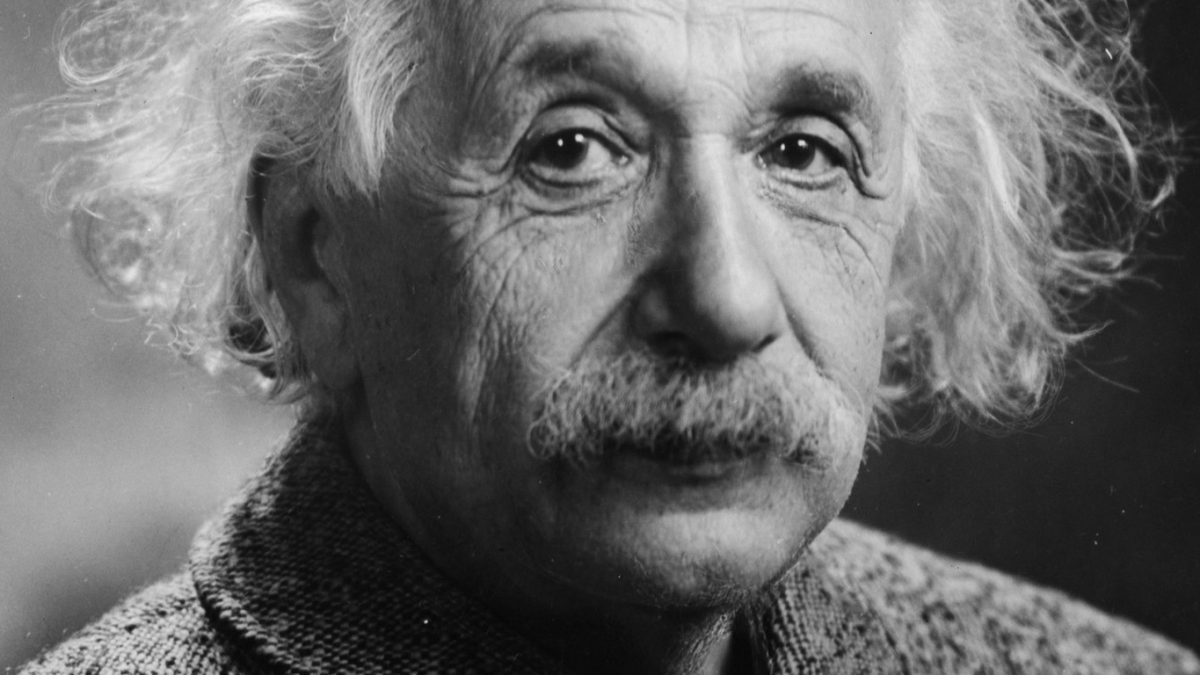
In 1905, during his Annus Mirabilis (Miracle Year) as a technical examiner at the Bern patent office, twenty-six-year-old Albert Einstein published four papers that revolutionized the foundations of science. His June 1905 paper, “Zur Elektrodynamik bewegter Körper” (On the Electrodynamics of Moving Bodies), demolished Isaac Newton’s three-hundred-year-old dogma of absolute space and uniform, flowing time, forging space and time into a single four-dimensional continuum: spacetime.
The Crisis of the Luminiferous Aether
Maxwell’s wave equations proved that electromagnetic waves propagate at speed $c$. But velocity according to Galilean relativity must always be measured relative to a medium. Physicists had posited the existence of an invisible, rigid, friction-free substance permeating all matter and void: the luminiferous aether.
If Earth orbited the Sun through this stationary aether sea at roughly 30 km/s, an ‘aether wind’ should alter the measured speed of light along perpendicular axes. In 1887, at Case School of Applied Science in Cleveland, Ohio, Albert A. Michelson and Edward W. Morley constructed the world’s most sensitive optical interferometer, floating on an annular sandstone slab inside a trough of liquid mercury.
The result was a devastating, historic null: no fringe shifts were detected. Light moved at precisely the identical speed in all directions regardless of the Earth’s orbital velocity through space.
Einstein’s Two Radical Postulates
Where Hendrik Lorentz and Henri Poincaré proposed ad hoc physical contractions of objects moving through the aether, Einstein took an audacious conceptual leap: discard the aether entirely and accept the experimental facts as fundamental principles.
- Time Dilation: Moving clocks tick slower: $Delta t = gamma Delta t_0$.
- Length Contraction: Moving objects contract along their direction of motion: $L = frac{L_0}{gamma}$.
- Relativistic Velocity Addition: $u = frac{u’ + v}{1 + frac{u’v}{c^2}}$, ensuring no material signal can ever exceed $c$.
Minkowski’s Spacetime & E = mc²
In 1908, Hermann Minkowski formalized Einstein’s physics into a non-Euclidean four-dimensional geometry:
“Henceforth space by itself, and time by itself, are doomed to fade away into mere shadows, and only a kind of union of the two will preserve an independent reality.” — Hermann Minkowski, 1908
In his follow-up paper of September 1905, Einstein deduced the ultimate symmetry of mass and energy. If a body emits energy $L$ in radiation, its mass diminishes by $L/c^2$. Generalized across all physical domains, mass is simply concentrated, latent energy:
$$E = gamma m_0 c^2$$
For an object at rest ($v = 0, gamma = 1$), this reduces to the most celebrated formula in human civilization:
$$E_0 = m c^2$$
Because $c^2 approx 9 times 10^{16} text{ m}^2/text{s}^2$, a single gram of matter conceals ninety terajoules of energy—the energetic engine that powers the stars, drives nuclear fission, and binds the cosmic order.
- The Principle of Relativity: The laws of physics are identical in all inertial (non-accelerating) reference frames.
- The Constancy of the Speed of Light: Light in vacuum propagates with a definite speed $c$, independent of the state of motion of the emitting body or the observer.
The Lorentz Transformations & The Death of Simultaneity
To reconcile these two postulates, the classical Galilean transformation ($x’ = x – vt, t’ = t$) had to be replaced by the relativistic Lorentz transformations:
$$x’ = gamma (x – vt), quad y’ = y, quad z’ = z, quad t’ = gamma left( t – frac{vx}{c^2} right)$$
where the Lorentz factor $gamma$ is defined as:
$$gamma = frac{1}{sqrt{1 – frac{v^2}{c^2}}}$$
The immediate physical consequence was shattering: simultaneity is relative. Two events that appear simultaneous to an observer at rest occur at different times to an observer in motion. Furthermore, as velocity approaches $c$ ($gamma to infty$):
- Time Dilation: Moving clocks tick slower: $Delta t = gamma Delta t_0$.
- Length Contraction: Moving objects contract along their direction of motion: $L = frac{L_0}{gamma}$.
- Relativistic Velocity Addition: $u = frac{u’ + v}{1 + frac{u’v}{c^2}}$, ensuring no material signal can ever exceed $c$.
Minkowski’s Spacetime & E = mc²
In 1908, Hermann Minkowski formalized Einstein’s physics into a non-Euclidean four-dimensional geometry:
“Henceforth space by itself, and time by itself, are doomed to fade away into mere shadows, and only a kind of union of the two will preserve an independent reality.” — Hermann Minkowski, 1908
In his follow-up paper of September 1905, Einstein deduced the ultimate symmetry of mass and energy. If a body emits energy $L$ in radiation, its mass diminishes by $L/c^2$. Generalized across all physical domains, mass is simply concentrated, latent energy:
$$E = gamma m_0 c^2$$
For an object at rest ($v = 0, gamma = 1$), this reduces to the most celebrated formula in human civilization:
$$E_0 = m c^2$$
Because $c^2 approx 9 times 10^{16} text{ m}^2/text{s}^2$, a single gram of matter conceals ninety terajoules of energy—the energetic engine that powers the stars, drives nuclear fission, and binds the cosmic order.