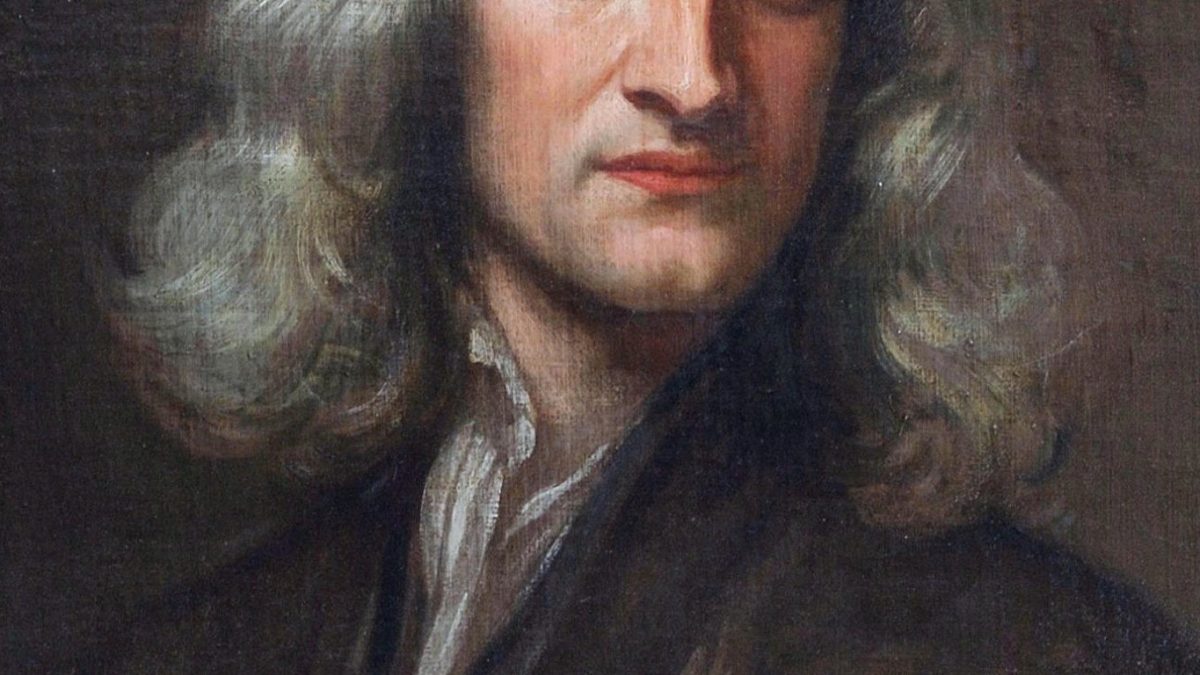
In 1665, when the Great Plague closed the University of Cambridge, a twenty-two-year-old student named Isaac Newton retreated to his family home in Woolsthorpe, Lincolnshire. Over the next eighteen months of isolation, in what is widely regarded as the most extraordinary intellectual surge in history, Newton developed the foundations of calculus, conducted pioneering experiments in the dispersion of light, and conceived the law of universal gravitation. Twenty-two years later, in 1687, the Royal Society published his masterwork: Philosophiae Naturalis Principia Mathematica.
1. The Mechanical Foundations: The Three Axioms of Motion
Newton began not with speculation, but by defining mass, momentum ($p = mv$), and force, formulating the three universal laws of motion that govern classical mechanics:
Every body continues in its state of rest or uniform motion in a right line unless compelled to change that state by forces impressed upon it.
The rate of change of momentum is directly proportional to the applied force and occurs in the direction of the straight line in which the force acts.
To every action there is always opposed an equal and opposite reaction.
2. Universal Gravitation: Bridging the Earth and the Moon
Newton’s profound insight was unification: the downward acceleration that causes an apple to fall from a tree is the exact same physical force that holds the Moon in its orbit around the Earth. If gravity did not act on the Moon, it would fly off into space along a straight tangential path.
By comparing the Moon’s orbital acceleration ($a_{text{moon}} = v^2/r approx 0.00272text{ m/s}^2$) with the acceleration at Earth’s surface ($g approx 9.8text{ m/s}^2$), Newton noted that the distance from Earth’s center to the Moon is approximately $60$ Earth radii:
This was the experimental confirmation of the Inverse-Square Law: gravitational attraction decays precisely with the square of the distance between centers of mass:
3. Deriving Kepler’s Laws from First Principles
Before Newton, Johannes Kepler had empirically described planetary motion with three kinematic rules, but had no causal explanation for why they held. Using his new calculus of fluxions, Newton proved that an inverse-square central force mathematically requires:
- Orbits are Conic Sections: Bound trajectories must be ellipses with the Sun at one focus.
- Conservation of Angular Momentum: Equal areas are swept out in equal times ($frac{dA}{dt} = frac{L}{2m} = text{constant}$).
- Harmonic Law: The square of the orbital period $T$ is proportional to the cube of the semi-major axis $a$: