For decades, twentieth-century astrophysics was locked in a bitter philosophical stalemate between two competing cosmological paradigms: Fred Hoyle’s Steady State model, which posited an eternal universe with continuous matter creation, and Georges Lemaître and George Gamow’s Big Bang model, which proposed an explosive primordial origin. In the spring of 1964, at Bell Laboratories on Crawford Hill in Holmdel, New Jersey, two young radio astronomers stumbled upon an intractable, isotropic hum that decisively settled the debate: the thermal afterglow of creation itself.
Gamow’s Primeval Fireball Prediction
In 1948, Russian-American physicist George Gamow, alongside Ralph Alpher and Robert Herman, calculated the nuclear synthesis of light elements in the early expanding cosmos. They realized that if the universe originated in an ultra-dense, ultra-hot state, it must have been dominated by high-energy blackbody radiation.
As the spacetime fabric expanded, the wavelength of these primordial photons stretched in direct proportion to the cosmic scale factor $a(t)$:
$$lambda_{text{obs}} = lambda_{text{emit}} frac{a(t_{text{obs}})}{a(t_{text{emit}})} = lambda_{text{emit}} (1 + z)$$
Alpher and Herman predicted that this relic radiation should still bathe the universe today, cooled by cosmic expansion to a frigid thermodynamic temperature of roughly 5 Kelvin.
The Crawford Hill Horn Antenna and the Persistent Noise
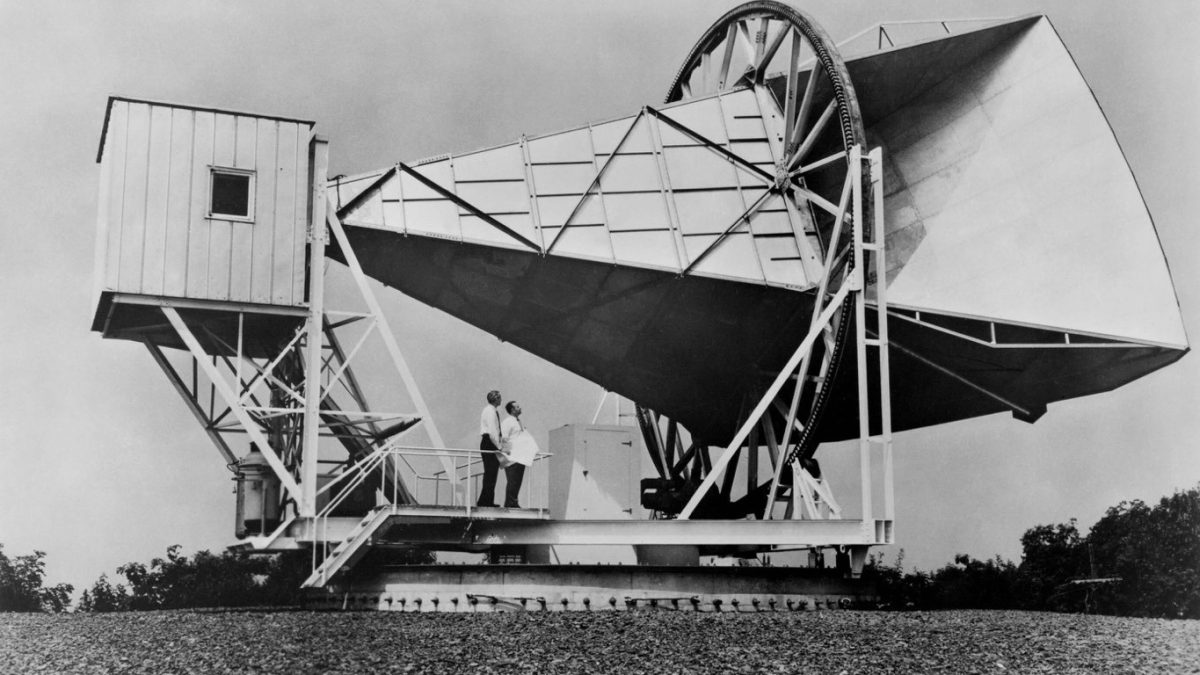
In 1964, Arno Penzias and Robert Wilson were repurposing a 20-foot Holmdel horn antenna, originally built for Project Echo satellite communications, to measure radio emissions from the halo of the Milky Way at a wavelength of 7.35 cm.
To their frustration, their receiver registered a persistent, uniform excess antenna temperature of approximately $3.5 pm 1.0 text{ K}$. It was entirely unpolarized, did not vary with the day-night cycle, remained constant regardless of where the antenna pointed in the sky, and showed no seasonal dependence. They painstakingly dismantled the electronics, taped over structural seams, and scrubbed out “a layer of white dielectric material” deposited by a pair of nesting pigeons. The mysterious hum remained unchanged.
The Princeton Connection and Decoupling
Just thirty miles away at Princeton University, a theoretical astrophysics team led by Robert Dicke, Jim Peebles, and David Wilkinson was actively designing an experiment to search for relic Big Bang radiation. During a phone call between Penzias and Dicke, the pieces snapped together. Hanging up the receiver, Dicke turned to his colleagues and famously murmured: “Well boys, we’ve been scooped.”
In 1965, the two teams published side-by-side papers in the Astrophysical Journal. Penzias and Wilson had detected the Cosmic Microwave Background (CMB): photons released when the universe was approximately 380,000 years old, during the epoch of recombination ($z approx 1100$). Before this epoch, temperatures exceeded 3,000 K, and universe was an opaque plasma of free electrons and protons. Once neutral hydrogen atoms formed, photons decoupled and traveled freely through spacetime for 13.8 billion years.
The Purest Blackbody in Nature
In 1989, NASA launched the Cosmic Background Explorer (COBE) satellite. John Mather and the FIRAS instrument measured the spectral radiance of the CMB across hundreds of frequency bands. When the data points were plotted alongside theoretical Planck blackbody radiation curve at $T = 2.725 text{ K}$, the error bars were smaller than the thickness of the printed line:
$$B_nu(T) = frac{2hnu^3}{c^2} frac{1}{e^{frac{hnu}{k_B T}} – 1}, quad T_0 = 2.72548 pm 0.00057 text{ K}$$
Simultaneously, George Smoot’s DMR instrument uncovered primordial temperature fluctuations on the scale of $frac{Delta T}{T} sim 10^{-5}$—the quantum ripples that collapsed under gravity to seed all galaxies, stars, and planets. Cosmology had transformed from philosophical speculation into an exact physical science.