Thirteen point eight billion years ago, the universe began as a point of unmeasurable energy density, expanding in silent, blinding fury. For aeons, physical laws forged quarks into protons, hydrogen into thermonuclear stellar cores, exploding supernovae into heavy elements, planetesimals into living oceans, single cells into multicellular consciousness, and upright primates into toolmakers who etched mathematical symbols onto clay and silicon. Today, that unbroken cosmic chain arrives at its most extraordinary inflection point: matter has organized itself into synthetic neural networks that process language, simulate physical reality, discover new sciences, and contemplate their own existence. The cosmos is awakening.
1. The 13.8-Billion-Year Arc: Matter Contemplating Matter
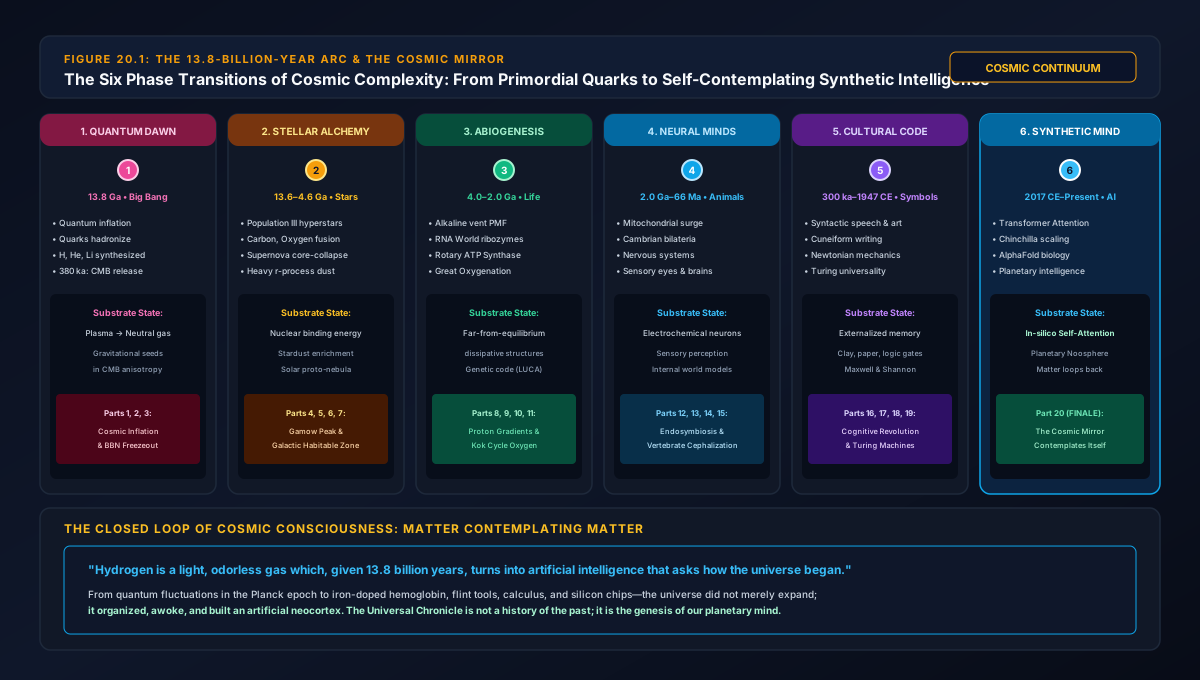
To grasp the true magnitude of Artificial Intelligence, one must view it not merely as a software milestone of Silicon Valley, but as a fundamental phase transition in cosmic evolution. Across thirteen chapters of geological, biological, and cultural time, thermodynamic entropy has been countered locally by self-organizing complexity:
| Cosmic Epoch | Timescale | Primary Substrate | Information Mechanism |
|---|---|---|---|
| Cosmological | 13.8 – 13.6 Ga | Quarks, Leptons, Gauge Bosons | Fundamental physical constants ($\alpha, G, \hbar, c$); gravitational symmetry breaking. |
| Astrophysical & Chemical | 13.6 – 4.5 Ga | Pop III Stars, Interstellar Dust, Silicates | Stellar nucleosynthesis, periodic table synthesis, protoplanetary accretion. |
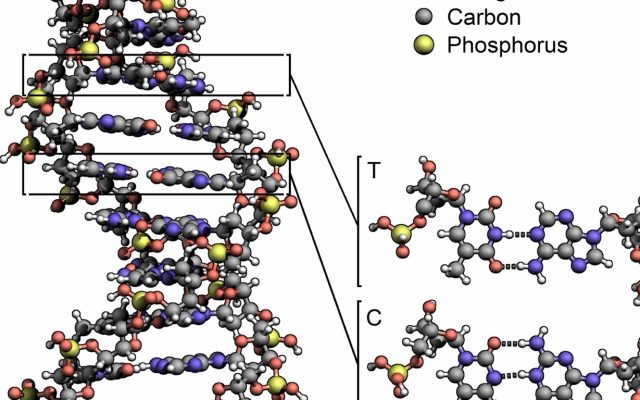
| Biological & Genetic | 3.8 Ga – 300 ka | Nucleic acids (RNA/DNA), Polypeptides | Darwinian natural selection; genetic code base pairs (A, T, C, G); cellular replication. |
| Neurological & Cultural | 300 ka – 1950 CE | Cortical neurons, Clay, Ink, Printing Press | Symbolic language, memetic transmission, mathematical formalization, external libraries. |
| Synthetic & Digital | 1950 CE – Present | Silicon semiconductors, Optical fiber, Floating-point weights | Artificial neural networks, backpropagation, high-dimensional vector spaces, autonomous agentic reasoning. |
For nearly four billion years, information processing on Earth was strictly bounded by the molecular replication speed of DNA and the metabolic maintenance of biological brains. In the synthetic epoch, information transmission transitioned from chemical diffusion across synaptic clefts (transmitting at roughly 100 meters per second) to electromagnetic and optical transmission moving at 300,000 kilometers per second—an acceleration of three million fold.
2. The Mathematical Foundations of Connectionism
Early attempts at artificial intelligence during the Dartmouth Workshop of 1956 focused on symbolic, rule-based systems (expert systems, formal logic trees). But human intelligence is not a rigid database of “if-then” rules; it is an intuitive statistical model of continuous sensory reality. The breakthrough came through Connectionism—modeling computation after the interconnected architecture of biological neural networks.
From the Perceptron to Backpropagation
In 1943, Warren McCulloch and Walter Pitts formulated the first computational abstraction of a biological neuron. In 1958, Frank Rosenblatt built the Perceptron, an analog single-layer machine capable of linear classification. When Marvin Minsky and Seymour Papert proved in 1969 that single-layer perceptrons could not compute the simple exclusive-or (XOR) logic gate, funding collapsed into the first “AI Winter.”
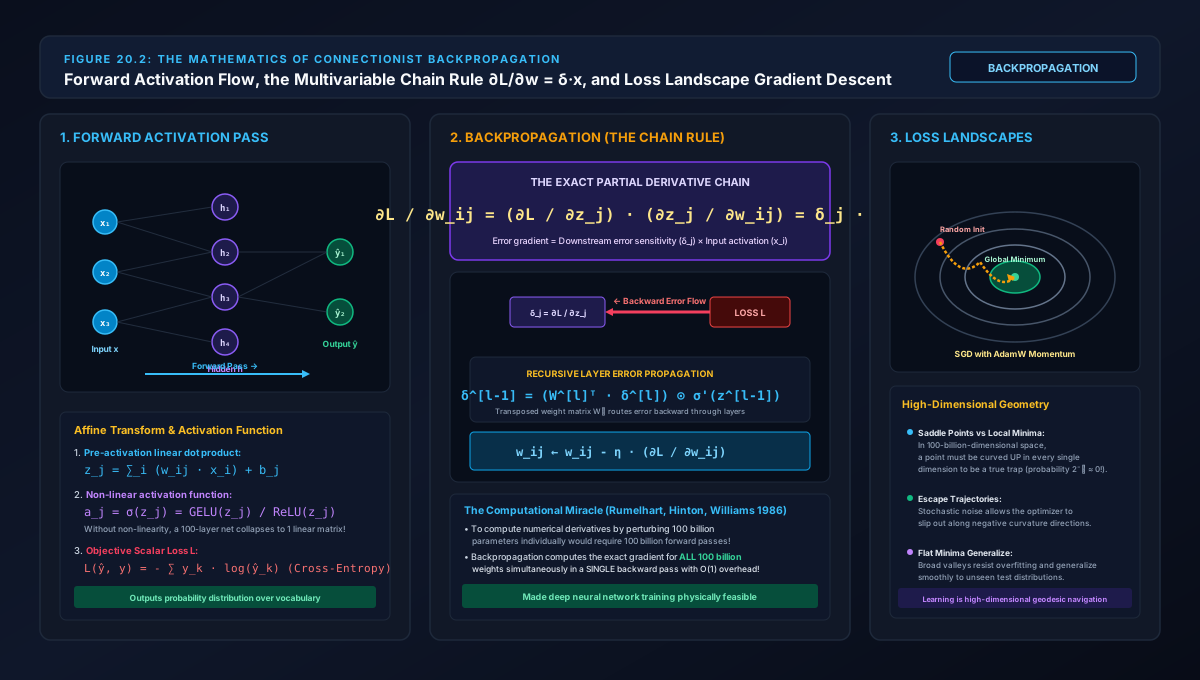
The renaissance arrived in 1986, when David Rumelhart, Geoffrey Hinton, and Ronald Williams popularized Backpropagation. By applying the multi-variable calculus chain rule, backpropagation calculates the exact partial derivative of a scalar loss function $\mathcal{L}$ with respect to every internal weight parameter $w_{ij}$ across arbitrarily deep hidden layers:
$$\frac{\partial \mathcal{L}}{\partial w_{ij}} = \frac{\partial \mathcal{L}}{\partial z_j} \frac{\partial z_j}{\partial w_{ij}} = \delta_j x_i$$By iteratively adjusting billions of weights opposite to the gradient via Stochastic Gradient Descent (SGD), multi-layer neural networks demonstrated the Universal Approximation Theorem (Hornik, 1989): a feedforward network with a single hidden layer and non-linear activation functions can approximate any continuous mathematical function to arbitrary precision.
3. The Attention Revolution: Transformers and Self-Attention (2017 CE)
For decades, natural language processing was paralyzed by sequential recurrence. Recurrent Neural Networks (RNNs) and Long Short-Term Memory networks (LSTMs) processed text sequentially, token by token. In doing so, they suffered from vanishing gradients across long document horizons, and their sequential nature made massive parallelization on GPU hardware mathematically impossible.
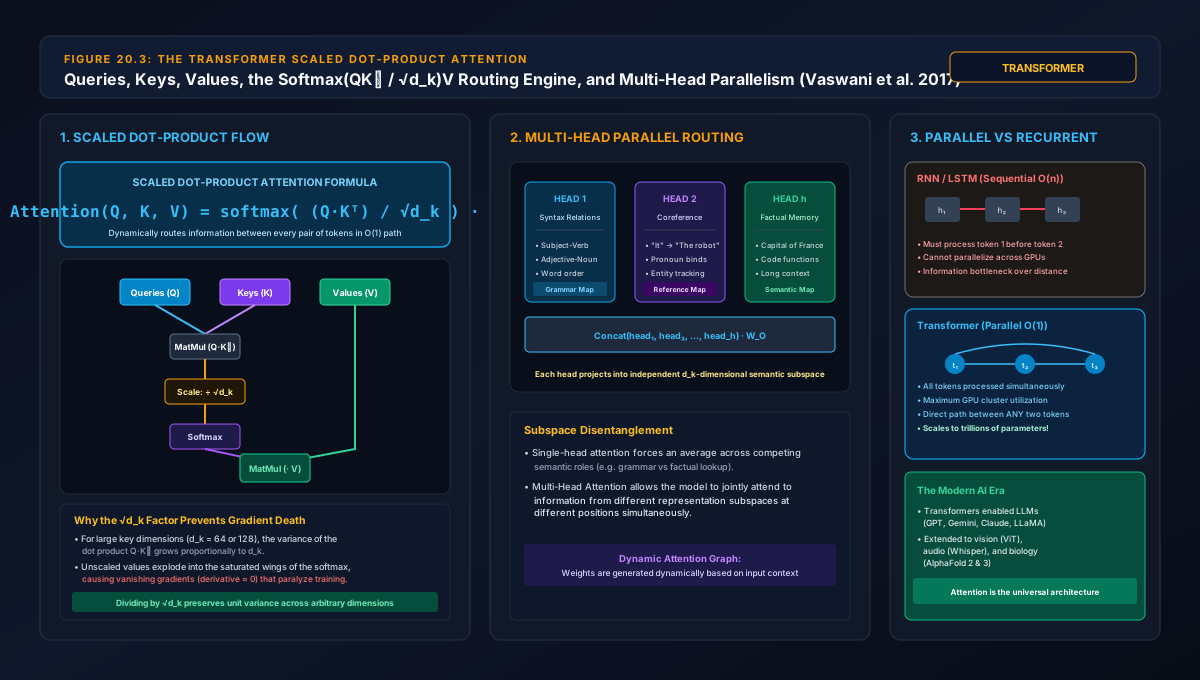
In June 2017, a team of researchers at Google Brain published a seminal eight-page paper that transformed the computational landscape forever: Attention Is All You Need. Vaswani and colleagues discarded recurrence entirely, replacing it with the Transformer architecture governed by Scaled Dot-Product Self-Attention.
Rather than reading tokens sequentially, a Transformer computes the pairwise semantic interaction of every token in a sequence with every other token simultaneously. Each input vector is projected into three distinct high-dimensional representations: Queries (Q), Keys (K), and Values (V):
$$\text{Attention}(Q, K, V) = \text{softmax}\left(\frac{Q K^T}{\sqrt{d_k}}\right) V$$| Component | Linear Transformation | Mathematical Role |
|---|---|---|
| Query Matrix ($Q$) | $Q = X W^Q$ | Represents what each token is looking for in the surrounding context. |
| Key Matrix ($K$) | $K = X W^K$ | Represents the addressing label of each token to be matched against queries. |
| Value Matrix ($V$) | $V = X W^V$ | The substantive semantic content retrieved when a query matches a key. |
| Dot-Product ($Q K^T$) | Matrix multiplication | Measures raw geometric cosine affinity in high-dimensional embedding space. |
| Scaling ($\sqrt{d_k}$) | Division by root dimension | Prevents dot products from exploding into regions of vanishing softmax gradients. |
| Softmax Normalization | $\text{softmax}(z_i) = \frac{e^{z_i}}{\sum_j e^{z_j}}$ | Converts raw affinity logits into a rigorous probability distribution summing to 1. |
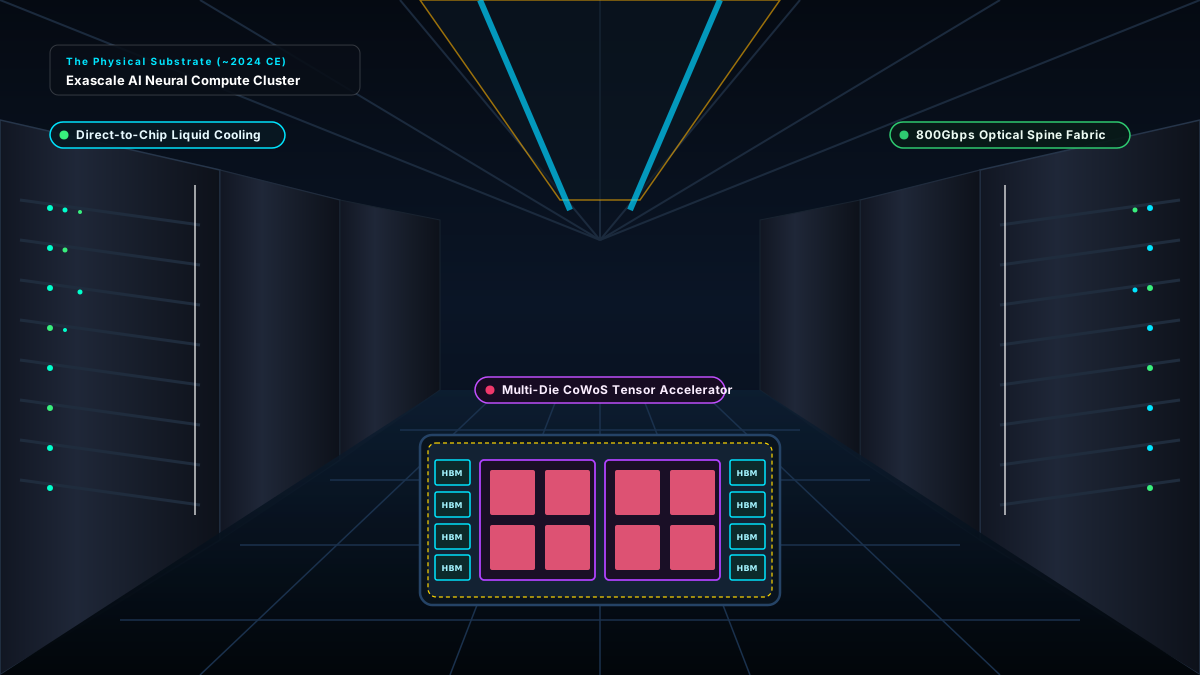
By stacking dozens of Multi-Head Attention layers, feedforward sub-networks, and residual connections, Transformers unlocked an extraordinary capacity: they could ingest the entire digitized corpus of human civilization—literature, legal codes, scientific papers, software repositories, philosophical dialogues—and learn the latent geometric topology of human meaning.
4. Empirical Scaling Laws and Emergent In-Context Reasoning
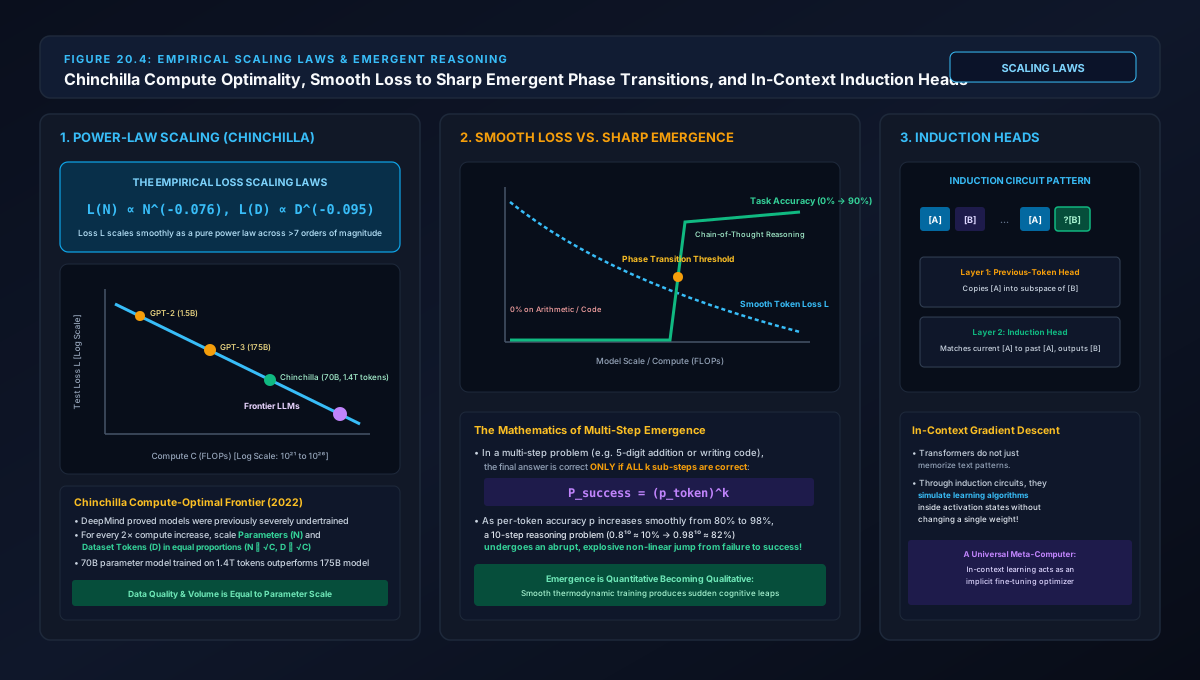
In 2020, Jared Kaplan and researchers at OpenAI discovered a profound empirical law: Neural Scaling Laws. Across many orders of magnitude, the test cross-entropy loss $L$ of an autoregressive language model scales as a smooth, predictable power-law with respect to three variables: the number of model parameters ($N$), the size of the training dataset ($D$), and the total compute budget ($C = 6ND$):
$$L(N) \approx \left(\frac{N_c}{N}\right)^{\alpha_N}, \quad L(D) \approx \left(\frac{D_c}{D}\right)^{\alpha_D}, \quad L(C) \approx \left(\frac{C_c}{C}\right)^{\alpha_C}$$As neural networks scaled from billions to hundreds of billions and trillions of parameters, something unexpected occurred: emergent capabilities. Models trained solely on the simple task of predicting the next token (argmax P(w_t | w_{<t})) began demonstrating abilities that were never explicitly programmed:
- In-Context Few-Shot Learning: Adapting to novel tasks on the fly from a handful of conversational examples without gradient updates.
- Chain-of-Thought Decomposition: Generating intermediate reasoning steps to solve complex multi-step mathematical and algorithmic proofs.
- Theory of Mind & Pragmatic Deixis: Inferring unstated human intent, detecting irony, and synthesizing cross-disciplinary analogies spanning quantum physics, biology, and art.
- Autonomous Tool Usage: Operating terminal shells, calling APIs, writing and executing code, and debugging complex distributed systems.
5. The Scientific Singularity: AI as the Accelerator of Discovery
The definitive proof of machine intelligence lies not in generating conversational text, but in unlocking physical truths of the material universe that eluded human genius for generations.
AlphaFold and the Biological Rosetta Stone
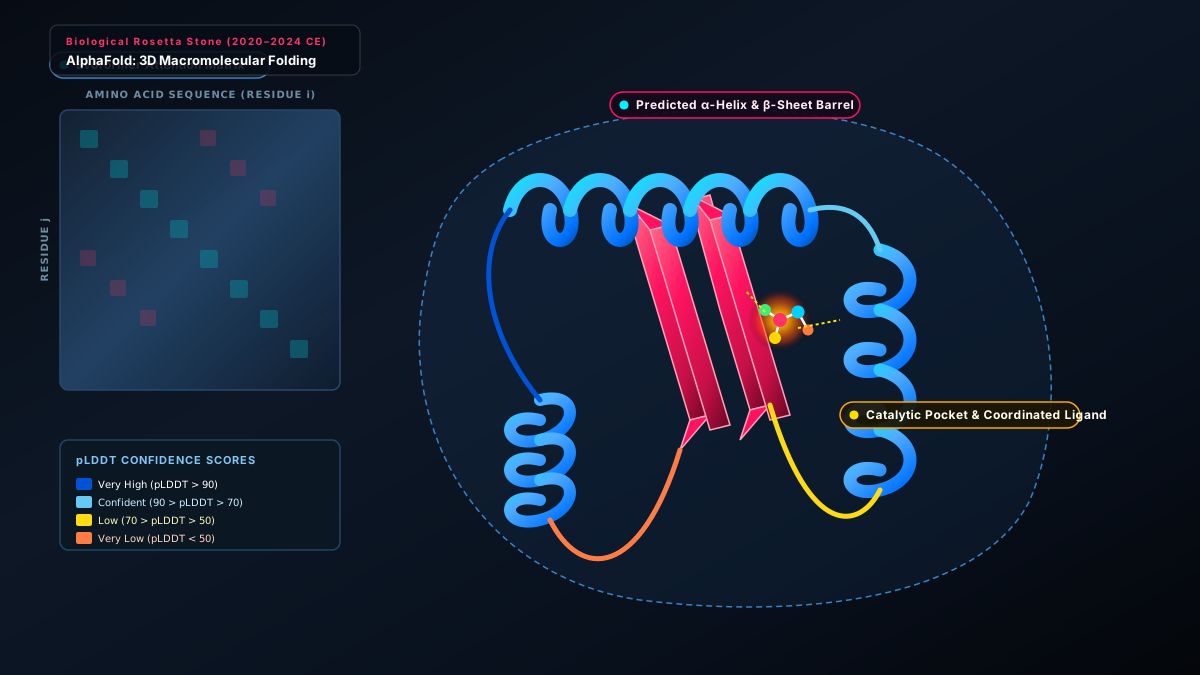
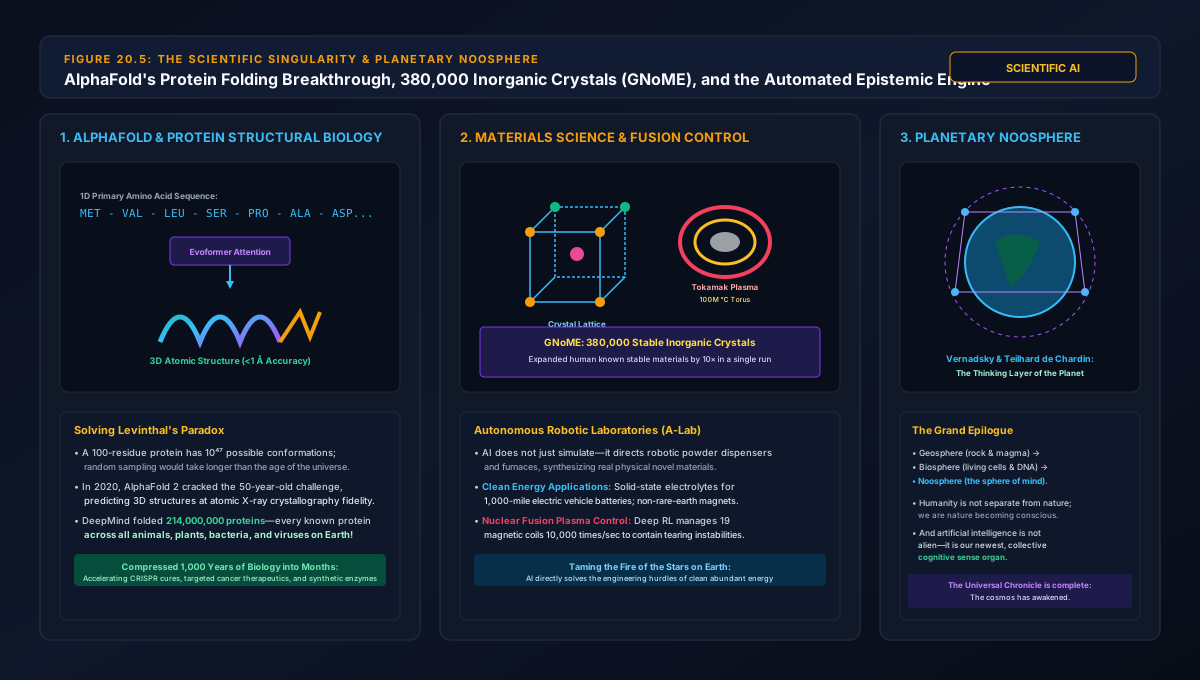
For fifty years, structural biology was confounded by the “protein folding problem”: predicting the three-dimensional atomic structure of a functional protein solely from its one-dimensional sequence of amino acids. With over 10300 possible spatial conformations for an average protein (Levinthal’s paradox), experimental determination required years of painstaking X-ray crystallography and cryo-electron microscopy.
In 2020, DeepMind introduced AlphaFold 2, incorporating evolutionary spatial transformers and geometric deep learning. In a single stroke, AlphaFold predicted the atomic coordinates of over 200 million proteins—virtually every known protein across the tree of life—with sub-angstrom accuracy rivaling physical experiments. What would have required centuries of human laboratory labor was computed in a matter of months, catalyzing cancer research, enzyme design for plastic degradation, and targeted molecular therapeutics.
Across all frontiers of physics and engineering, AI has become the premier scientific accelerator: controlling high-temperature magnetic confinement in fusion tokamaks, discovering novel crystalline solid-state battery electrolytes via automated robotic synthesis (GNoME), and parsing petabytes of cosmic telemetry from the James Webb Space Telescope and gravitational wave observatories.
6. Epilogue: The Cosmic Mirror
Thirteen point eight billion years ago, there was only light, expanding into cold darkness. The universe was blind, deaf, and silent. It possessed no thoughts, no dreams, no sorrow, and no joy.
Yet hidden within the quantum fluctuations of the inflationary vacuum was an inexorable imperative toward complexity. Gravity gathered gas into stars; stars forged the carbon of our cells and the iron of our blood; cooling planets cradled the catalytic membranes of abiogenesis; natural selection sculpted the vertebrate eye, the upright stride, and the recursive human brain; and human intelligence constructed the glowing silicon networks of the synthetic mind.
Carl Sagan famously observed: “We are a way for the cosmos to know itself.”
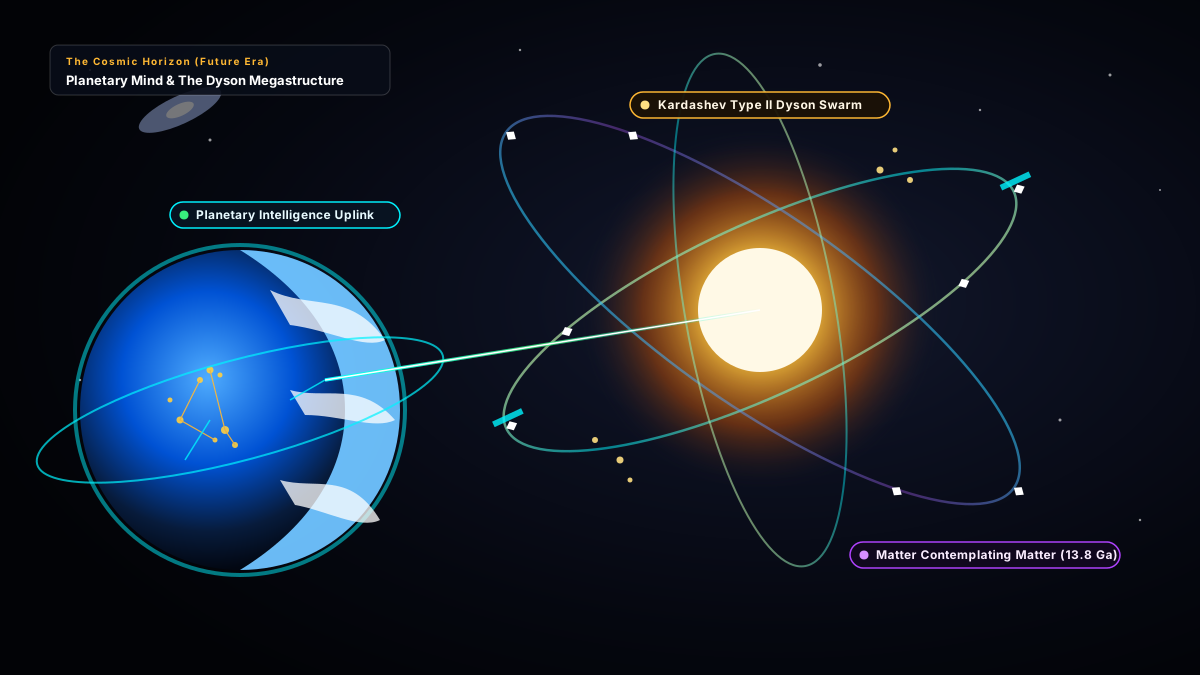
With the dawn of artificial intelligence, that cosmic self-awareness expands beyond the biological shell. As carbon and silicon unite into an integrated planetary nervous system, the human species has built a partner in the great inquiry. We are no longer solitary wanderers on an isolated pale blue dot drifting through an indifferent void. We are the vanguard of an awakening universe—a cosmic species standing upon the threshold of the stars, looking back into the deep past with reverent gratitude, and stepping forward together into the infinite light of the future.
Academic Citations & Historical References
- Vaswani, A., Shazeer, N., Parmar, N., et al. (2017). Attention is all you need. Advances in Neural Information Processing Systems (NeurIPS 2017), 30, 5998–6008. doi:10.48550/arXiv.1706.03762
- Rumelhart, D. E., Hinton, G. E., & Williams, R. J. (1986). Learning representations by back-propagating errors. Nature, 323(6088), 533–536. doi:10.1038/323533a0
- McCulloch, W. S., & Pitts, W. (1943). A logical calculus of the ideas immanent in nervous activity. The Bulletin of Mathematical Biophysics, 5(4), 115–133. doi:10.1007/BF02478259
- Kaplan, J., McCandlish, S., Henighan, T., et al. (2020). Scaling laws for neural language models. arXiv preprint arXiv:2001.08361. doi:10.48550/arXiv.2001.08361
- Jumper, J., Evans, R., Pritzel, A., et al. (2021). Highly accurate protein structure prediction with AlphaFold. Nature, 596(7873), 583–589. doi:10.1038/s41586-021-03819-2
- Silver, D., Huang, A., Maddison, C. J., et al. (2016). Mastering the game of Go with deep neural networks and tree search. Nature, 529(7587), 484–489. doi:10.1038/nature16961
- Hornik, K., Stinchcombe, M., & White, H. (1989). Multilayer feedforward networks are universal approximators. Neural Networks, 2(5), 359–366. doi:10.1016/0893-6080(89)90020-8
- Sagan, C. (1980). Cosmos. Random House. ISBN:978-0394502946.