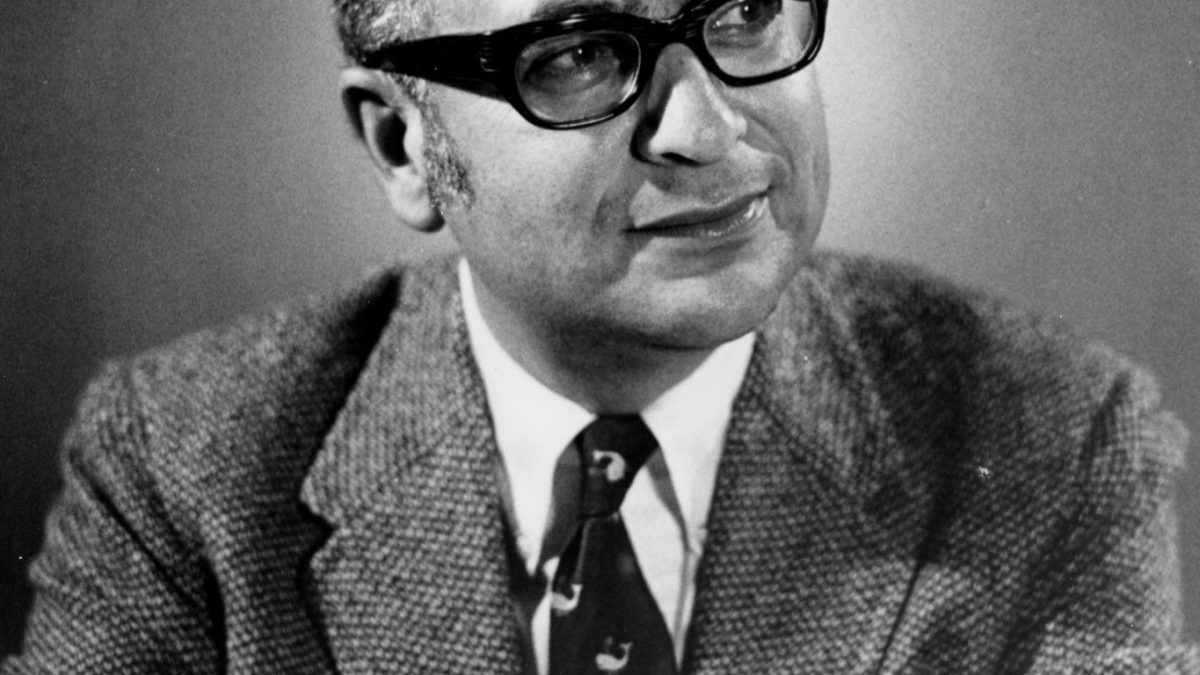
By the late 1950s, the pristine simplicity of early twentieth-century physics—atoms composed of protons, neutrons, and electrons interacting via photons—had degenerated into chaotic anarchy. High-energy cyclotrons and synchrotrons were blasting atomic nuclei apart, discovering hundreds of strongly interacting subatomic particles: pions, kaons, lambdas, sigmas, and deltas. Physicist Willis Lamb quipped in his Nobel lecture that the finder of a new subatomic particle should be punished with a $10,000 fine. The man who brought order to this bewildering ‘Particle Zoo’ was Caltech polymath Murray Gell-Mann.
Strangeness and the Eightfold Way
The new particles presented a profound puzzle: they were produced copiously and rapidly via the strong nuclear force ($10^{-23}$ seconds), yet they decayed extraordinarily slowly via the weak force ($10^{-10}$ seconds). In 1953, Gell-Mann and Kazuhiko Nishijima solved the riddle by introducing a new conserved quantum number: Strangeness ($S$), related to electric charge $Q$, third component of isospin $I_3$, and baryon number $B$:
$$Q = I_3 + frac{Y}{2} = I_3 + frac{B + S}{2}$$
In 1961, Gell-Mann (and independently Yuval Ne’eman) organized the known mesons and baryons into geometric hexagonal and octagonal patterns based on the mathematical Lie group $SU(3)_{text{flavor}}$. Gell-Mann poetically dubbed this classification the Eightfold Way, after the Buddhist Noble Eightfold Path.
The Prediction of the Omega-Minus (Ω⁻)
When arranging spin-$3/2$ baryons into a ten-member pyramid (decuplet), the apex was conspicuously vacant. Gell-Mann predicted the existence of an undiscovered particle: the Omega-Minus ($Omega^-$), calculating its electric charge ($-1$), strangeness ($S = -3$), and rest mass ($approx 1680 text{ MeV}/c^2$):
In February 1964, Nicholas Samios and his team at Brookhaven National Laboratory analyzed 100,000 bubble chamber photographs and discovered the $Omega^-$ particle with a measured mass of $1672 text{ MeV}/c^2$. The triumph echoed Mendeleev’s periodic table prediction of gallium and germanium a century earlier.
The Quark Hypothesis
Why did hadrons arrange themselves into the representations of $SU(3)$? In 1964, Gell-Mann (and independently George Zweig, who called them ‘aces’) proposed a radical underlying ontology: protons, neutrons, and all hadrons are not fundamental. They are composite structures built from fractional-charge spin-$1/2$ constituents:
Gell-Mann named them quarks, inspired by a nonsensical line in James Joyce’s Finnegans Wake: “Three quarks for Muster Mark!”
- Up ($u$): Charge $= +frac{2}{3}e$, Strangeness $= 0$
- Down ($d$): Charge $= -frac{1}{3}e$, Strangeness $= 0$
- Strange ($s$): Charge $= -frac{1}{3}e$, Strangeness $= -1$
Under this elegant scheme, a proton is simply $uud$ ($+frac{2}{3} + frac{2}{3} – frac{1}{3} = +1$), a neutron is $udd$ ($+frac{2}{3} – frac{1}{3} – frac{1}{3} = 0$), and mesons are bound quark-antiquark pairs ($qbar{q}’$).
Deep Inelastic Scattering and the Standard Model
Between 1968 and 1971, Jerome Friedman, Henry Kendall, and Richard Taylor fired 20-GeV electrons from the two-mile linear accelerator at SLAC deep into liquid hydrogen protons. The electrons bounced off hard, localized point-like constituents inside the proton—proving that quarks were not merely mathematical book-keeping devices, but concrete physical reality.
Over the subsequent decades, three heavier quark flavors were discovered—Charm ($c$, 1974), Bottom ($b$, 1977), and Top ($t$, 1995)—completing the three generations of matter. Bound together by gluons carrying the color charge of Quantum Chromodynamics (QCD), quarks cemented the Standard Model of particle physics:
$$SU(3)_C times SU(2)_L times U(1)_Y$$