In June 1916, Albert Einstein published a paper demonstrating that accelerated masses generate oscillating disturbances in the fabric of spacetime that propagate outward at the speed of light: gravitational waves. Yet Einstein was so deeply ambivalent about their physical reality that in 1936 he submitted a paper attempting to prove they did not exist. For a century, gravitational waves remained undetected because their interaction with matter is staggeringly infinitesimal. On September 14, 2015, human civilization crossed an epochal threshold when the twin detectors of the Laser Interferometer Gravitational-Wave Observatory (LIGO) recorded the sound of two colliding black holes 1.3 billion light-years away.
The Linearized Einstein Field Equations
In the weak-field regime, spacetime can be expressed as flat Minkowski metric $eta_{munu}$ perturbed by a microscopic strain tensor $h_{munu}$ ($|h_{munu}| ll 1$):
$$g_{munu} = eta_{munu} + h_{munu}$$
Under the Lorenz gauge condition ($partial^mu bar{h}_{munu} = 0$), Einstein’s non-linear field equations linearize into three-dimensional inhomogeneous wave equations:
$$Box bar{h}_{munu} = left( -frac{1}{c^2}frac{partial^2}{partial t^2} + nabla^2 right) bar{h}_{munu} = -frac{16pi G}{c^4} T_{munu}$$
Because the source of gravitational waves is the mass quadrupole moment tensor $I_{ij}$, purely spherically symmetric pulsations emit zero radiation. The total radiated gravitational power follows Einstein’s Quadrupole Formula:
$$P = frac{G}{5c^5} leftlangle dddot{I}_{ij} dddot{I}_{ij} rightrangle$$
Because the denominator contains $c^5 approx 2.43 times 10^{42} text{ m}^5/text{s}^5$, only the violent collision of cosmic leviathans—neutron stars and black holes—can generate detectable amplitudes.
LIGO: The Pinnacle of Metrological Engineering
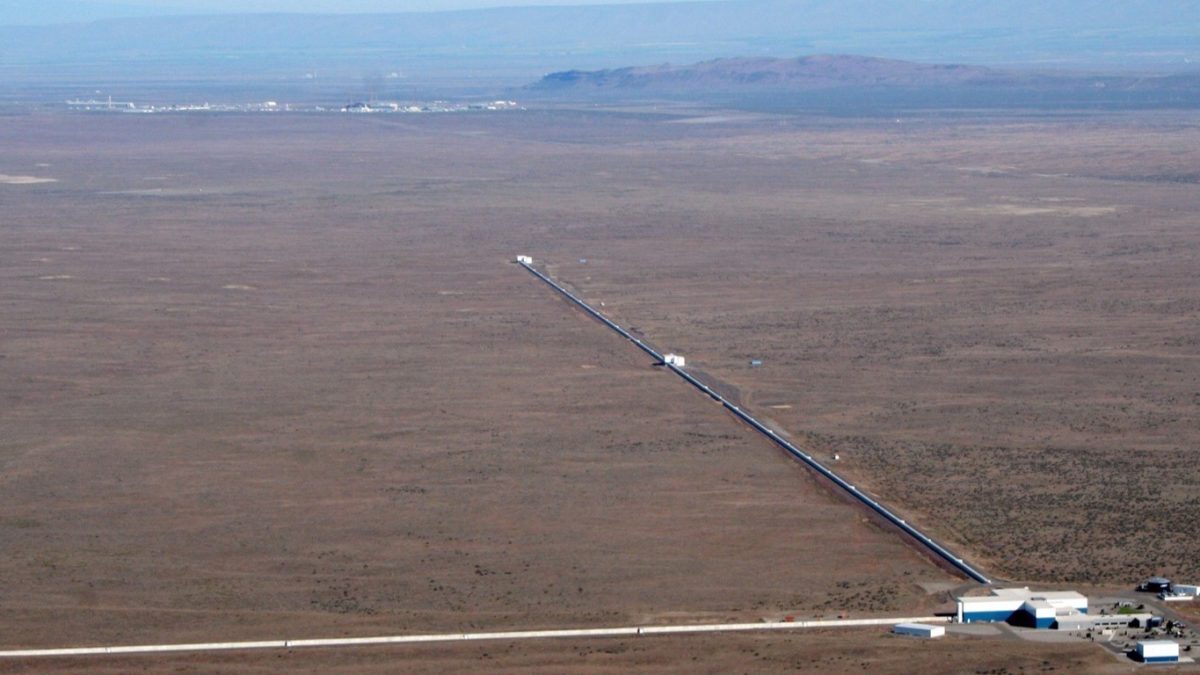
Conceived by Rainer Weiss, Kip Thorne, and Ronald Drever, Advanced LIGO operates two identical L-shaped Michelson interferometers separated by 3,002 kilometers—one in Hanford, Washington, and the other in Livingston, Louisiana. Each arm stretches exactly 4 kilometers inside ultra-high vacuum tubes.
When a transverse quadrupole gravitational wave passes through Earth, it alternatively stretches one arm while compressing the orthogonal arm:
$$h = frac{2 Delta L}{L}$$
For an incoming astrophysical strain of $h sim 10^{-21}$, the differential arm length change across a 4-kilometer laser path is:
$$Delta L approx 10^{-18} text{ meters}$$
This is less than one-thousandth the diameter of a single proton! To achieve this sensitivity, LIGO suspended 40-kilogram fused silica test-mass mirrors on quadruply-isolated pendulums, cooled laser optics, and pioneered squeezed quantum vacuum states of light to bypass the standard quantum limit.
GW150914: The Event of September 14, 2015
At 09:50:45 UTC on September 14, 2015, both LIGO detectors registered a rising chirp signal sweeping from 35 to 250 Hertz over 0.2 seconds. The waveform matched numerical relativity simulations with absolute perfection:
Two black holes possessing masses of approximately $36 M_odot$ and $29 M_odot$ spiraled together at half the speed of light, coalescing into a single spinning Kerr black hole of $62 M_odot$. In less than a tenth of a second, three full solar masses of pure physical matter were annihilated directly into pure gravitational wave energy:
$$E_{text{radiated}} = 3 M_odot c^2 approx 5.4 times 10^{47} text{ Joules}$$
During the brief peak of the merger, the gravitational luminosity of that single event exceeded the combined electromagnetic output of every shining star in all the observable galaxies in the universe put together.
Multi-Messenger Astronomy
On August 17, 2017, LIGO and the European Virgo detector observed GW170817: the inspiral of two colliding neutron stars. Just 1.7 seconds later, NASA’s Fermi Gamma-ray Space Telescope detected a short gamma-ray burst from the same region, and seventy optical telescopes pinpointed a kilonova in galaxy NGC 4993, confirming that neutron star mergers are the primary cosmic forge of heavy elements like gold and platinum. Humanity had ceased to be deaf in the cosmos; we can now listen to the dynamic rhythm of spacetime.