By the end of the nineteenth century, physicists believed the architecture of reality was essentially solved. Newtonian mechanics governed particles, Maxwellian electrodynamics governed fields, and thermodynamics governed heat. Lord Kelvin famously announced in 1900 that physics was nearly complete, save for ‘two clouds on the horizon.’ The darker of those two clouds was the blackbody spectrum, whose classical resolution precipitated the quantum revolution.
The Enigma of the Blackbody Cavity
A blackbody is an idealized physical object that absorbs all incident electromagnetic radiation regardless of frequency or angle of incidence. When held at thermodynamic equilibrium at temperature $T$, it emits thermal radiation with a universal spectral distribution dependent solely upon temperature, independent of material composition or shape.
Experimental precision measurements conducted at the Physikalisch-Technische Reichsanstalt in Berlin by Heinrich Rubens, Ferdinand Kurlbaum, and Otto Lummer revealed a smooth curve: emission rises from zero at low frequencies, reaches a distinct spectral peak determined by Wien’s displacement law ($lambda_{text{max}} T = b approx 2.898 times 10^{-3} text{ m}cdottext{K}$), and tapers gracefully to zero at high frequencies.
The Rayleigh-Jeans Disaster: The Ultraviolet Catastrophe
Lord Rayleigh and Sir James Jeans applied rigorous classical thermodynamics and the equipartition theorem to the standing electromagnetic waves inside a cavity. According to classical statistical mechanics, every standing wave mode possessed an average thermal energy of:
$$langle E rangle = k_B T$$
Because higher-frequency modes grow quadratically with frequency ($propto nu^2$), the energy density per unit frequency diverged to infinity as frequency approached the ultraviolet:
$$u(nu) dnu = frac{8pi nu^2}{c^3} k_B T dnu implies int_0^infty u(nu) dnu = infty$$
This absurd theoretical result—coined the Ultraviolet Catastrophe by Paul Ehrenfest—implied that opening an oven door should instantly blast the universe with an infinite wave of high-energy gamma rays and lethal ultraviolet radiation. Classical physics had reached an impossible dead end.
Planck’s ‘Act of Desperation’: Energy Quantization
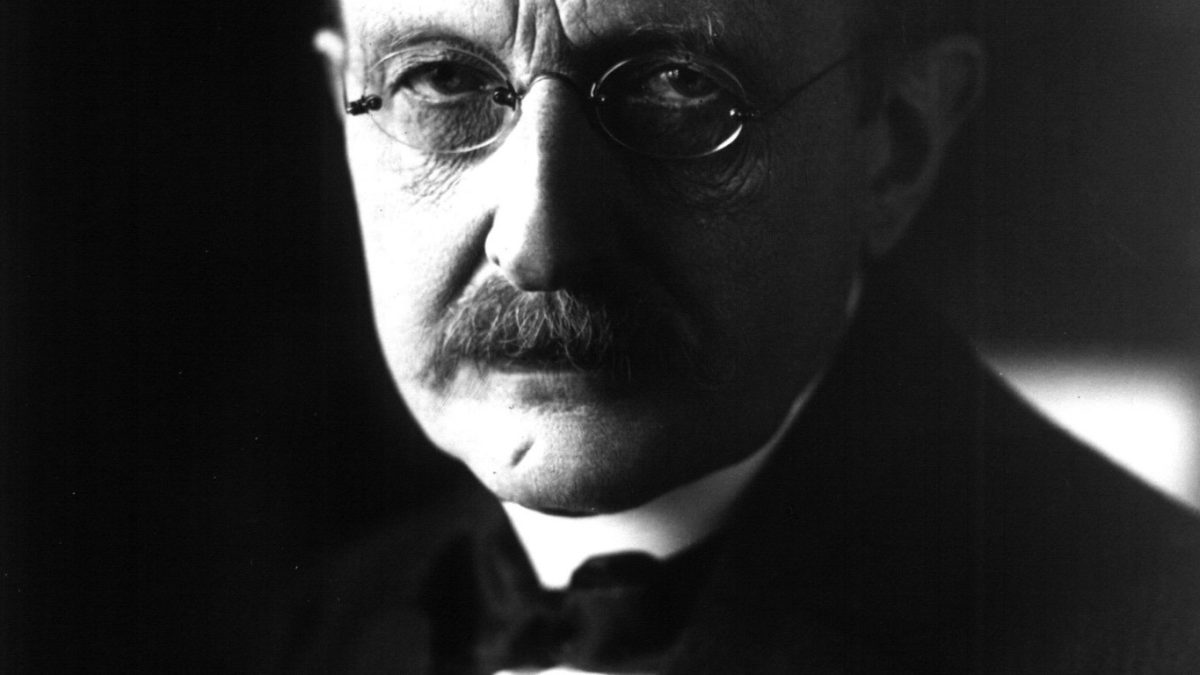
Max Planck, a conservative thermodynamicist devoted to the inviolability of entropy, spent years analyzing the problem. On the evening of October 19, 1900, Planck presented an empirical interpolation formula to the German Physical Society that matched the experimental Reichsanstalt data flawlessly across all measured wavelengths.
Over the following eight weeks, Planck searched for a physical derivation. In what he later described as “an act of mathematical desperation,” he adopted Ludwig Boltzmann’s statistical entropy method, but found he could only make the mathematics converge if he made a radical assumption: submicroscopic atomic oscillators inside the cavity walls do not absorb or emit radiation continuously, but only in discrete, indivisible packets called quanta:
$$E = n h nu, quad n in {0, 1, 2, 3, dots}$$
Here, $nu$ represents frequency, and $h$ is a fundamental constant of nature—now celebrated as Planck’s constant:
$$h approx 6.62607015 times 10^{-34} text{ J}cdottext{s}$$
The Planck Radiation Law
By restricting energy states to discrete ladders, the Boltzmann probability distribution penalized high-frequency modes exponentially ($e^{-frac{hnu}{k_B T}}$), choking off the ultraviolet divergence. The resulting Planck radiation formula yielded the exact spectral radiance of the cosmos:
$$B_nu(T) = frac{2hnu^3}{c^2} frac{1}{e^{frac{hnu}{k_B T}} – 1}$$
When expanded in terms of wavelength:
$$B_lambda(T) = frac{2hc^2}{lambda^5} frac{1}{e^{frac{hc}{lambda k_B T}} – 1}$$
Planck initially viewed $h$ as a mathematical trick rather than a revolution in the ontology of nature. But in 1905, an obscure patent clerk in Bern, Albert Einstein, took Planck’s quantum seriously, arguing that light itself was quantized into corpuscles—photons. Classical continuity had cracked, and modern quantum physics was born.