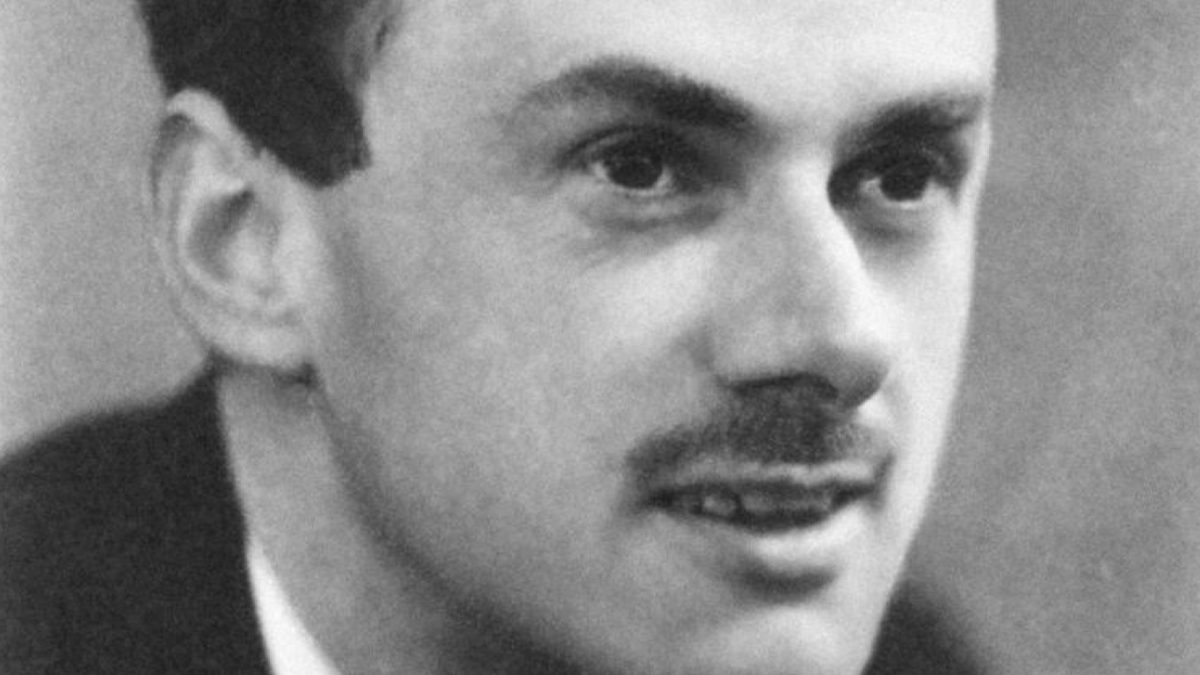
By 1927, Schrödinger’s wave mechanics was triumphantly explaining non-relativistic atomic spectra, but it suffered from a fundamental flaw: it was completely incompatible with Einstein’s Special Theory of Relativity. In early 1928, a painfully quiet twenty-five-year-old mathematical prodigy at St. John’s College, Cambridge—Paul Adrien Maurice Dirac—achieved one of the purest mathematical masterstrokes in human history: uniting quantum mechanics and relativity into a single linear equation that predicted spin and the mirror universe of antimatter.
The Relativistic Dilemma: The Klein-Gordon Dead End
Schrödinger’s equation treated space and time asymmetrically: second-order in spatial derivatives ($nabla^2$) but first-order in time ($frac{partial}{partial t}$). Physicists Oskar Klein and Walter Gordon had attempted to satisfy the relativistic mass-energy relation ($E^2 = p^2 c^2 + m^2 c^4$) by constructing a second-order equation in both space and time:
$$left( frac{1}{c^2} frac{partial^2}{partial t^2} – nabla^2 + frac{m^2 c^2}{hbar^2} right) psi = 0$$
The Klein-Gordon equation yielded catastrophic physical pathology: it produced negative probability densities ($rho < 0$), rendering it mathematically unviable for single-particle probability interpretations.
The Dirac Equation: Taking the Square Root of Spacetime
Dirac realized that to preserve a conserved positive probability density, the wave equation must be strictly first-order in time. To satisfy relativity, it must therefore also be strictly first-order in space. In an audacious mathematical leap, Dirac took the literal “square root” of the relativistic energy operator:
$$ihbar gamma^mu partial_mu psi – m c psi = 0 quad text{or} quad (i gamma^mu partial_mu – m)psi = 0$$
For the equation to remain invariant under Lorentz transformations, the coefficients $gamma^mu$ ($mu = 0, 1, 2, 3$) could not be ordinary numbers; they had to be $4 times 4$ matrices satisfying the Clifford anticommutation algebra:
$${gamma^mu, gamma^nu} = gamma^mu gamma^nu + gamma^nu gamma^mu = 2eta^{munu} I_4$$
Consequently, the wavefunction $psi$ could not be a scalar: it was a four-component vector in spin space known as a Dirac bispinor.
The Natural Genesis of Spin
Without ever inputting it by hand, Dirac’s equation automatically reproduced the intrinsic angular momentum of the electron: spin-$1/2$ ($hbar/2$), as well as its anomalous gyromagnetic factor ($g approx 2$). Spin was not a mysterious classical gyroscopic wobble grafted onto the atom; it was the inescapable mathematical consequence of combining quantum mechanics with Einstein’s four-dimensional spacetime.
Negative Energy and the Dirac Sea
Yet Dirac’s equation harbored a frightening theoretical spectre: it possessed two positive energy solutions ($E = +mc^2$) and two symmetric negative energy solutions ($E = -mc^2$). In classical physics, negative energy roots are discarded as unphysical. In quantum mechanics, an electron in a positive state must inevitably cascade into negative energy states, radiating infinite energy.
In 1930, Dirac proposed the Dirac Sea: the vacuum of space is not empty, but is completely packed with an infinite sea of negative-energy electrons satisfying the Pauli exclusion principle. If a high-energy gamma photon ($ge 2mc^2 approx 1.022 text{ MeV}$) strikes a negative-energy electron in the vacuum, it kicks the electron into the positive energy world, leaving behind a hole in the sea.
This “hole” would behave as a real physical particle possessing identical mass to the electron but an opposite, positive electric charge ($+e$): antimatter.
“My equation was smarter than I was.” — Paul Dirac
In August 1932, Carl Anderson at Caltech was examining cloud chamber tracks of cosmic ray showers in a magnetic field. He observed a particle whose track curvature and ionization density matched an electron, but bent in the opposite direction: the positron ($e^+$). Dirac’s purely mathematical abstraction had uncovered a mirror realm of matter, confirming that every fundamental particle in the universe possesses an antiparticle.