Special Relativity successfully unified mechanics with Maxwellian electrodynamics, but it contained a glaring limitation: it applied exclusively to uniform, non-accelerating inertial frames, and stood in direct contradiction with Newton’s law of universal gravitation, which assumed instantaneous action-at-a-distance across infinite space. For ten agonizing years (1905–1915), Albert Einstein labored to subsume gravity into geometry, culminating in November 1915 with the formulation of the General Theory of Relativity.
The Happiest Thought: The Equivalence Principle
In November 1907, while sitting in his chair at the patent office, Einstein experienced what he later called “the happiest thought of my life”:
“If a person falls freely, he will not feel his own weight. He will perceive himself to be at rest in a gravitational-field-free environment.” — Albert Einstein
This insight formed the cornerstone of the Equivalence Principle: locally, the physical effects of a uniform gravitational field are completely indistinguishable from the effects of uniform acceleration in a rocket ship. Inertial mass ($m_i = F/a$) and gravitational mass ($m_g = F/g$) are fundamentally identical.
From this thought experiment, Einstein immediately reasoned that light must bend in a gravitational field: an observer inside an accelerating elevator would see a horizontal beam of light trace a curved parabolic path toward the floor. Therefore, gravity must bend light.
Non-Euclidean Geometry and the Field Equations
To mathematically express spacetime that bends and stretches in the presence of mass and energy, standard Euclidean geometry was utterly inadequate. Einstein turned to his close friend, mathematician Marcel Grossmann, who introduced him to the non-Euclidean differential geometry developed by Carl Friedrich Gauss, Bernhard Riemann, and Gregorio Ricci-Curbastro.
Spacetime became a pseudo-Riemannian four-dimensional manifold described by the metric tensor $g_{munu}$. After intense competition with David Hilbert in Göttingen during the autumn of 1915, Einstein presented the definitive Einstein Field Equations to the Prussian Academy of Sciences on November 25, 1915:
$$G_{munu} + Lambda g_{munu} = frac{8pi G}{c^4} T_{munu}$$
where $G_{munu} = R_{munu} – frac{1}{2} R g_{munu}$ is the Einstein curvature tensor (encoding the curvature of spacetime), $Lambda$ is the cosmological constant, and $T_{munu}$ is the stress-energy-momentum tensor (encoding the distribution of matter, radiation, and pressure).
Physicist John Archibald Wheeler famously summarized the profound symmetry of this equation in a single aphorism: “Spacetime tells matter how to move; matter tells spacetime how to curve.”
The First Triumphs: Mercury’s Perihelion and the 1919 Eclipse
For decades, astronomers were baffled by an anomalous precession in the orbit of Mercury: 43 arcseconds per century that Newtonian celestial mechanics could not account for despite factoring in all known planets. When Einstein inserted the Schwarzschild metric of curved spacetime into Mercury’s orbital equations, the exact 43 arcseconds dropped out without a single adjustable parameter.
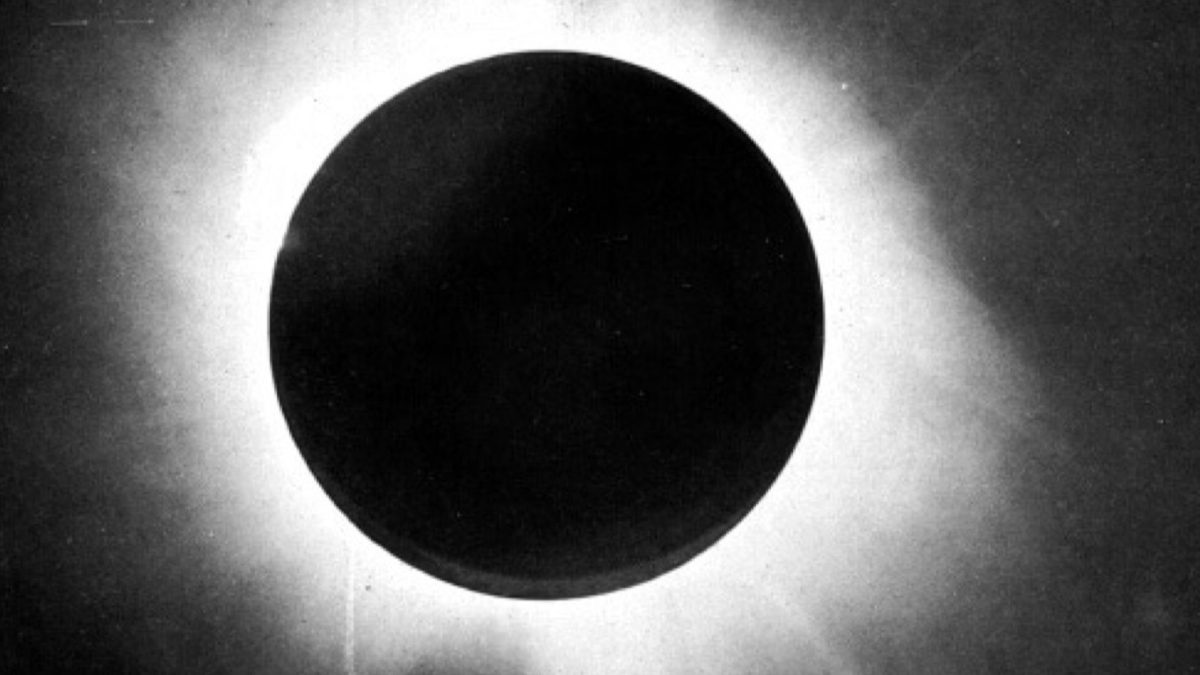
The definitive global confirmation came on May 29, 1919. British astrophysicist Sir Arthur Eddington led an expedition to the island of Príncipe off the coast of West Africa during a total solar eclipse, photographing stars near the darkened solar limb. Einstein had predicted a gravitational deflection angle of:
$$theta = frac{4GM}{c^2 R} approx 1.75 text{ arcseconds}$$
Newton’s corpuscular approximation predicted exactly half of this value ($approx 0.875”$). Eddington’s astrometric plates verified Einstein’s prediction within experimental error. On November 7, 1919, The Times of London carried the banner headline: “Revolution in Science — New Theory of the Universe — Newtonian Ideas Overthrown.” Albert Einstein became a global icon, and the cosmos was revealed to be a dynamic, curved geometric tapestry.