In December 1915, while serving on the artillery front in World War I, German astrophysicist Karl Schwarzschild calculated the first exact solution to Albert Einstein’s field equations of General Relativity. His solution revealed a monstrous gravitational reality: if a spherical mass is compressed below a critical radius, escape velocity exceeds the speed of light, creating a bottomless gravitational abyss from which nothing—not even light—can ever return: a black hole. Over the twentieth century, black holes evolved from theoretical curiosities into the ultimate thermodynamic and quantum information crucible of physics.
The Schwarzschild Metric and the Event Horizon
In vacuum outside a static, non-rotating spherical mass $M$, the spacetime metric takes the Schwarzschild form:
$$ds^2 = -left(1 – frac{r_s}{r}right) c^2 dt^2 + left(1 – frac{r_s}{r}right)^{-1} dr^2 + r^2 (dtheta^2 + sin^2theta , dphi^2)$$
This metric exhibits two mathematical singularities:
- The Event Horizon ($r = r_s$): A coordinate singularity marking the boundary of causal disconnection from the outside universe, defined by the Schwarzschild radius:
$$r_s = frac{2GM}{c^2}$$ For Earth, $r_s approx 9 text{ mm}$; for our Sun, $r_s approx 3 text{ km}$. - The Central Singularity ($r = 0$): A true physical singularity where spacetime curvature and density diverge to infinity ($R_{alphabetagammadelta}R^{alphabetagammadelta} to infty$), signaling the breakdown of General Relativity itself.
Chandrasekhar’s Limit and Stellar Collapse
In 1930, nineteen-year-old Indian prodigy Subrahmanyan Chandrasekhar, sailing aboard a steamship from Madras to England, calculated the fate of dying stars. Balancing relativistic electron degeneracy pressure against Newtonian gravity, Chandrasekhar proved that white dwarf stars have an absolute upper mass limit:
$$M_{text{Ch}} approx 1.44 M_odot$$
Stars exceeding this threshold inevitably collapse into neutron stars (stabilized by neutron degeneracy pressure) or, beyond the Tolman-Oppenheimer-Volkoff limit ($sim 2.2 M_odot$), crush themselves uncontrollably into a stellar-mass black hole.
Black Hole Thermodynamics and Hawking Radiation
In 1972, Jacob Bekenstein proposed that the surface area $A$ of a black hole’s event horizon is a direct measure of its physical entropy. In 1974, Stephen Hawking applied quantum field theory to curved spacetime near the horizon and made a shocking discovery: black holes are not completely black; they glow with thermal quantum radiation.
Quantum fluctuations near the event horizon continuously generate virtual particle-antiparticle pairs. If one particle falls past the horizon while its partner escapes into outer space, the black hole emits a steady flux of thermal Hawking Radiation at temperature:
$$T_H = frac{hbar c^3}{8pi G M k_B}$$
The total thermodynamic entropy of a black hole—the Bekenstein-Hawking entropy—equals precisely one quarter of its horizon area measured in Planck units:
$$S_{text{BH}} = frac{k_B c^3 A}{4 G hbar} = frac{k_B A}{4 ell_P^2}$$
The Information Paradox and the Event Horizon Telescope
Hawking’s discovery precipitated the Black Hole Information Paradox: if a black hole radiates away its entire mass and evaporates completely into thermal radiation, the quantum state describing everything that fell into the black hole appears permanently destroyed, violating the fundamental quantum principle of unitarity ($hat{U}hat{U}^dagger = hat{I}$). Resolving this conflict has driven modern holographic duality and string theory.
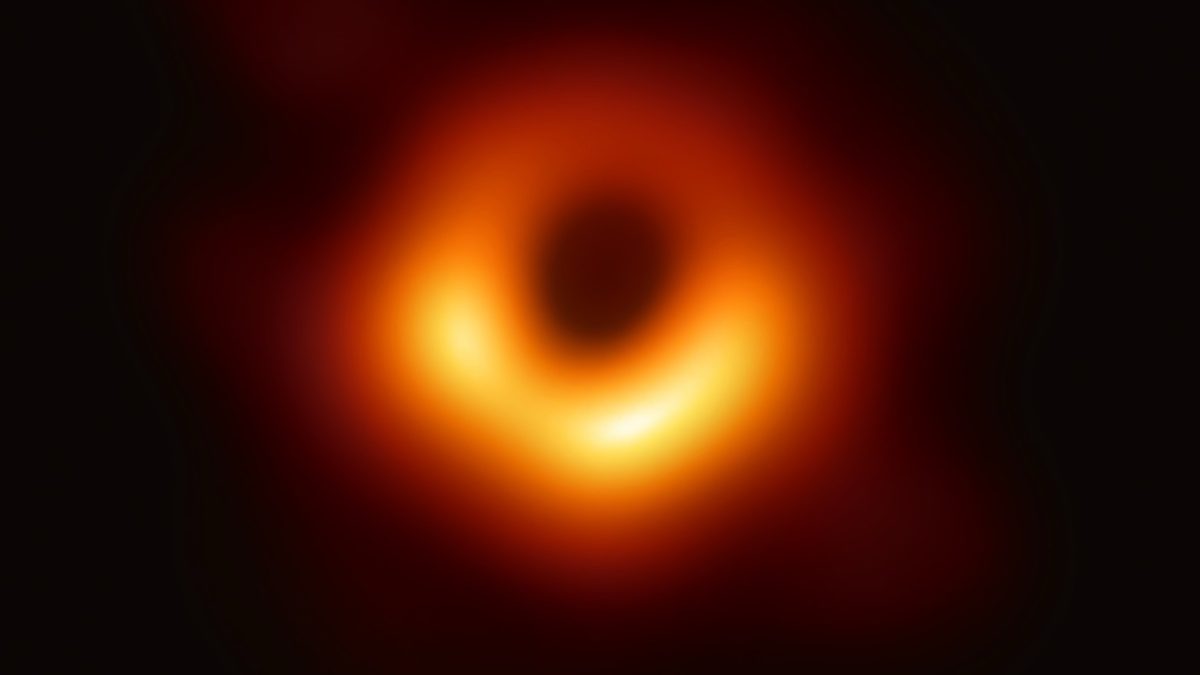
In April 2019, the Event Horizon Telescope (EHT)—a global network of synchronized millimeter-wave radio observatories—captured the first direct visual image of the supermassive black hole at the center of galaxy M87 ($M approx 6.5 times 10^9 M_odot$). The bright asymmetrical ring of orbiting plasma surrounding the dark central shadow confirmed Einstein’s geometric equations in the strongest gravitational regime in the universe.