By the late 1960s, the Standard Model of particle physics stood on the threshold of perfection, yet it concealed a lethal foundational paradox: mathematically, local gauge symmetry strictly forbids elementary particles from possessing intrinsic mass. If quarks and electrons were massless, they would race across the cosmos at the speed of light, atoms could never cohere, and physical matter could never exist. On July 4, 2012, nearly five decades after theoretical physicists Peter Higgs, François Englert, and Robert Brout predicted a cosmic mass-generating field, scientists at CERN’s Large Hadron Collider announced the discovery of the Higgs boson, completing the Standard Model.
The Gauge Symmetry Dilemma: Why Mass Is Forbidden
In quantum field theory, the fundamental interactions are governed by gauge invariance. Adding a direct explicit mass term for gauge bosons ($frac{1}{2} M^2 A_mu A^mu$) or fermions ($-m bar{psi}psi = -m(bar{psi}_L psi_R + bar{psi}_R psi_L)$) directly breaks the $SU(2)_L times U(1)_Y$ gauge symmetry, destroying renormalizability and producing mathematical chaos.
The Brout-Englert-Higgs Mechanism
In 1964, three independent research groups—François Englert and Robert Brout in Brussels; Peter Higgs in Edinburgh; and Gerald Guralnik, C. R. Hagen, and Tom Kibble at Imperial College London—uncovered an astonishing resolution. The Lagrangian of the universe remains perfectly symmetric, but its vacuum ground state is asymmetric.
They introduced a complex scalar doublet field $Phi$ permeating all space, governed by the famous ‘Mexican Hat’ or wine-bottle potential:
$$V(Phi) = mu^2 Phi^dagger Phi + lambda (Phi^dagger Phi)^2, quad mu^2 0$$
While the origin $Phi = 0$ is symmetric, it is an unstable local maximum. The stable ground state rolls down into the continuous circular minimum of the trough, establishing a non-zero vacuum expectation value (VEV) across the entire universe:
$$langle Phi rangle = frac{1}{sqrt{2}} begin{pmatrix} 0 \ v end{pmatrix}, quad v = sqrt{-frac{mu^2}{lambda}} approx 246 text{ GeV}$$
How Particles Acquire Mass
As the universe cooled after the Big Bang, the electroweak symmetry spontaneously broke. Three of the four degrees of freedom of the complex scalar field were ‘eaten’ by the $W^+$, $W^-$, and $Z^0$ gauge bosons, endowing them with longitudinal polarization states and vast rest masses:
$$M_W = frac{1}{2} g v approx 80.4 text{ GeV}/c^2, quad M_Z = frac{1}{2} sqrt{g^2 + g’^2} v approx 91.2 text{ GeV}/c^2$$
Elementary fermions (quarks and leptons) acquire mass through Yukawa couplings with the pervasive Higgs field:
$$mathcal{L}_{text{Yukawa}} = -y_f left( bar{psi}_L Phi psi_R + text{h.c.} right) implies m_f = frac{y_f v}{sqrt{2}}$$
Particles that interact strongly with the vacuum Higgs condensate—such as the top quark ($y_t approx 1$)—experience immense drag and manifest heavy masses. Particles that interact weakly—such as electrons ($y_e approx 3 times 10^{-6}$)—remain light. The remaining physical excitation of the scalar field manifested as a neutral, spin-0 particle: the Higgs boson ($H$).
The Large Hadron Collider and the Discovery of 2012
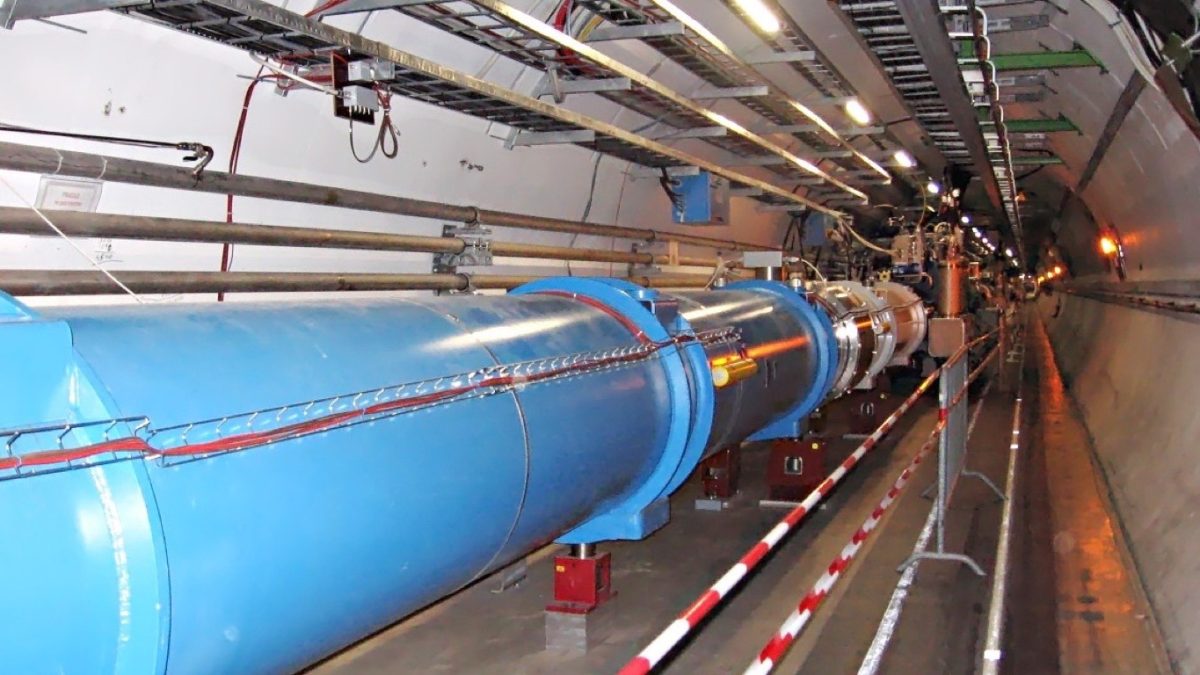
To produce this elusive particle, human ingenuity constructed the most complex machine in history: CERN’s Large Hadron Collider (LHC). Burrowed 100 meters beneath the French-Swiss border near Geneva, the 27-kilometer circular tunnel accelerates counter-rotating beams of protons to $99.9999991%$ the speed of light, colliding them at center-of-mass energies of 7 to 13 TeV inside colossal cathedral-sized detectors: ATLAS and CMS.
On July 4, 2012, in a packed CERN auditorium with eighty-three-year-old Peter Higgs and François Englert sitting in the audience, spokespersons Fabiola Gianotti and Joe Incandela announced the definitive discovery of a new boson with a mass of:
$$m_H approx 125.10 pm 0.14 text{ GeV}/c^2$$
Observed primarily through decays into photon pairs ($H to gammagamma$) and four leptons ($H to ZZ^* to 4ell$) at statistical significance exceeding five standard deviations ($5sigma$), the discovery confirmed that the cosmic vacuum is not an empty void, but a living medium that bestows substance and form upon all matter in the universe.