Across the Gangetic plain and the Deccan plateau, ancient India forged a civilizational model that harmonized imperial statecraft with profound metaphysical inquiry, radical pacifism, and foundational mathematical discoveries. From the centralized empire of the Mauryas (322–185 BCE) under the moral transformation of Emperor Ashoka to the classical renaissance of the Gupta Empire (c. 320–550 CE), the Indian subcontinent established intellectual benchmarks—including the invention of decimal place-value notation and the mathematical zero—that became the universal operating system of modern science.
The Crucible of Magadha: Chandragupta and the Arthashastra
In the fourth century BCE, following the eastern retreat of Alexander the Great’s Macedonian phalanxes from the Punjab, a brilliant strategist named Chanakya (Kautilya) guided a young warrior named Chandragupta Maurya to overthrow the opulent Nanda dynasty of Magadha. Chandragupta established Pataliputra (modern Patna) as the capital of the largest empire yet seen in South Asia, extending from the Hindu Kush mountains across the northern plains to Bengal.
Kautilya synthesized the political theory of this imperial epoch in the Arthashastra (“The Science of Material Wealth and Statecraft”). Unsentimental and acutely pragmatic, the Arthashastra analyzed governance as an empirical science of power, economic productivity, and espionage:
- The Saptanga (Seven Organs of the State): Kautilya defined the state organic system comprising the sovereign (Swami), the minister (Amatya), the territory (Janapada), the fortified capital (Durga), the treasury (Kosha), the army (Danda), and foreign allies (Mitra).
- The Mandala Theory: A geopolitical doctrine positing that one’s immediate neighbor is a natural adversary, while the state bordering that neighbor is a natural ally—formulating concentric rings of diplomatic strategy.
- State-Managed Infrastructure: The Mauryan state regulated irrigation networks, mining monopolies, long-distance trade routes, and weights and measures, recognizing that fiscal surplus was the bedrock of military sovereignty.
The Edicts of Ashoka: From Kalinga’s Bloodshed to Moral Imperialism
The geopolitical trajectory of the Maurya dynasty underwent a profound spiritual revolution during the reign of Chandragupta’s grandson, Ashoka the Great (r. 268–232 BCE). In the eighth year of his reign, Ashoka launched a brutal military campaign against the coastal kingdom of Kalinga (modern Odisha). The war resulted in over 100,000 casualties, 150,000 deportations, and catastrophic civilian suffering.
Overwhelmed by remorse upon witnessing the battlefield carnage, Ashoka renounced aggressive imperial expansion (Digvijaya) and embraced Dhamma Vijaya—conquest through righteousness and moral law—guided by the teachings of the Buddha. To communicate this ethical paradigm to his polyglot subjects, Ashoka ordered royal inscriptions engraved upon towering monolithic sandstone pillars and cliff faces across modern India, Pakistan, Afghanistan, and Nepal.
These Edicts of Ashoka, inscribed primarily in the ancient Prakrit language using Brahmi script (as well as Kharosthi, Greek, and Aramaic in the northwest), articulated a revolutionary public policy:
- Universal Tolerance and Pluralism: Ashoka mandated respect for all religious traditions (Brahmanas, Shramanas, Ajivikas), decreeing that whoever honors their own sect while disparaging another solely out of devotion severely injures their own sect.
- State Welfare and Environmental Stewardship: The emperor established hospitals for humans and veterinary clinics for animals, prohibited animal sacrifices in the capital, banned the slaughter of pregnant cattle, and planted banyan shade trees and dug wells along public highways every eight kos (approx. 16 miles).
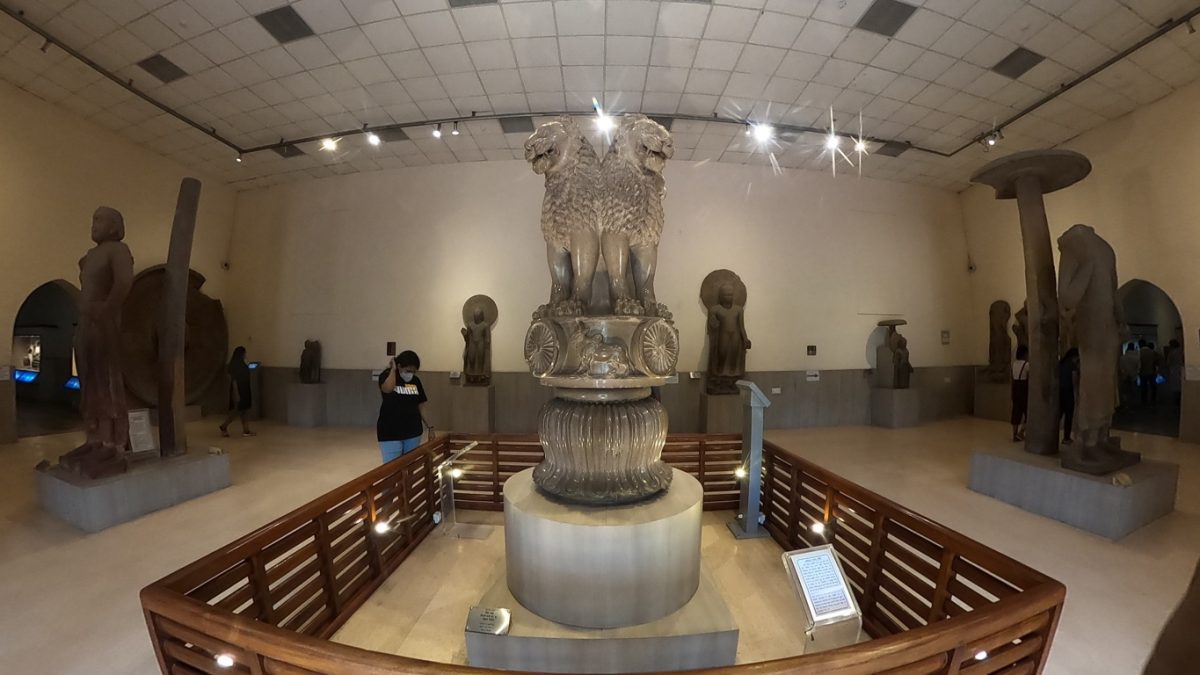
- The Pillars of Sarnath: The monumental Lion Capital of Ashoka at Sarnath—featuring four back-to-back Asiatic lions standing upon an abacus carved with four animals (elephant, horse, bull, lion) separated by the twenty-four-spoked Dharmachakra (Wheel of Law)—became the eternal emblem of Indian moral sovereignty.
The Gupta Renaissance: Science, Literature, and Classical Art
Following the decline of the Mauryas and centuries of regional transitions, northern India achieved an unprecedented flowering of intellectual, scientific, and artistic synthesis under the Gupta Empire (c. 320–550 CE). Founded by Chandragupta I and expanded by Samudragupta and Chandragupta II (Vikramaditya), the Gupta era is universally recognized as the Classical Golden Age of India.
In literature, the dramatist Kalidasa composed masterworks of Sanskrit lyricism, including the dramatic masterpiece Abhijnanashakuntalam and the poetic masterpiece Meghaduta (“The Cloud Messenger”), characterized by exquisite aesthetic sensibilities and metric perfection. In art and sculpture, the rock-cut monasteries and caves of Ajanta and Ellora brought Buddhist fresco painting and high-relief carving to absolute zenith, capturing both sublime transcendent serenity and the vibrant courtly elegance of Gupta society.
The Mathematical Revolution: Zero, Decimals, and Trigonometry
The crowning achievement of Gupta civilization lay in the exact sciences. In the fifth century CE, at the imperial astronomical center of Kusumapura (Pataliputra), the brilliant mathematician and astronomer Aryabhata (476–550 CE) composed the Aryabhatiya:
- The Decimal Place-Value System and Zero (Shunya): Indian mathematicians abstracted numbers from physical counters, treating zero not merely as a placeholder or void, but as a fully operational mathematical quantity subject to arithmetic operations. This positional decimal system spread across the Islamic world via al-Khwarizmi and into Renaissance Europe via Fibonacci, becoming the universal language of global calculation.
- Planetary Astronomy: Aryabhata correctly deduced that the Earth is spherical, rotates daily upon its own axis, and that lunar and solar eclipses are caused by planetary shadows rather than mythical demons (Rahu and Ketu).
- Trigonometry and Pi: Aryabhata calculated the value of $pi approx 3.1416$ (accurate to four decimal places) and formulated explicit sine tables (jya), laying the cornerstone of modern spherical trigonometry.
Subsequent masters like Varahamihira and later Brahmagupta (598–668 CE) formulated the fundamental algebraic rules governing positive and negative numbers and zero, proving that $a times 0 = 0$ and $a – (-b) = a + b$. Meanwhile, at Nalanda University in modern Bihar, thousands of scholars from China, Korea, Tibet, and Central Asia gathered to study philosophy, logic, grammar, and medicine under a rigorous monastic curriculum.
From the philosophical depth of the Upanishads and the compassionate edicts of Ashoka to the profound mathematical theorems of Aryabhata, classical Indian civilization demonstrated that enduring human progress requires the simultaneous cultivation of inward ethical mastery and outward scientific precision.