Across the vast, dry plateau stretching from the Zagros Mountains to the Indus River, there arose in the sixth century BCE the largest transcontinental empire the ancient world had ever witnessed: the Achaemenid Persian Empire. Founded by the visionary military and political genius Cyrus the Great (Kurush), Persia unified under a single Pax Persica an astonishing forty-four percent of the globe’s human population across three continents. In an era dominated by Assyrian terror and Babylonian deportations, Persia engineered an unprecedented paradigm of imperial statecraft based on cultural tolerance, administrative decentralization via the Satrapy system, an intercontinental network of roads, and the philosophical ethics of Zoroastrian cosmic dualism.
Cyrus the Great and the Paradigm of Tolerance
Before Cyrus, imperial conquest in the Near East was synonymous with systemic annihilation: Assyrian kings proudly inscribed palace reliefs with boasts of skinning rebel chiefs alive, flaying prisoners, blinding captives, and desecrating enemy temples. In 550 BCE, Cyrus overthrew his Median overlords, swiftly annexed the fabulously wealthy kingdom of Croesus in Lydia, and in October 539 BCE marched into the impregnable city of Babylon without a battle, overthrowing the decadent Neo-Babylonian king Nabonidus.
Upon his entry into Babylon, Cyrus did not sack the city. Instead, he made offerings to the chief Babylonian deity Marduk, forbade his soldiers from looting, and issued a royal declaration inscribed in Akkadian cuneiform on a barrel-shaped clay cylinder: the Cyrus Cylinder. Celebrated today as the world’s first declaration of human rights, the edict declared:
- Religious freedom and the restoration of desecrated local sanctuaries across Mesopotamia.
- The abolition of forced labor and arbitrary oppression of subjugated citizens.
- The repatriation of deported peoples to their ancestral homelands—most famously ending the seventy-year Babylonian Exile of the Jewish people, funding their return to Jerusalem and the rebuilding of the Second Temple.
“When I entered Babylon in a peaceful manner, with rejoicing and gladness I established the seat of dominion in the palace of the king… I freed all slaves; I brought an end to their misfortune and relieved them of their sorrow.”
— Inscription of Cyrus the Great, The Cyrus Cylinder, 539 BCE
Darius the Great and the Architectural Machinery of Empire
If Cyrus was the empire’s conqueror, Darius I (Darius the Great, reigned 522–486 BCE) was its organizational and architectural master builder. Ascending the throne following the dynastic crisis of Bardiya/Gaumata, Darius immortalized his victory in the towering trilingual Behistun Inscription carved into a sheer cliff face in Kermanshah, inscribed in Old Persian, Elamite, and Babylonian.
Darius transformed the colossal empire into an administrative machine functioning through several institutional breakthroughs:
- The Satrapy System: The empire was divided into twenty large provinces known as Satrapies, each governed by a Satrap (“Protector of the Realm”). To prevent regional rebellions, military commands were separated from civil administration, and the Great King dispatched roving imperial auditors known as the “Eyes and Ears of the King” to conduct unannounced inspections backed by royal garrisons.
- The Royal Road: Darius constructed an intercontinental highway network spanning over 2,700 kilometers (1,677 miles) from Susa in Elam to Sardis on the Aegean coast of Asia Minor. Equipped with 111 postal relay stations (Chapar Khaneh) situated a day’s ride apart with fresh horses and royal messengers, urgent imperial decrees traversed the entire breadth of the empire in just seven days—a speed of communication unmatched until the telegraph. Herodotus marveled: “Neither snow nor rain nor heat nor gloom of night stays these couriers from the swift completion of their appointed rounds.”
- Monetary Standardization: Darius introduced the Daric, a coin of almost pure gold (95.8% purity, 8.4 grams), paired with the silver Siglos, establishing an intercontinental monetary standard that fueled global trade from the Mediterranean to the Indus.
The Cosmic Sanctuary of Persepolis (Takht-e Jamshid)
In the arid Fars heartland, Darius founded Persepolis (“City of the Persians”), known to the Persians as Pārsa. Raised upon a gargantuan stone terrace of 125,000 square meters, Persepolis was not an ordinary administrative capital; it was a sacred, celestial stage designed for the annual spring celebration of Nowruz (the Persian New Year and Vernal Equinox).
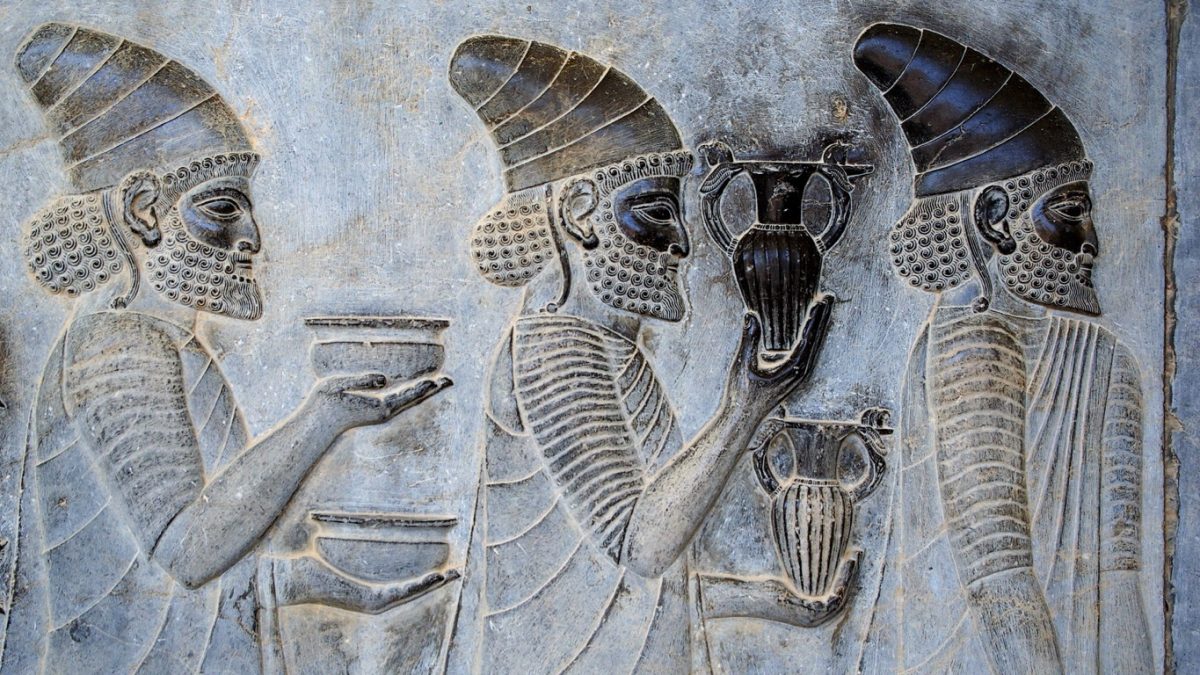
Approached via the monumental Gate of All Nations guarded by winged bull-colossi (Lamassu), the ceremonial heart was the Apadana (Grand Audience Hall), whose cedar roof was supported by seventy-two fluted limestone columns standing twenty meters high. Carved along the monumental grand staircases of the Apadana are the famous tribute friezes: meticulously realistic bas-reliefs depicting twenty-three distinct national delegations—Ionians, Lydians, Babylonians, Egyptians, Bactrians, Indians, and Ethiopians—marching peacefully side by side, dressed in their native national costumes and bearing gifts characteristic of their homelands.
Zoroastrianism: The Metaphysics of Cosmic Dualism
The moral backbone of the Achaemenid state was rooted in the teachings of the prophet Zarathustra (Zoroaster). Zoroastrianism was an ethical, dualistic faith positing a cosmic struggle between Ahura Mazda, the Lord of Light, Truth, and Wisdom, and Angra Mainyu (Ahriman), the destructive spirit of Darkness, Lies, and Chaos.
Every human being was summoned to participate actively in this metaphysical war through three guiding principles: Humata, Hukhta, Huvarshta (Good Thoughts, Good Words, Good Deeds). Persian kings did not claim divinity; they presented themselves as the moral lieutenants of Ahura Mazda on earth, bound by sacred duty to defend the Truth (Arta) and stamp out the Lie (Drauga).
Though the empire was conquered in 330 BCE by Alexander the Great, who burned the magnificent cedar halls of Persepolis, the administrative and philosophical vision of Persia permanently reshaped the world. Its satrapic governance became the blueprint for the Hellenistic and Roman empires, its postal relays inspired modern communications, and its ethos of cultural tolerance and human rights remains an enduring beacon of enlightened statecraft.