Between the meandering, silt-laden waters of the Tigris and Euphrates rivers in modern southern Iraq, human history crossed its second and most definitive rubicon: the urban revolution. In the sun-baked mudflats of Sumer during the fourth millennium BCE, humanity gathered for the first time into true cities. There, in metropolises such as Eridu, Uruk, and Ur, our ancestors invented the monumental stepped ziggurat, the cylinder seal, institutional canal irrigation, bureaucratic law, and, above all, the ultimate cognitive technology of civilization: Cuneiform writing.
The Ecological Engine of the Mesopotamian Alluvium
Sumer possessed virtually no stone, no timber, and no metallic ores. Its wealth was derived entirely from an extraordinary ecological dynamic: deep, fertile alluvial soil and an unyielding desert sun, perpetually fertilized by the spring floodwaters of the twin rivers. To tame the catastrophic floods and distribute water to parched fields during blistering summers, individual families were helpless. Survival demanded collective coordination on a continental scale.
Under the direction of temple priesthoods, communities dug hundreds of kilometers of irrigation canals, built earthen dikes, and organized centralized communal grain stores. The agricultural bounty was astounding: yields of two-row barley regularly reached thirty-to-one or forty-to-one ratios. This immense caloric surplus concentrated wealth into monumental civic centers, transforming agrarian hamlets into bustling administrative cities housing up to 50,000 citizens.
The Uruk Expansion and the Invention of Writing
By 3400 BCE, the city of Uruk (the biblical Erech, modern Warka) covered over 250 hectares, enclosed by a six-mile defensive brick wall built, according to legend, by King Gilgamesh. At its ceremonial heart stood the Eanna District, dedicated to Inanna, the goddess of love, fertility, and war. Here, the sheer velocity of economic exchange broke the limits of human organic memory.
The administrative priesthood could no longer track thousands of bushels of barley, herds of sheep, jars of sesame oil, and shifts of compulsory labor using mental recall. The evolution of writing progressed through four distinct conceptual leaps:
- Clay Tokens (8000–3500 BCE): Geometric clay tokens representing discrete commodities (cones for grain measures, spheres for animals) kept inside hollow clay envelopes known as bullae.
- Impressed Tablets (c. 3400 BCE): Pressing the tokens into the soft external surface of the wet clay envelope before baking, rendering the sealed interior redundant.
- Proto-Cuneiform Pictographs (c. 3200 BCE): Using a sharp reed stylus to draw literal pictorial sketches of objects (ox heads, sheaves of wheat, beer jugs) onto flat clay tablets.
- Phonetic Cuneiform (c. 2800 BCE): The wedge-shaped stylus impressed into soft clay to represent phonetic syllables via the Rebus Principle. Writing transformed from an accounting ledger into a universal medium capable of capturing the full spectrum of human poetry, mythology, and abstract legal philosophy.
The Temple, the Palace, and the Ziggurat
Early Sumerian urbanism was organized around the Temple (É), the terrestrial home of the city’s patron deity. Rising high above the flat desert horizon was the Ziggurat—a colossal, stepped terrace of sun-dried mud bricks faced with baked bitumen-mortared bricks, functioning as a staircase connecting earth to heaven. The Great Ziggurat of Ur, commissioned by King Ur-Nammu around 2100 BCE, rose three tiers into the sky, dedicated to Nanna, the Moon God.
As inter-city warfare over land and water rights intensified, power shifted from the purely religious temple priesthood to secular military warlords, the Lugal (“Big Man”), who established royal palaces. Sumerian society crystallized into an intricate hierarchical order: royalty and high priests at the apex, scribes, artisans, and merchant guilds in the middle tiers, and agricultural serfs and enslaved captives at the base.
Law, Order, and the Stele of Hammurabi
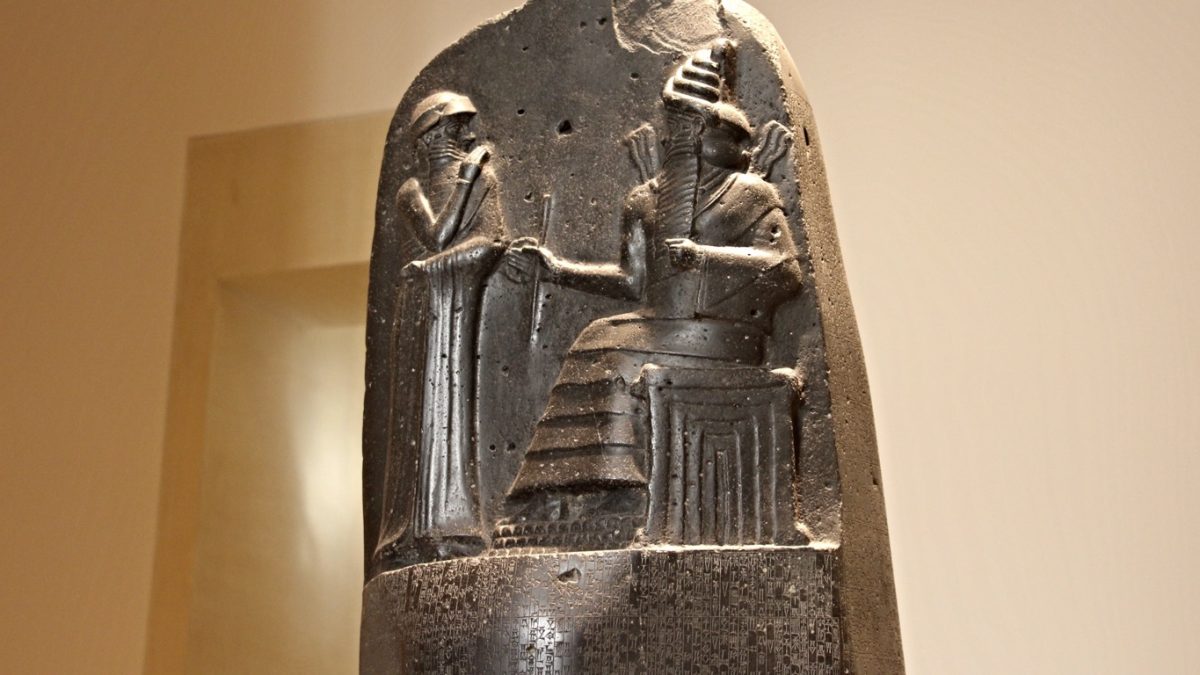
Sumerian civilization eventually amalgamated into the wider Semitic empires of Akkad and Babylon. In the eighteenth century BCE, King Hammurabi of Babylon (reigned c. 1792–1750 BCE) unified Mesopotamia through conquest and administrative centralization. To cement his rule, he erected seven-foot-tall black diorite stelae inscribed with the world’s most famous early legal code: The Code of Hammurabi.
Beneath a carved relief depicting Hammurabi receiving the scepter and ring of justice directly from Shamash, the sun god of equity, are 282 legal rulings covering property rights, commerce, marriage, medical malpractice, and violent crime. It codified the principle of retributive justice (Lex Talionis):
From the mud of southern Iraq emerged the foundational institutions of human civilization: the city, the rule of written law, institutional taxation, mathematical measurement (including our 60-minute hour and 360-degree circle), and literature. In Sumer, humanity learned to write its own destiny upon tablets of eternal stone.