When the western provinces of the Roman Empire fractured under economic exhaustion and barbarian migrations in the fifth century CE, the imperial mantle did not perish. Centered upon the impenetrable sea-girt bastion of Constantinople, the Byzantine Empire (the Eastern Roman Empire) endured for another thousand years. Blending Roman administrative law, Greek intellectual culture, and Orthodox Christian mysticism, Byzantium preserved the heritage of antiquity while creating monumental masterpieces of spiritual architecture and serving as the cultural shield of medieval Europe.
The Golden Horn: The Strategic Bastion of Constantinople
On May 11, 330 CE, Emperor Constantine the Great solemnly inaugurated his “New Rome” upon the ancient Greek colony of Byzantium, situated on a triangular peninsula jutting between the Sea of Marmara, the Bosphorus Strait, and the natural harbor of the Golden Horn. This geopolitical positioning commanded the primary maritime trade corridor between the Mediterranean and the Black Sea, as well as the overland military highway linking Europe and Asia.
Constantinople was transformed into the most impregnable fortress of the pre-modern world through the construction of the Theodosian Walls under Emperor Theodosius II in the early fifth century. This tripartite defensive system spanned four miles across the landward approaches:
- An outer deep moat with water-retaining dams and low breastworks.
- An outer wall flanked by defensive battlements.
- A colossal inner wall standing twelve meters high and five meters thick, anchored by ninety-six multistory octagonal and square watchtowers projecting outward.
For more than a millennium, these ramparts turned back waves of formidable besiegers: Huns, Persians, Avars, Arab caliphates, Bulgars, and Rus fleets. When besieged by sea, Byzantine navies unleashed their secret state-monopolized chemical weapon, Greek Fire (pyr thalassion)—a pressurized petroleum-based incendiary compound propelled through bronze siphons that burned vigorously upon the surface of water, incinerating enemy armadas.
Justinian the Great: The Imperial Restoration and the Corpus Juris Civilis
The sixth century witnessed the grand zenith of early Byzantium under Emperor Justinian I (r. 527–565 CE) and his brilliant, politically astute empress, Theodora. Guided by the strategic genius of his general Belisarius, Justinian reconquered North Africa from the Vandals, Italy from the Ostrogoths, and southern Iberia from the Visigoths, briefly restoring the Mediterranean into a Roman lake (Mare Nostrum).
Yet Justinian’s most enduring monument was intellectual: the comprehensive codification of Roman jurisprudence known as the Corpus Juris Civilis (Body of Civil Law). Directed by the master jurist Tribonian, imperial commissions reviewed, reconciled, and systematized centuries of contradictory Roman statutes and judicial rulings:
- The Codex Justinianus: A systematic compilation of all living imperial edicts.
- The Digest (Pandects): A massive fifty-volume synthesis of authoritative opinions from classical Roman jurists like Ulpian and Papinian.
- The Institutes: An introductory handbook for law students across imperial academies.
- The Novels (Novellae Constitutiones): New legislation promulgated during Justinian’s own reign, written primarily in Greek.
The Corpus Juris Civilis established foundational legal principles—including the presumption of innocence, the distinction between public and private law, contract validity, and property rights—that were rediscovered by Italian scholars in the eleventh century, forming the structural bedrock of the Napoleonic Code and the civil legal systems of modern Europe and Latin America.
Hagia Sophia: The Vault of Heaven Descended to Earth
Following the catastrophic Nika Riots of 532 CE, which leveled large sections of the capital, Justinian commissioned the physicists and mathematicians Isidore of Miletus and Anthemius of Tralles to construct a cathedral that would eclipse every religious structure on earth: Hagia Sophia (the Church of the Holy Wisdom).
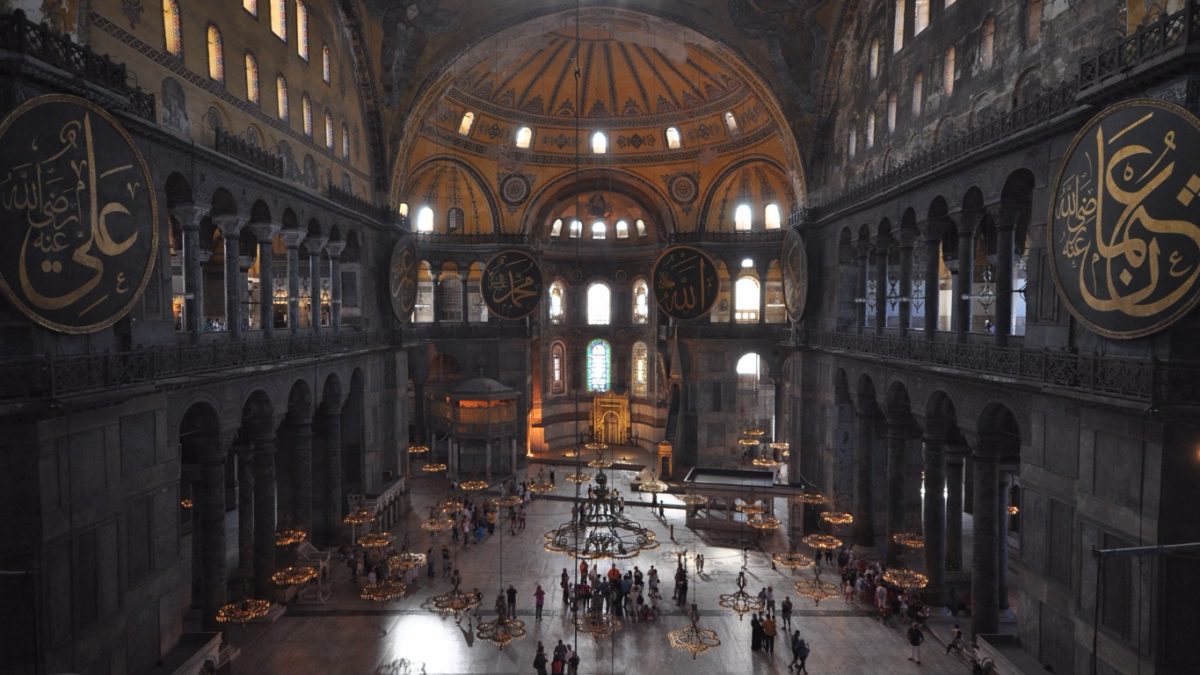
Completed in just five years and ten months, Hagia Sophia revolutionized monumental architecture through its pioneering structural engineering. The central dome—spanning 31 meters (102 feet) in diameter and rising 55 meters above the marble pavement—is supported not by massive perimeter walls, but by four massive triangular spherical curved surfaces known as pendentives resting upon four colossal masonry piers:
Around the base of the dome, forty arched windows pierce the stone masonry. When sunlight streams through the windows, illuminated against millions of micro-faceted gold leaf tesserae, the dome appears to be suspended from heaven by a golden chain, creating a metaphysical space where imperial majesty converged with mystical transcendence. Upon entering the completed nave on December 27, 537 CE, Justinian exclaimed: “Solomon, I have surpassed thee!”
The Byzantine Mirror: Orthodoxy, Diplomacy, and the Slavic Conversion
Byzantium survived through centuries of geopolitical storms not merely by military force, but through extraordinary diplomatic sophistication. The imperial bureau of foreign relations, the Skrinion Barbaron, practiced intricate alliance-craft, lavish gifts, courtly ceremonial psychology, and ideological influence.
The defining cultural triumph of Byzantine diplomacy occurred in the ninth century, when two scholarly brothers from Thessalonica, Saints Cyril and Methodius, were dispatched to evangelize the Slavic nations. To translate the Greek scriptures into the Old Church Slavonic language, Cyril invented a customized phonetic script based on Greek cursive—the precursor to the modern Cyrillic alphabet used today by hundreds of millions of people across Eastern Europe.
In 988 CE, Prince Vladimir the Great of Kievan Rus was baptized into Orthodox Christianity, adopting Byzantine liturgy, iconography, and imperial legal traditions. When Constantinople finally fell to the Ottoman artillery of Sultan Mehmed II on May 29, 1453, Byzantine scholars fled westward to Italy carrying precious ancient Greek manuscripts, igniting the spark that ignited the Italian Renaissance.