Between the publication of Nicolaus Copernicus’s heliocentric treatise in 1543 and the storming of the Bastille in 1789, Western civilization underwent an epistemological earthquake: the Scientific Revolution and the Enlightenment. By substituting ancient scholastic authority and scriptural dogma with empirical observation, mathematical deduction, and critical skepticism, human thinkers decoded the clockwork mechanisms of the physical cosmos and challenged the divine right of absolute monarchs, formulating the universal principles of human rights and democratic constitutionalism.
The Celestial Shattering: Copernicus, Kepler, and Galileo
For more than fourteen centuries, Christian Europe adhered to the geocentric cosmology of Claudius Ptolemy and Aristotle: a stationary, corruptible Earth fixed immovably at the center of concentric crystalline celestial spheres turned by angelic intelligences. This comfortable anthropocentric cosmos was dismantled in three empirical stages:
- The Copernican Hypothesis (1543): On his deathbed, Polish canon Nicolaus Copernicus published De revolutionibus orbium coelestium, proposing that the Sun—not the Earth—was the stationary radiant center around which planets orbit in uniform circles.
- Kepler’s Elliptical Laws (1609): German mathematician Johannes Kepler analyzed the painstakingly accurate planetary data of Tycho Brahe. Discarding mystical circles, Kepler discovered that planetary orbits are ellipses with the Sun at one focus, moving faster when closest to the perihelion.
- Galileo’s Telescope (1610): In Padua, Galileo Galilei turned a twenty-power spyglass toward the night sky. In Sidereus Nuncius, Galileo reported mountainous craters on the imperfect Moon, four orbiting moons circling Jupiter, sunspots disfiguring the pristine face of the Sun, and the phases of Venus. When the Roman Inquisition condemned heliocentrism in 1633 and forced Galileo to recant, legend holds that he muttered: “Eppur si muove” (And yet it moves).
The Newtonian Synthesis: The Mathematical Cosmos
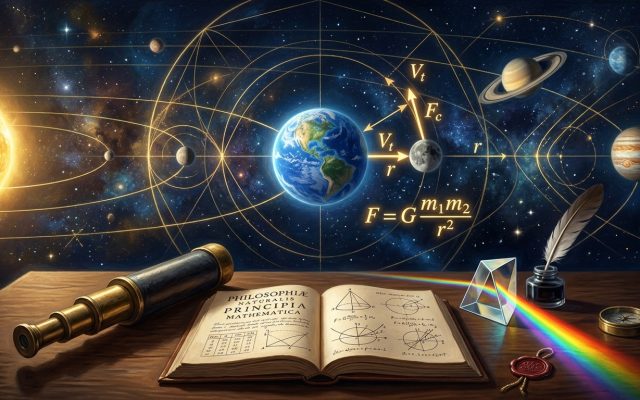
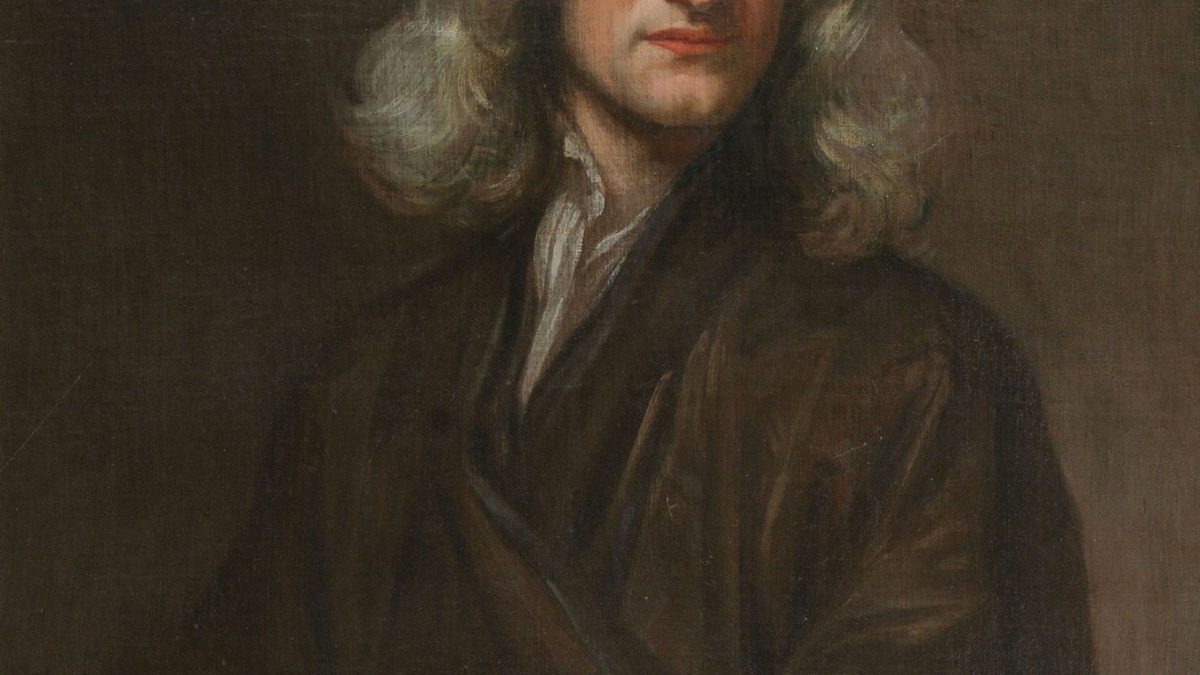
The philosophical climax of the Scientific Revolution occurred in 1687 with the publication of Sir Isaac Newton’s Philosophiae Naturalis Principia Mathematica (“Mathematical Principles of Natural Philosophy”). Newton accomplished a transcendent unification: demonstrating that the identical mathematical laws govern the falling of an apple on Earth and the eternal orbits of the planets in the heavens.
Newton formulated the three fundamental laws of classical motion and the universal law of gravitation:
By demonstrating that every particle of matter in the universe attracts every other particle with a force proportional to the product of their masses and inversely proportional to the square of the distance between them, Newton transformed nature into a vast, deterministic, rational machine. The cosmos was no longer an inscrutable theater of unpredictable miracles; it was a sublime clockwork universe whose mathematical gears were fully transparent to human reason.
The Enlightenment: Daring to Know
In 1784, the German philosopher Immanuel Kant defined the core ethos of the eighteenth-century Enlightenment in a famous Latin maxim: Sapere Aude!—“Dare to know!” Have the courage to use your own understanding without the guidance of another.
Across Parisian salons, London coffeehouses, and Scottish universities, the Philosophes applied the empirical methods of the Scientific Revolution to human society, politics, economics, and religion:
- John Locke (Two Treatises of Government, 1689): Refuted absolute monarchy, arguing that all human beings are born free and equal, possessing inalienable natural rights to Life, Liberty, and Property. Government was a conditional social contract; if a sovereign violated those rights, citizens had the moral duty of revolution.
- Voltaire (François-Marie Arouet): Wielded biting satirical wit against religious intolerance, church corruption, and political tyranny, defending free speech and civil liberties.
- Montesquieu (The Spirit of the Laws, 1748): Proposed the foundational constitutional doctrine of the Separation of Powers—dividing sovereign authority among legislative, executive, and judicial branches to prevent tyrannical abuse.
- Denis Diderot and Jean le Rond d’Alembert (Encyclopédie, 1751–1772): Edited a monument of twenty-eight volumes designed to classify, secularize, and democratize all human mechanical, philosophical, and scientific knowledge.
The Democratic Crucible: Atlantic Revolutions
The philosophical ideas of the Enlightenment were not confined to intellectual debate; they sparked the revolutionary transformation of the Atlantic world. In 1776, Thomas Jefferson drafted the American Declaration of Independence, channeling Lockean natural rights to justify secession from the British Crown.
In 1789, the French National Assembly issued the Declaration of the Rights of Man and of the Citizen, declaring that men are born and remain free and equal in rights, and that sovereignty resides in the nation rather than the person of the King. From the Enlightenment emerged the modern architecture of democratic republicanism, secular rule of law, and the moral conviction that reason and liberty are the birthright of all humanity.