Deep within the dense rainforests of the Yucatán Peninsula, Belize, Guatemala, and Honduras, the Maya civilization erected monumental limestone cities that aligned the architecture of human power with the mathematical geometry of the stars. Thriving during their Classical zenith (c. 250–900 CE), the Maya developed the only fully literate writing system of the pre-Columbian Americas, calculated planetary orbital mechanics with terrifying precision, and integrated agricultural wetland engineering with a sacred cosmos mediated by blood sacrifice and divine kingship.
The Jungle Matrix: Agrarian Engineering in a Karst Landscape
The southern Maya lowlands present a severe geographical paradox: torrential tropical rainfall during the summer months followed by months of absolute dry drought upon a porous limestone bedrock that swallows surface water into underground caverns (cenotes). Rather than an impediment, the Maya transformed this demanding ecosystem into an intensively managed landscape capable of supporting dense urban populations exceeding several million people.
Archaeological remote sensing utilizing LiDAR (Light Detection and Ranging) has stripped away the jungle canopy to reveal massive anthropogenic earthworks previously invisible:
- Bajos and Wetland Canals: The Maya drained seasonal swamps into crisscrossing networks of raised planting beds (chinampa-like fields), trapping nutrient-rich organic silts to harvest multiple yields of maize, beans, squash, and cacao annually.
- Monumental Reservoirs: At major city-states like Tikal, civic engineers paved urban plazas and temples with non-permeable plaster, tilting expansive causeways (sacbeob) to channel millions of gallons of rainwater into deep, clay-lined municipal cisterns filtered through quartz sand and zeolite matrices.
- The Milpa Agro-Ecosystem: Rotational polyculture mimicked the forest canopy, preserving delicate soil micro-nutrients through symbiotic companion planting.
The K’uhul Ajaw: Sacred Monarchy and the Cosmic Drama
Maya political civilization was not an autocratically unified empire, but an interconnected network of competitive, sovereign city-states (such as Tikal, Calakmul, Copán, Palenque, and Yaxchilan) bound by a shared cosmological religion, sophisticated courtly prestige, and intense geopolitical rivalry. At the center of each city reigned the K’uhul Ajaw (“Holy Lord”).
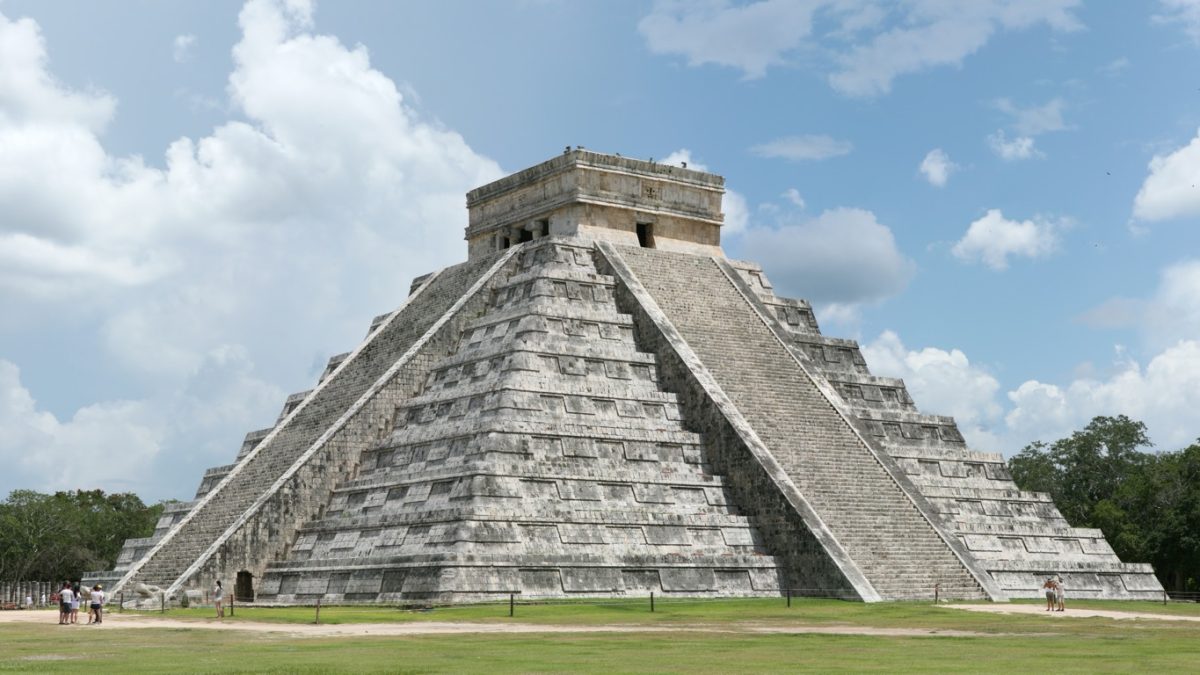
The Maya viewed the universe as a multidimensional living organism divided into three planes: the heavens (comprising thirteen layers), the earthly middle world, and the watery, cavernous underworld of Xibalba (comprising nine levels). The King was the pivotal axis mundi—the living conduit between mortal subjects and ancestral deities. Monumental stepped pyramids, such as the Temple of the Inscriptions at Palenque or Temple I at Tikal, functioned as artificial sacred mountains bridging the underworld tomb below with the celestial zenith above.
Because the gods had sacrificed their own essence to animate humanity out of maize and divine blood, the king and the royal nobility performed ritual autosacrifice—piercing tongues, ears, and genitals with stingray spines and obsidian blades—letting drops of royal blood saturate bark-paper offerings to be consumed by fire, nourishing the sun and sustaining the cosmic equilibrium.
The Maya Hieroglyphic Script and Literary Codices
Of all indigenous American societies, the Maya created the most phonetically sophisticated and visually breathtaking writing system. Comprising over eight hundred distinct logograms (symbols representing entire words or concepts) and syllabograms (representing phonetic syllables), the script could transcribe every nuance of spoken Mayan languages.
Hieroglyphic texts were incised upon limestone lintels, carved upon towering portrait stelae, painted upon delicate polychrome ceramic vessels, and transcribed into concertina-folded bark-paper books known as codices (such as the Dresden, Madrid, and Paris Codices). Following the Spanish conquest, Franciscan friars burned hundreds of libraries as works of heresy. Yet surviving texts deciphered by modern epigraphers—pioneered by Yuri Knorozov and Tatiana Proskouriakoff—reveal rich chronicles of dynastic marriages, territorial wars, coronation rituals, and advanced celestial tables.
Celestial Mechanics: The Long Count and the Venus Cycles
To the Maya, time was not linear and neutral, but cyclical, sacred, and imbued with living spiritual personality. Maya mathematical astronomers devised a vigesimal (base-20) positional numbering system incorporating zero, utilizing simple dots for units of one, bars for units of five, and stylized conch shells for zero.
Through centuries of empirical observation from specialized observatories (like El Caracol at Chichen Itza), Maya priests calibrated interlocking calendar systems:
- The Tzolk’in (Sacred Almanac): A cycle of 260 days formed by the permutation of twenty day-names with numbers 1 through 13, matching both human gestation and the maize agricultural cycle.
- The Haab’ (Solar Year): A 365-day vague year consisting of 18 months of 20 days each, plus five unlucky epagomenal days known as the Wayeb’.
- The Calendar Round: The intermeshing of the Tzolk’in and Haab’, creating a unique date designation that repeated only once every 52 solar years (18,980 days).
- The Long Count: A linear chronological tally measuring elapsed days from a mythological creation anchor point corresponding to August 11, 3114 BCE.
The Dresden Codex contains complex mathematical ephemerides tracking the synodic period of Venus (calculated as 584 days, miraculously close to the modern astronomical value of 583.92 days). The morning appearance of Venus as the dawn star (Chak Ek’) was viewed as a ferocious cosmic harbinger, coordinating the timing of coordinated warfare and ritual captives.
The Classic Collapse: Ecological Strain and Fractured Sovereignty
Between 750 and 900 CE, the great Southern Maya centers experienced a systemic demographic and political crisis known as the Classic Maya Collapse. Cities like Tikal, Palenque, and Copán were gradually abandoned to the encroaching jungle; monumental construction ceased, stelae carving ended, and dynasties fell.
Contemporary palaeoclimatology has demonstrated that this crisis was not a singular catastrophic event, but the devastating intersection of three systemic factors: a series of multi-decade megadroughts, severe anthropogenic deforestation and soil erosion driven by population overshoot, and escalating warfare between rival dynasties competing for shrinking food supplies. Yet Maya civilization did not vanish; power migrated northward to the arid karst plains of Yucatán, where urban centers like Chichen Itza, Uxmal, and Mayapan flourished until the early modern era, leaving an indelible legacy of mathematical genius and architectural splendor.