In the radiant city-states of fourteenth- and fifteenth-century northern Italy—most luminous among them, the banking republic of Florence—human civilization witnessed an intellectual and aesthetic rebirth that overturned medieval scholastic dogma: the Italian Renaissance. Driven by the philosophy of Humanism, patronage from banking dynasts like the Medici, and the rediscovery of classical Greco-Roman manuscripts, visionary polymaths like Leonardo da Vinci, Michelangelo, and Brunelleschi elevated human potential, empirical observation, and linear perspective to sublime heights.
The Tuscan Spring: Florence, Capital of Merchant Capitalism
The geographic cradle of the Renaissance was the fertile Arno valley of Tuscany. Florence was not ruled by a feudal lord or divine monarch, but by an elite oligarchy of wealthy merchant and craft guilds (Arti), anchored by the wool trade (Arte della Lana) and international high finance (Arte del Cambio).
The rise of the Medici family, beginning with Giovanni di Bicci de’ Medici and reaching legendary zenith under Cosimo the Elder and Lorenzo the Magnificent, established a revolutionary paradigm of civic patronage. By funneling private banking wealth into monumental public architecture, humanistic libraries, and artistic commissions, the Medici legitimized their political primacy while transforming Florence into an “Athens on the Arno.”
Humanism: The Rediscovery of Classical Antiquity
The intellectual engine of the Renaissance was Humanism (Studia Humanitatis)—the study of grammar, rhetoric, history, poetry, and moral philosophy through original classical texts. Pioneered in the fourteenth century by the poet Francesco Petrarch, humanists scoured damp monastic libraries across Europe, recovering lost speeches of Cicero, treatises of Quintilian, and natural histories of Lucretius.
Following the fall of Constantinople in 1453, a diaspora of Byzantine scholars arrived in Florence carrying original Greek manuscripts of Plato and the Neo-Platonists. Cosimo de’ Medici financed the foundation of the Platonic Academy at Careggi, directed by Marsilio Ficino:
- Medieval scholasticism had subordinated human life as a miserable, corrupted prelude to the afterlife (contemptus mundi).
- Humanism, epitomized by Pico della Mirandola’s revolutionary manifesto Oration on the Dignity of Man (1486), celebrated humanity as the magnificent masterpiece of creation, endowed with free will to shape its own destiny between beast and angel.
The Architecture of Wonder: Brunelleschi and the Duomo
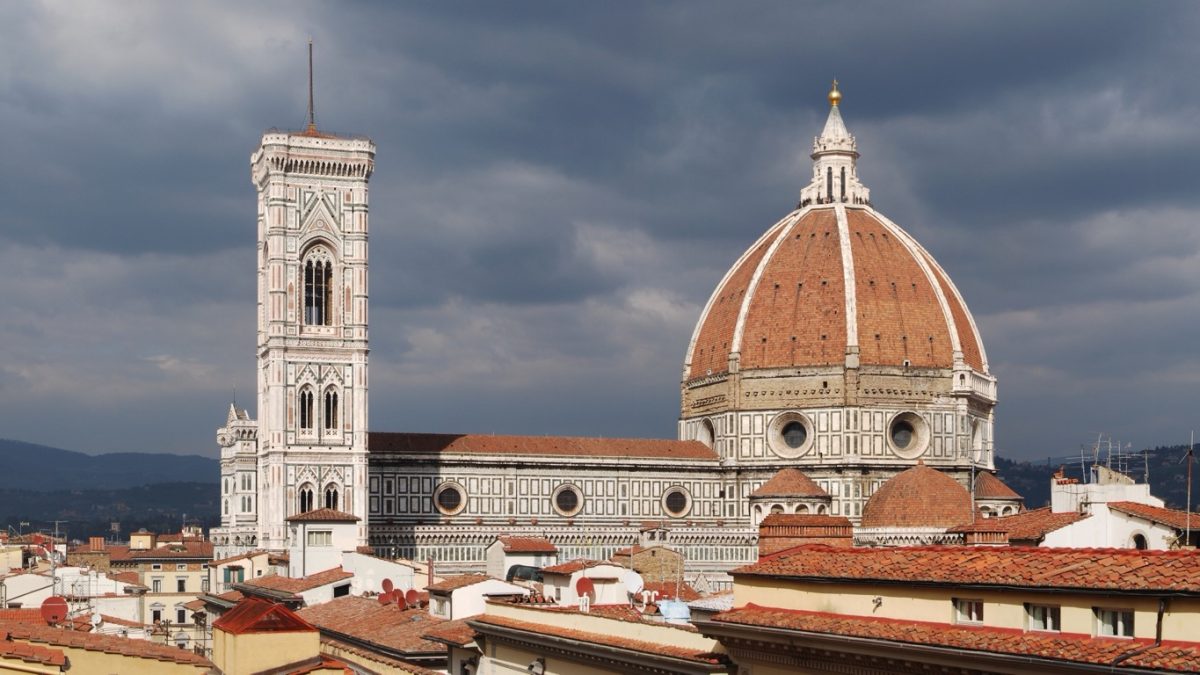
In 1418, the city fathers of Florence held an open architectural competition to solve an engineering impossibility: constructing a massive octagonal dome over the cavernous, unfinished crossing of Santa Maria del Fiore (the Duomo), spanning 42 meters (140 feet) without collapsing under its own immense outward deadweight.
The goldsmith and architect Filippo Brunelleschi devised an audacious, revolutionary solution. Drawing insights from his archaeological measurements of the Roman Pantheon, Brunelleschi constructed a double-shell dome without timber centering scaffolding:
Brunelleschi arranged the masonry in a spiraling herringbone pattern (spina di pesce), transferring lateral thrust downward onto inner stone ribs bound by oak and iron circumferential tension chains. In solving the dome, Brunelleschi also formulated the mathematical laws of linear perspective (vanishing point geometry), providing painters with the scientific tools to render three-dimensional spatial reality upon a two-dimensional surface.
The Universal Titans: Leonardo, Michelangelo, and Raphael
The High Renaissance achieved its supreme crystallization through three transcendent masters:
- Leonardo da Vinci (1452–1519): The ultimate embodiment of the Homo Universalis (“Renaissance Man”). Rejecting bookish authority, Leonardo treated direct empirical observation as the sole arbiter of truth. His clandestine nocturnal human dissections produced anatomical sketches of unprecedented accuracy; his hydrodynamic and mechanical studies anticipated aviation and modern hydraulics; and his painting—mastering sfumato (smoky tonal gradation) in the Mona Lisa and psychological narrative in The Last Supper—fused scientific inquiry with artistic transcendence.
- Michelangelo Buonarroti (1475–1564): The titan of sculptural and architectural form. Believing that the finished sculpture already resided within the block of Carrara marble awaiting liberation, Michelangelo sculpted the triumphant youthful majesty of the David. Between 1508 and 1512, working suspended beneath the barrel vault of the Sistine Chapel in Rome, he painted the monumental theological drama of human creation, culminating in the electric, near-touching fingertips of God and Adam.
- Raphael Sanzio (1483–1520): The master of harmonious classical composition. In the Papal Apartments of the Vatican, Raphael painted The School of Athens, an allegorical fresco depicting Plato pointing upward to the metaphysical ideal forms and Aristotle gesturing downward to earthly empirical reality, surrounded by Pythagoras, Euclid, and Ptolemy—the definitive visual synthesis of humanism and divine philosophy.
The Italian Renaissance dismantled the rigid intellectual cloister of the Middle Ages. By validating human dignity, celebrating empirical curiosity, and wedding mathematical rigor to visual beauty, the Renaissance masters forged the cultural consciousness that ushered humanity into the modern era.