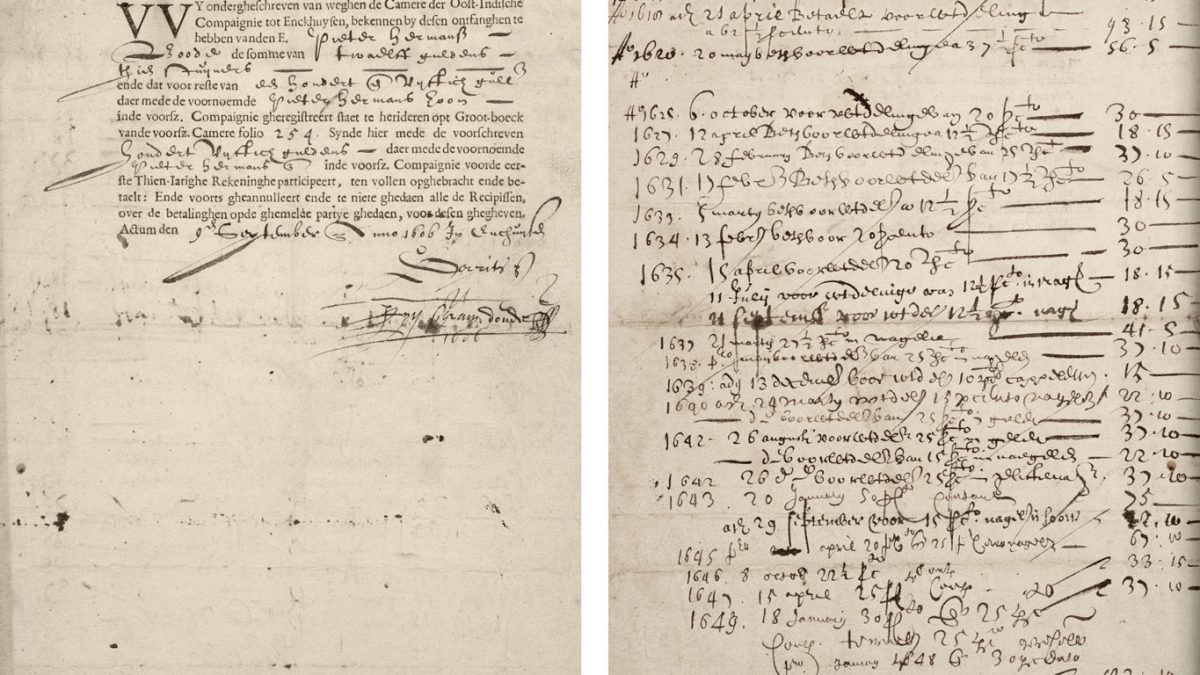
In the early seventeenth century, a tiny confederation of seven swampy, flood-prone provinces along the North Sea—the Dutch Republic—achieved the most astounding economic ascendancy in early modern history. Having rebelled against the mighty Catholic Habsburg Empire in the Eighty Years’ War, the Dutch transformed their financial capital, Amsterdam, into the undisputed commercial emporium of the world. While Spain squandered mountains of Andean silver on ideological warfare, Dutch merchants engineered an entirely new paradigm of financial capitalism based on commercial efficiency, low-interest borrowing, institutional transparency, and the revolutionary democratization of capital investment.
Between 1602 and 1609, Amsterdam assembled the three interconnected institutional pillars of the modern global economy: the world’s first publicly traded multinational corporation (the Dutch East India Company, or VOC), the world’s first modern central clearing bank (the Amsterdam Wisselbank), and the world’s first permanent, liquid stock exchange (the Amsterdam Beurs). Modern financial capitalism did not begin in London or New York; it was born in the brick trading halls and canal-side coffee houses of the Dutch Golden Age.
The Vereenigde Oostindische Compagnie (VOC): Inventing Perpetual Equity
Prior to 1602, European maritime voyages to the East Indies were organized on a temporary, piecemeal basis. A group of merchants pooled capital for a single expedition (known as a voorcompagnie). When the fleet returned laden with nutmeg, cloves, and pepper, the ships and goods were liquidated, profits were distributed, and the legal partnership dissolved. If an expedition was lost to storms or Portuguese armadas, the investors suffered total financial ruin.
On March 20, 1602, the States-General of the Dutch Republic, under the visionary statesmanship of Johan van Oldenbarnevelt, consolidated these competing syndicates into a single national monopoly: the Vereenigde Oostindische Compagnie (United East India Company, or VOC). The charter granted the VOC quasi-sovereign powers: it had the legal authority to wage war, build fortresses, recruit private armies, establish overseas colonies, and mint its own coinage.
Yet the true financial genius of the VOC lay in its revolutionary corporate balance sheet:
- Massive Capital Mobilization: The VOC opened its subscription books to all citizens of the Republic, raising an unprecedented 6,424,588 Dutch guilders from over 1,800 investors—ranging from wealthy regents to domestic servant girls investing a few guilders.
- Perpetual Capital Lock-In: Initially intended to liquidate after ten years, the directors (the Heeren XVII) realized that long-term colonial fortresses and naval supremacy required permanent funding. In 1612, the company refused to return the original capital to shareholders, establishing the principle of perpetual corporate equity: the company’s capital belonged to the legal corporate entity, not to individual investors.
- Secondary Market Liquidity: If an investor needed cash, they could not demand their money back from the VOC treasury. Instead, the charter permitted shareholders to sell their ownership claims to third parties. Thus, the world’s first freely tradable corporate stock was born.
The Amsterdam Beurs: The First Liquid Stock Exchange
To facilitate the buying and selling of VOC shares, the municipal government opened the Amsterdam Beurs (Exchange) in 1611, designed by architect Hendrick de Keyser. Every morning at eleven o’clock, bells rang across the city, and hundreds of merchants, brokers, and foreign emissaries packed into the open-air arcades of the Dam square.
Within this brick courtyard, Dutch financiers rapidly invented nearly every complex derivative and financial contract employed on Wall Street today:
| Modern Financial Instrument | 17th-Century Dutch Term / Mechanism | Market Function & Economic Purpose |
|---|---|---|
| Stock Shares: | Actiën | Fractional ownership in the VOC (and later the West India Company, WIC). |
| Short-Selling: | Windhandel (“Trading in the Wind”) | Selling borrowed shares in anticipation of a price decline before settlement. |
| Futures Contracts: | Termijnhandel | Agreeing on a fixed price today for delivery and settlement at a future quarterly date. |
| Options (Calls and Puts): | Premiehandel | Purchasing the right, but not the obligation, to buy or sell shares at a specified strike price. |
In 1688, the Spanish-Jewish financier Joseph de la Vega, living in Amsterdam, published Confusion of Confusions (Confusión de Confusiones)—the world’s first psychological and technical analysis of stock trading. De la Vega brilliantly described the market dynamics of herd behavior, panic selling, insider trading, and speculative euphoria that remain unalterably true four centuries later.
The Amsterdam Wisselbank (1609): The Sound Anchor of Global Trade
A thriving stock exchange requires a rock-solid, stable monetary foundation. In the early 1600s, Amsterdam’s markets were plagued by chaos: over eight hundred varieties of clipped, debased, and counterfeit coins from every minor German principality and European kingdom circulated through the city’s ports.
To eliminate this monetary friction, the city government founded the Amsterdamsche Wisselbank (Bank of Amsterdam) on January 31, 1609. The Wisselbank was not a lending institution that engaged in fractional-reserve speculation; it was designed as a 100% full-reserve public deposit and clearing bank.
The mechanics of the Wisselbank operated with pristine mathematical integrity:
- Merchants deposited their heterogenous, worn metallic coins into the bank’s vaults beneath the Amsterdam Town Hall.
- Assayers weighed and tested the bullion, crediting the merchant’s account in an abstract, unvarying money of account: the Bank Guilder (florin banco), tied to an exact physical weight of fine silver.
- Merchants could settle debts of any magnitude simply by instructing the bank clerks to debit their account and credit the account of a creditor in the central ledger—entirely without moving physical bags of metal.
Because the Bank Guilder was immune to debasement, guaranteed by the City of Amsterdam, and backed by a mountain of silver and gold bullion, it traded at a permanent premium of 3% to 5% over physical circulating coins (known as the agio). For a century and a half, the Bank of Amsterdam served as the monetary anchor of the Western world. When Adam Smith studied the Wisselbank in The Wealth of Nations, he lauded it as the pinnacle of financial stability and public institutional trust.
Tulip Mania (1636–1637): The First Speculative Bubble
The immense prosperity and financial liquidity of the Dutch Golden Age created a unique cultural vulnerability: when capital is abundant and interest rates are near historical lows (2% to 3%), money inexorably searches for speculative yield. In the 1630s, this speculative mania attached itself to an exotic botanical luxury imported from the Ottoman Empire: the tulip.
Particularly prized were bulbs infected with a benign mosaic virus that caused their petals to erupt into unpredictable, feathered patterns of contrasting colors, such as the legendary Semper Augustus. By late 1636, trading had expanded from wealthy connoisseurs into the taprooms of Dutch taverns, where ordinary weavers, innkeepers, and cobblers traded futures contracts for bulbs still buried beneath winter snow.
At the peak of the mania in January 1637, a single Semper Augustus bulb reportedly traded for 5,500 guilders—enough money to purchase a grand canal-side mansion, complete with coach and horses, or enough wheat to feed a family for thirty years. In February 1637, the market abruptly collapsed overnight when buyers at an auction in Haarlem refused to bid at inflated prices. Prices fell by more than 90% in a matter of weeks.
While nineteenth-century historians like Charles Mackay sensationalized Tulip Mania as an event that destroyed the Dutch economy, modern economic research (notably by Anne Goldgar) reveals that the crash was largely self-contained within taverns and settled by municipal arbitration without causing systemic financial failure. The true institutional legacy of the Dutch Golden Age was not the tulip bubble, but the indestructible infrastructure of the VOC, the Wisselbank, and the Stock Exchange.
Conclusion: The Dutch Financial Matrix
The Dutch Republic achieved global commercial hegemony not through numerical military superiority, but through financial engineering. By pioneering perpetual corporate equity, liquid secondary markets, full-reserve central bank clearing, and low borrowing costs, Amsterdam showed the world how financial abstraction could multiply real geopolitical power. When the Dutch Prince William of Orange sailed across the English Channel in 1688 to seize the English throne in the Glorious Revolution, he carried this entire financial matrix with him to London, planting the seeds of the British Empire.